By Ky Tutur, Javanese Culturalist • Published on September 27, 2025
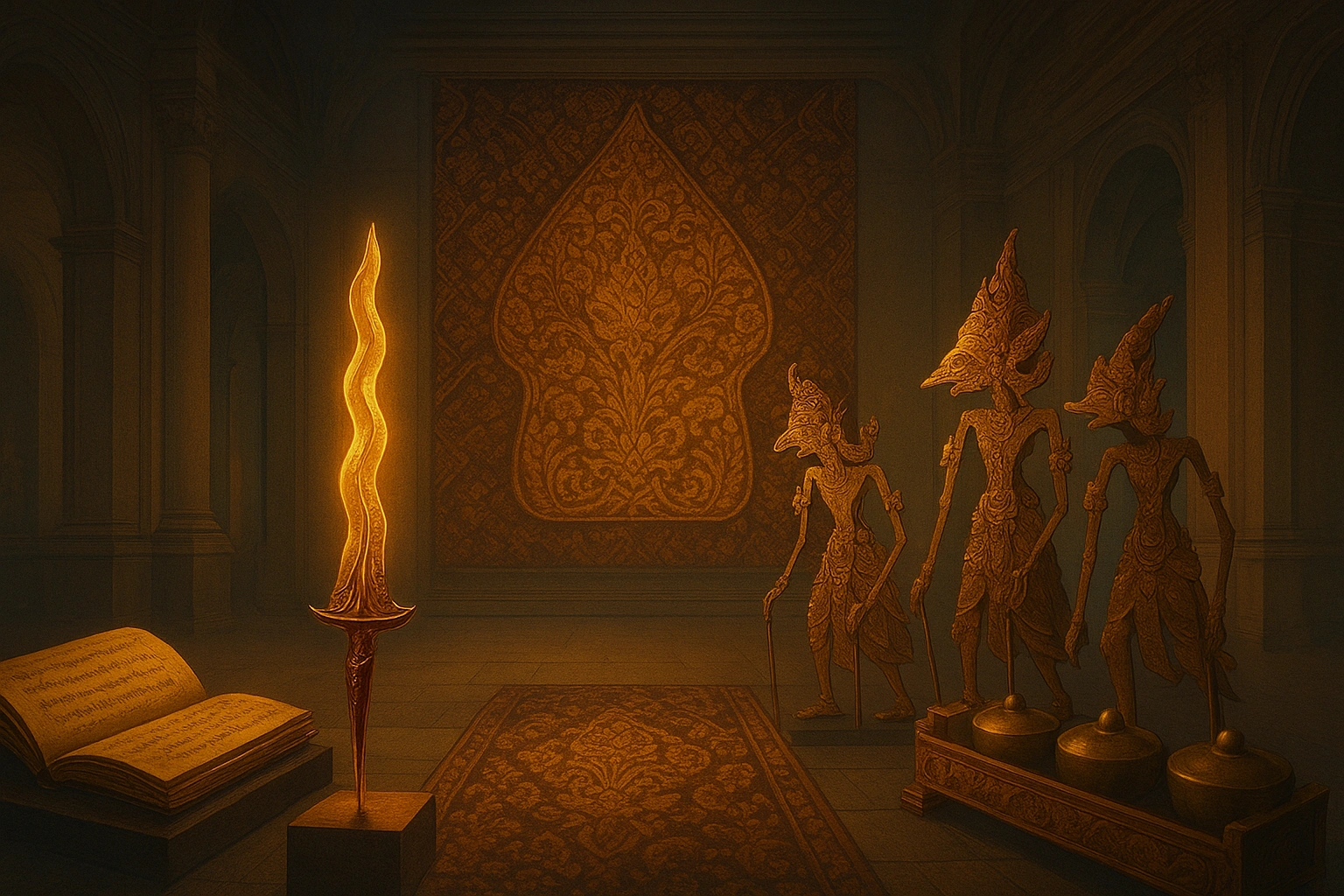
While the heart of Javanese culture beats strongest on its home island, you don’t need a plane ticket to Indonesia to witness its profound artistic and historical treasures. Thousands of miles away, housed within the grand halls of European museums, lie some of the world’s most significant Javanese collections. These Javanese collections are not mere curiosities; they represent a living bridge to a rich civilization. From sacred court daggers to ancient palm-leaf manuscripts, Javanese collections tell stories that continue to shape cultural memory across generations.
But how did these objects get here? And for a curious visitor, what should you even look for among the vast displays? This guide is your key. We’ll delve into the complex history that brought Javanese collections to Europe and then spotlight the top institutions you can visit. Most importantly, we’ll give you a treasure hunter’s map, revealing the five types of Javanese collections you absolutely must see, explaining the deep cultural stories they tell. From royal textiles to the instruments that produce the island’s soul-stirring music, Javanese collections continue to offer a vivid experience that connects history with living culture.
Prepare to see these museum collections not as static objects, but as vibrant, living pieces of Javanese identity, waiting to be discovered right in the heart of Europe.

A Shared, Complex History: Why Europe?
The existence of vast Javanese collections in Europe is a direct result of a long and complicated history, primarily centered on the Dutch colonial presence in Indonesia, which spanned over 350 years. Javanese collections were transferred across continents during this time, often shaped by politics, power, and scholarship. During this era, a massive quantity of artifacts was moved to Europe through various channels, and many of these Javanese collections became the foundation of today’s leading museums. For modern visitors, Javanese collections are not just reminders of the past but also keys to understanding how cultural heritage traveled and survived across centuries.
- Colonial Administration: Officials, soldiers, and administrators collected items as souvenirs, status symbols, or for “official” documentation.
- Scientific Expeditions: European scholars, ethnographers, and botanists traveled to Java throughout the 19th and early 20th centuries, collecting objects for study in universities and newly-formed ethnographic museums.
- Gifts & Diplomacy: Javanese sultans and rulers often presented valuable items like kris daggers and fine batik as diplomatic gifts to European representatives.
Today, this legacy is being re-examined. Important conversations about provenance and repatriation are taking place, with institutions like the UNESCO-backed Dutch National Museum of World Cultures actively involved in returning objects to Indonesia. When you visit these collections, you are not just seeing art, but also engaging with this living history.
Top Museums for Javanese Collections
While many museums have Indonesian artifacts, a few institutions stand out for the depth and quality of their Javanese holdings.
- Nationaal Museum van Wereldculturen (Netherlands): This is arguably the most important institution. A consortium of the Wereldmuseum (Rotterdam), Tropenmuseum (Amsterdam), and Museum Volkenkunde (Leiden), it holds an unparalleled collection of Javanese artifacts, from everyday objects to royal court treasures. The Leiden University library, associated with the museum, is a world-leading center for Indonesian and Javanese manuscripts.
- The British Museum (London, UK): Thanks to the collection of Sir Stamford Raffles, who governed Java in the early 19th century, the British Museum has a significant collection, including a complete gamelan set, wayang puppets, and important stone sculptures.
- Musée du quai Branly – Jacques Chirac (Paris, France): Known for its focus on indigenous art from around the globe, this museum has a well-curated section on the Indonesian archipelago, with beautiful examples of Javanese textiles and ancestor figures.
A Treasure Hunter’s Guide: 5 Artifacts to Find
When you walk into a gallery, the sheer volume of objects can be overwhelming. Use this guide to focus your attention on artifacts that offer the deepest insight into Javanese culture.
1. The Kris: More Than a Dagger
The *keris* (or kris) is perhaps the most iconic Javanese artifact. These asymmetrical daggers are not just weapons; they are spiritual objects believed to possess magical powers and a life of their own. A kris is a status symbol, a family heirloom, and a mystical protector.
What to look for: Look closely at the blade. The wavy patterns, called *pamor*, are created by forge-welding different metals together and are believed to grant the owner specific powers or protection. Also, examine the hilt (*ukiran*), which is often intricately carved into divine or demonic figures.
2. Sacred Textiles: The Language of Batik
Javanese textiles, especially batik, are a form of storytelling. Every pattern and color has a specific meaning, and historically, certain designs were reserved exclusively for the royal court. A piece of batik could signify rank, protect the wearer, or be used in sacred ceremonies from birth to death.
What to look for: Ask the museum if they have examples of *batik larangan* (forbidden patterns). The most famous are the *Parang Rusak* (broken knife), symbolizing power and worn only by the Sultan, and the *Kawung*, a symmetrical pattern of four circles representing purity and justice. You can learn more about the meanings behind these motifs in our dedicated guide.

3. Wayang Puppets: Shadows of the Gods
Wayang is the traditional Javanese art of shadow puppetry, a sophisticated form of storytelling that brings Hindu epics and local myths to life. The puppets themselves are masterpieces of craftsmanship and artistic expression.
What to look for: Notice the difference between *Wayang Kulit* (intricately carved and painted leather shadow puppets) and *Wayang Golek* (three-dimensional wooden rod puppets). The fine details, from the facial expression to the clothing, all signify the character’s personality—whether they are a noble hero or a crude giant. Compare the refined features of a hero like Arjuna to the powerful form of Bima, as seen in our guide to epic Wayang heroes.
4. Lontar Manuscripts: The Words of Sages
Before paper was common, Javanese scribes recorded literature, history, and sacred texts on *lontar*—dried and treated leaves of the palmyra palm. These delicate manuscripts are incredibly precious, holding ancient poetry (*kakawin*), royal chronicles (*babad*), and mystical knowledge.
What to look for: You’ll see thin strips of palm leaf inscribed with the beautiful, rounded Javanese script (*aksara Jawa*). They are often bound between two decorative wooden covers. To see one is to look upon a direct link to the intellectual and spiritual world of ancient Java. The Leiden University Library has one of the world’s most extensive collections.
5. Gamelan Instruments: The Voice of the Island
A complete gamelan is a large percussion orchestra, an ensemble of bronze gongs, metallophones, drums, and other instruments. Displayed in a museum, a gamelan set is a stunning work of sculptural art, often with intricately carved wooden frames painted in red and gold. Each instrument is tuned to be part of a whole, creating a hypnotic, shimmering sound.
What to look for: Try to imagine the ensemble being played. Notice the giant hanging gongs (*gong ageng*) that punctuate the musical cycle, the rows of kettle-gongs (*bonang*), and the trough-resonated metallophones (*saron*). These instruments are the heart of Javanese court and ceremonial life, and you can learn about them in our guide to gamelan instruments.
A Window Into Another World
The Javanese collections in Europe’s museums offer a rare and precious opportunity. These Javanese collections act as a bridge across time and space, allowing us to connect with the philosophy, artistry, and history of this incredible culture. By exploring Javanese collections with attention, you can move beyond being a passive observer and become an active discoverer, piecing together the stories held within each sacred kris, ancient manuscript, and royal textile that form part of these Javanese collections.