We are in the golden age of self-reflection, yet many still struggle with the blank page. Weton journaling offers a way to guide thoughts, turning habits and goals into meaningful reflections. With Weton journaling, mental models gain structure, helping clarity grow. This ancient practice makes Weton journaling a simple but powerful path to start reflecting with purpose.
Enter Weton journaling, an ancient Javanese system that blends the 7-day week with the 5-day Pasaran cycle. Weton journaling helps you understand daily energies, making reflection more structured. Each Pasaran has a theme that guides Weton journaling into growth and clarity. With this guide, you can turn the calendar into a simple Weton journaling routine for self-discovery.
Beyond Fortune-Telling: Weton as a Mental Model
It’s crucial to understand that we are not using the Weton system for divination or to predict the future. While that is one of its traditional uses within Javanese culture, as we explore in our guide to Primbon, we are adapting it here as a powerful psychological tool. Think of it as a set of five “lenses” through which you can view your week. Instead of asking the vague question, “How was my day?”, you can ask a specific question aligned with the day’s theme, such as “Where did I plant seeds of growth today?” (a prompt for the day of Legi).
This approach aligns with modern psychological research on the benefits of structured journaling. A study published in the Journal of Experimental Psychology found that expressive writing can improve working memory and reduce intrusive thoughts. By providing a structure, Weton journaling makes this practice easier and more sustainable. It transforms the calendar from a passive grid of dates into an active partner in your personal development.

The Five Energies: Understanding the Pasaran Cycle
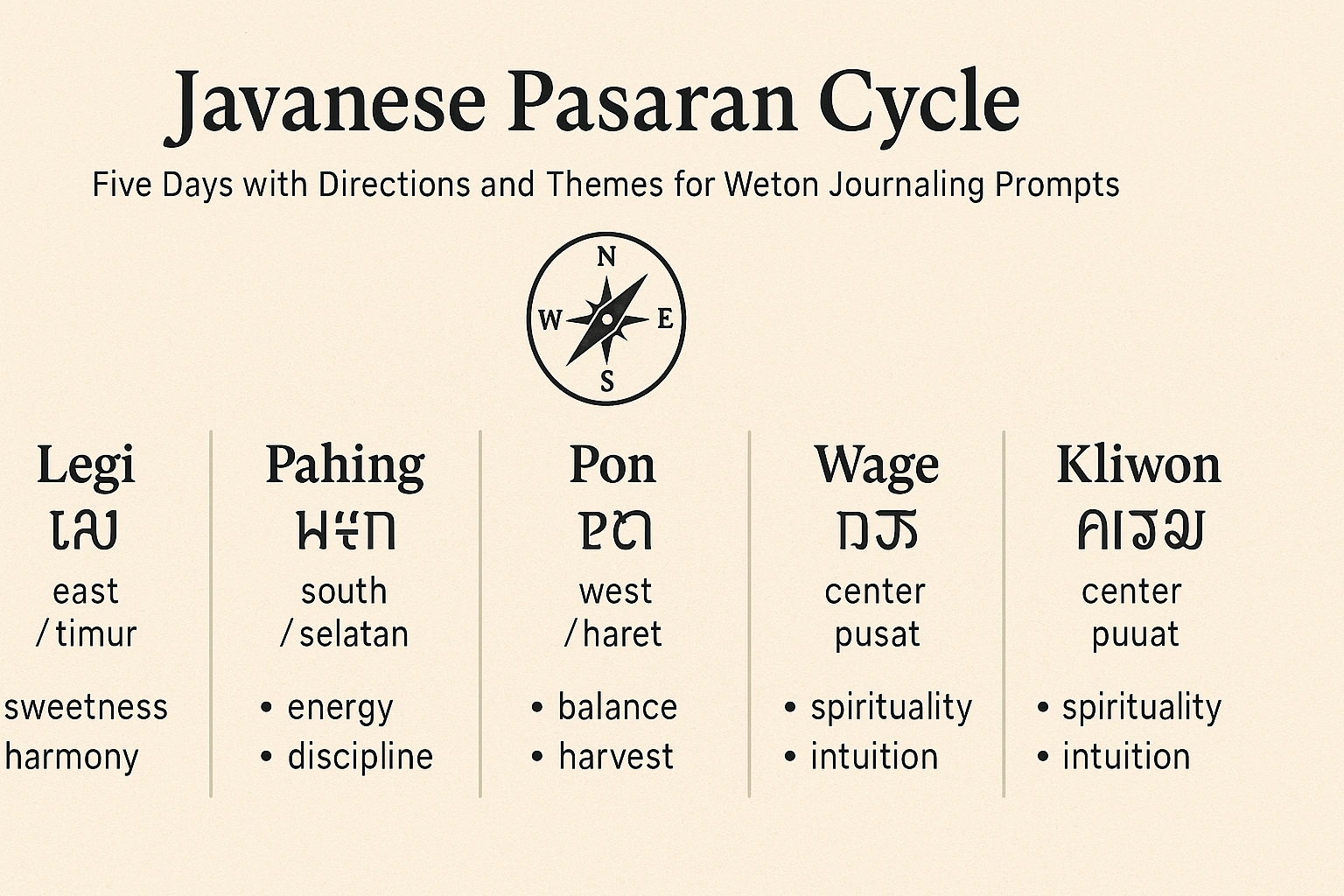
The heart of Weton journaling is the 5-day Pasaran cycle. Each day has a unique character, providing a different theme for your reflections. To start your practice, you first need to know the current Pasaran day, which you can find using our Weton Calculator or a Javanese calendar.
1. Legi (Manis) – The Energy of Beginnings
- Direction: East (Timur) – The direction of the rising sun.
- Theme: Growth, beginnings, optimism, potential, sweetness.
- Psychology: Legi is a day for planting seeds, both literally and metaphorically. Its energy is about looking forward, brainstorming new ideas, and embracing possibilities. It’s a day to focus on what *could be*.
- Journaling Prompts for Legi:
- What new idea or project sparked my interest today?
- Where can I plant a “seed” this week that will grow in the future?
- What small, sweet moment brought me joy today?
- What is one thing I am optimistic about right now?
2. Pahing (Pahit) – The Energy of Action
- Direction: South (Kidul) – The direction of fire and passion.
- Theme: Action, passion, ambition, facing challenges, bitterness.
- Psychology: Pahing is a “hot” day. Its energy is about doing the hard work, pursuing your ambitions, and confronting challenges head-on. The word *pahit* (bitter) reminds us that ambition and action often involve overcoming difficulties.
- Journaling Prompts for Pahing:
- What was the most significant action I took today?
- What challenge did I face, and how did I handle it?
- What is my biggest ambition for this month, and what is one step I can take toward it?
- Where did I feel passion or strong emotion today?
3. Pon (Petak) – The Energy of Leadership
- Direction: West (Kulon) – The direction of the setting sun.
- Theme: Leadership, confidence, decisions, communication, letting go.
- Psychology: Pon is associated with leadership and authority. It’s a day to reflect on your role in your family, work, and community. It’s about making clear decisions and communicating them effectively. Like the setting sun, it’s also a time to reflect on what needs to be brought to a close.
- Journaling Prompts for Pon:
- In what situation did I take the lead today? In what situation did I follow?
- What important decision did I make, or do I need to make?
- How was my communication with others today? Was I clear and confident?
- What is something I need to let go of to move forward?
4. Wage (Cemeng) – The Energy of Introspection
- Direction: North (Lor) – The direction of darkness and mystery.
- Theme: Introspection, rest, stability, learning, shadow work.
- Psychology: Wage is a “cold” and quiet day. Its energy encourages us to turn inward, to rest, and to reflect on our inner world. It’s a time for study, for analyzing our own thoughts and motivations, and for acknowledging our “shadow side”—the parts of ourselves we often ignore.
- Journaling Prompts for Wage:
- What did I learn today, either about the world or about myself?
- How did I make time for rest and rejuvenation?
- What thought or feeling kept recurring in my mind today?
- What is a fear or a “shadow” that I can acknowledge today?
5. Kliwon – The Energy of Synthesis
- Direction: Center (Tengah) – The focal point.
- Theme: Synthesis, spirituality, community, intuition, integration.
- Psychology: Kliwon is the spiritual center of the cycle. It is a day for bringing things together, for seeing the big picture, and for connecting with others and with your own intuition. It’s a powerful day for social gatherings and for integrating the lessons of the past four days.
- Journaling Prompts for Kliwon:
- How did I connect with my community or loved ones today?
- What was the overarching “theme” or lesson of my last five days?
- What did my intuition or “gut feeling” tell me today?
- Where did I feel a sense of spiritual connection or purpose?
Building Your Weekly Routine
The beauty of this system is its cyclical nature. A typical week will contain all five Pasaran days, giving you a balanced diet of self-reflection.
- Find the Day: Each morning, identify the Pasaran day.
- Set Your Intention: Briefly review the theme of the day. This can help you set a small intention for the day ahead.
- Evening Reflection: In the evening, spend 5-10 minutes answering one or two of the prompts for that day.
Over time, Weton journaling helps you build a rich and nuanced record of your life, shaped by the flow of the Pasaran cycle. With Weton journaling, you begin to notice how your thoughts and actions shift across different days, revealing hidden patterns in your behavior. Through Weton journaling, challenges faced on Pahing days become clearer, while moments of creativity on Legi days stand out. In this way, Weton journaling grows into a personal map that guides self-reflection and balance.
Conclusion: Ancient Wisdom for a Modern Mind
In a world that prizes constant action and forward momentum, the Weton journaling system offers a profound alternative: a cyclical, balanced approach to self-awareness. It provides the structure that so many of us crave in our self-reflection practices, turning the daunting task of “journaling” into a simple, daily conversation with yourself, guided by centuries of Javanese wisdom.
By adopting Weton journaling, you are not just writing down your thoughts; you are engaging with a powerful mental model that encourages growth, action, leadership, introspection, and synthesis in equal measure. Practicing Weton journaling turns reflection into a structured path, helping you reach a more balanced and examined life. With Weton journaling, your notebook becomes a companion for clarity and direction. Take out a notebook, find today’s Pasaran, begin your journey, and let Weton journaling guide your self-discovery.