Discover the history, the meaning of neptu, and how Javanese numbers can become a map for your spiritual journey.
“Ngger… in the land of Java, weton and Javanese numerology are not mere numbers. They are a mirror to the soul, a guide to character, and a spiritual message that has accompanied you since birth.”
“Ngger… have you ever asked yourself why you were born on that particular day? Not another? Why the rain fell that morning, or why the sun shone so gently, as if to welcome your arrival into this world?”
In the land of Java, nothing is truly a coincidence. Even the moment of your birth is not just a date on a family card. It is a vibration of the universe—calculated, weighed, and arranged. Not by man, but by the subtle order we inherit from our ancestors. The Javanese call it weton. It is your cosmic signature, a spiritual fingerprint left upon your soul by the universe at the exact moment you took your first breath.
It is not a horoscope. It is not a prophecy. It is a pangilon—a mirror to recognize the face of our inner self, which is sometimes a stranger even to us. In an age where we seek answers from external sources, the weton invites us to look inward.
“Weton iku dudu takdir. Weton iku piweling.”
“Weton is not a verdict. It is a reminder.”
Behind the combination of two day names—be it Senin Pahing, Jumat Kliwon, or Sabtu Wage—lie numbers that are not just any numbers. They are another language of the universe, a code to your soul’s potential and its inherent challenges. And today, Kyai Tutur will unfold it once more. Slowly. Like opening an old batik cloth that holds meaning in every pattern.
The History of Weton and the Pawukon System
“A Calendar That Records Character, Not Just Time”
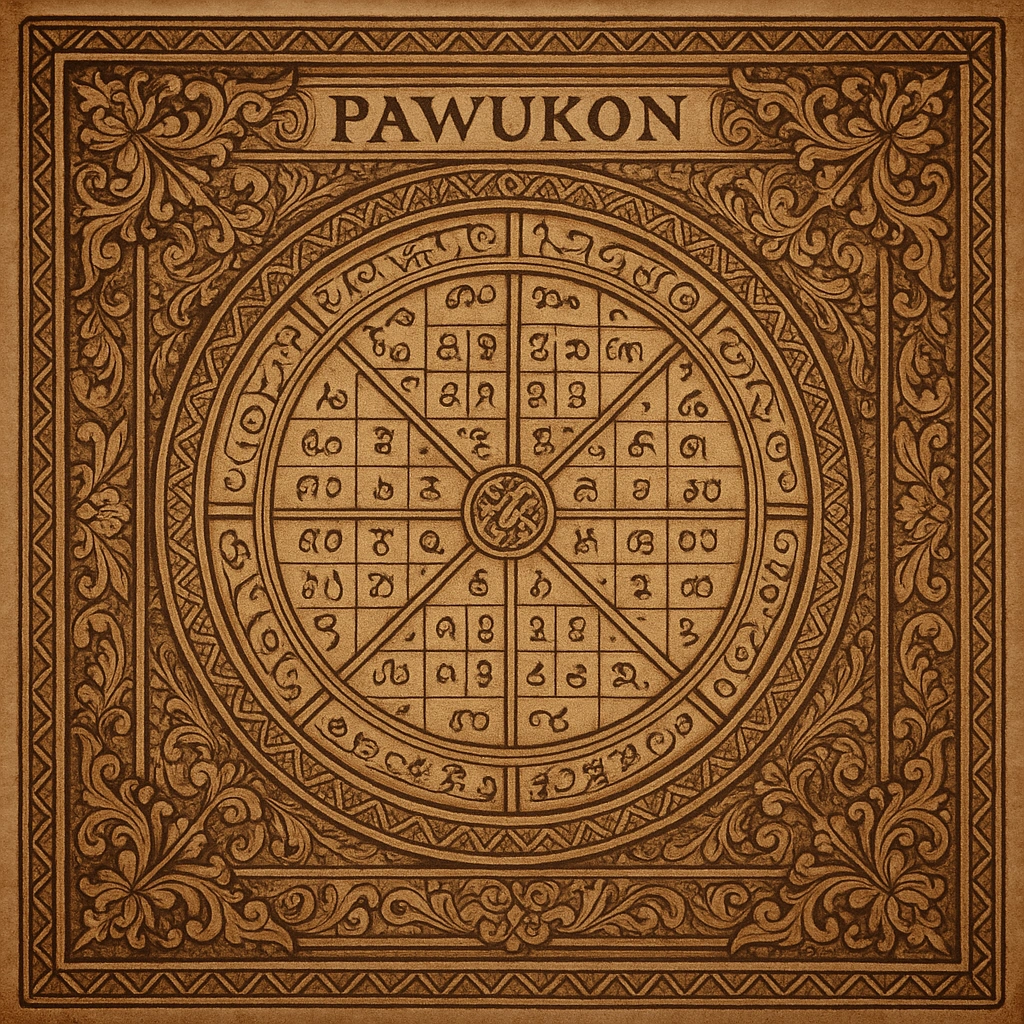
Before the Gregorian calendar was taught in schools, the Javanese already had their own calendrical system. Its name: Pawukon. This system is not based on the moon, but on a 210-day cycle that mirrors the rhythms of the earth and human life. Within it, time is structured by two overlapping layers:
- Saptawara: The seven-day week (Monday, Tuesday, etc.), representing the external, social rhythm of life.
- Pancawara: The five-day market week (Legi, Pahing, Pon, Wage, Kliwon), representing the inner, spiritual, and elemental rhythm.
These two cycles intersect, forming a unique combination that repeats every 35 days. When you were born, Ngger, you were recorded in one of those combinations. That is your weton. This system is a legacy of ancient masters (empu) and elders (pinisepuh), a fusion of celestial observation, earthly vibrations, and long contemplation. Some say its roots are in the Hindu-Buddhist era, later refined by the Wali Songo (the Nine Saints) to align with Islamic values. The result is a system that doesn’t just count days but maps the landscape of the human soul.
“Every child that is born, the universe notes its weton. It is like a fingerprint of the soul.”
Imagine, in the middle of a rice field or behind the walls of a palace, our ancestors sat calculating the neptu of the day, weighing the direction of the wind, reading the changes in the sky. From this deep listening, they composed a system that was not only beautiful but profound—a system that would later guide marriages, auspicious days for planting, and even the character of a leader.
Neptu: The Number That Holds Character and Life’s Path
“Javanese Numbers, a Soul’s Footprint”
Every day in the Javanese system has a numerical value, called a neptu. This value was derived from observing nature’s character, life’s conduct, and the vibration of time itself. It is the energetic weight of a day.
Saptawara (7-Day Week)
| Day | Neptu |
|---|---|
| Sunday | 5 |
| Monday | 4 |
| Tuesday | 3 |
| Wednesday | 7 |
| Thursday | 8 |
| Friday | 6 |
| Saturday | 9 |
Pancawara (5-Day Market Week)
| Market Day | Neptu |
|---|---|
| Legi | 5 |
| Pahing | 9 |
| Pon | 7 |
| Wage | 4 |
| Kliwon | 8 |
Example: If someone is born on Selasa Pahing, then: 3 (Tuesday) + 9 (Pahing) = 12. This is the person’s total neptu: the initial code to their character. This number is not just a sum; it is a vortex of energy that can be calm or overwhelming, depending on how you navigate it.
Weton in Relationships, Fortune, and Daily Conduct

In many old Javanese homes, before a marriage proposal was made, the couple’s weton was examined. Not to frighten, but to see the map of their characters: if united, would these two people help each other grow, or would they hurt each other? This tradition is known as petung jodho (matchmaking calculation).
Basic Formula for Weton Compatibility
The total neptu of both partners is added together. The resulting number is then matched to one of seven categories, each revealing the potential dynamic of the relationship:
| Total Neptu | Category Name | Meaning and Counsel |
|---|---|---|
| 7, 14, 21 | Pegat | (Separation) Characterized by many quarrels and a high risk of separation. This is a warning to cultivate extreme patience and communication. |
| 8, 15, 22 | Ratu | (Royalty) A harmonious and respected couple, seen as a model for others. They complement each other naturally. |
| 9, 16, 23 | Jodoh | (Match) A true soul match. They are mutually supportive and understand each other on a deep level. |
| 10, 17, 24 | Topo | (Asceticism) The relationship will face many trials, especially early on. However, if they endure, these challenges will lead to deep maturity and a strong bond. |
| 11, 18, 25 | Tinari | (Blessed) Characterized by smooth fortune, a pleasant life, and ease in finding sustenance. They bring luck to each other. |
| 12, 19, 26 | Padu | (Argument) Frequent arguments over small matters. This relationship can last, but it requires a high degree of maturity and the willingness to forgive. |
| 13, 20, 27 | Sujanan | (Suspicion) Prone to third-party interference and infidelity. This path requires unwavering trust and transparency to succeed. |
However, Kyai Tutur wishes to convey this: “Compatibility is not the result of a calculation, but the result of understanding. A number may give a warning. But a sincere heart can change the direction of destiny.”
This Wisdom is Not a Prophecy, It is a Mirror
“A wise person does not ask: ‘Is my weton good?’ But: ‘What can I learn from my weton?'”
A great mistake of modern times is to treat the weton as a verdict. “Because my compatibility is Pegat, I will surely divorce.” “Because my neptu is high, I am doomed to suffer.” The ancestors never used it as a tool for fear. They used it as an inner map, so that one would not live life carelessly or unconsciously.
In Javanese tradition, anyone who feels their life is heavy due to their neptu is advised to perform tirakat (spiritual discipline). This is not a mystical ritual to change fate, but the cultivation of feeling—a way to settle the ego, sharpen intuition, and align oneself with one’s inner nature. Practices like fasting (puasa mutih or ngrowot) are ways to actively balance the energies your weton describes.
“Javanese wisdom does not ask you to bow to a number. It invites you to become self-aware through the number.”
By recognizing your weton, you can learn to identify your ego’s tendencies, your sensitive emotional triggers, and your potential spiritual strengths. A person with a high neptu who tends to speak harshly can learn the discipline of silence. A person with a low neptu who feels insecure can strengthen their resolve through meditation and stillness.
Weton, a Gentle Greeting from the Universe
The weton is not a prophecy. It is a gentle greeting from the universe, spoken in the language of numbers, market days, and days of the week. You do not have to believe it like dogma. But if you open your heart, it can become a window into yourself. Some people spend their entire lives running from themselves, rejecting their own nature. But eventually, they grow weary. And in that moment of surrender, the weton they ignored can return like an old friend, waiting patiently in silence.
There was once a man with the weton of Sabtu Pahing, with a heavy neptu of 18. People said his character was too harsh, his fortune volatile, and that he was “prone to a short life.” But he did not run from his weton. He learned to understand himself. He practiced spiritual disciplines. He guarded his words. Years passed. He did not die young. Instead, he became a teacher for many, and he would always begin his counsel with this:
“Your weton may be heavy, but your determination can be heavier.”
“Ngger… your weton is not a verdict. It is a map. But the path is still yours to choose. And as long as you are aware (eling lan waspada), you can always change direction.”