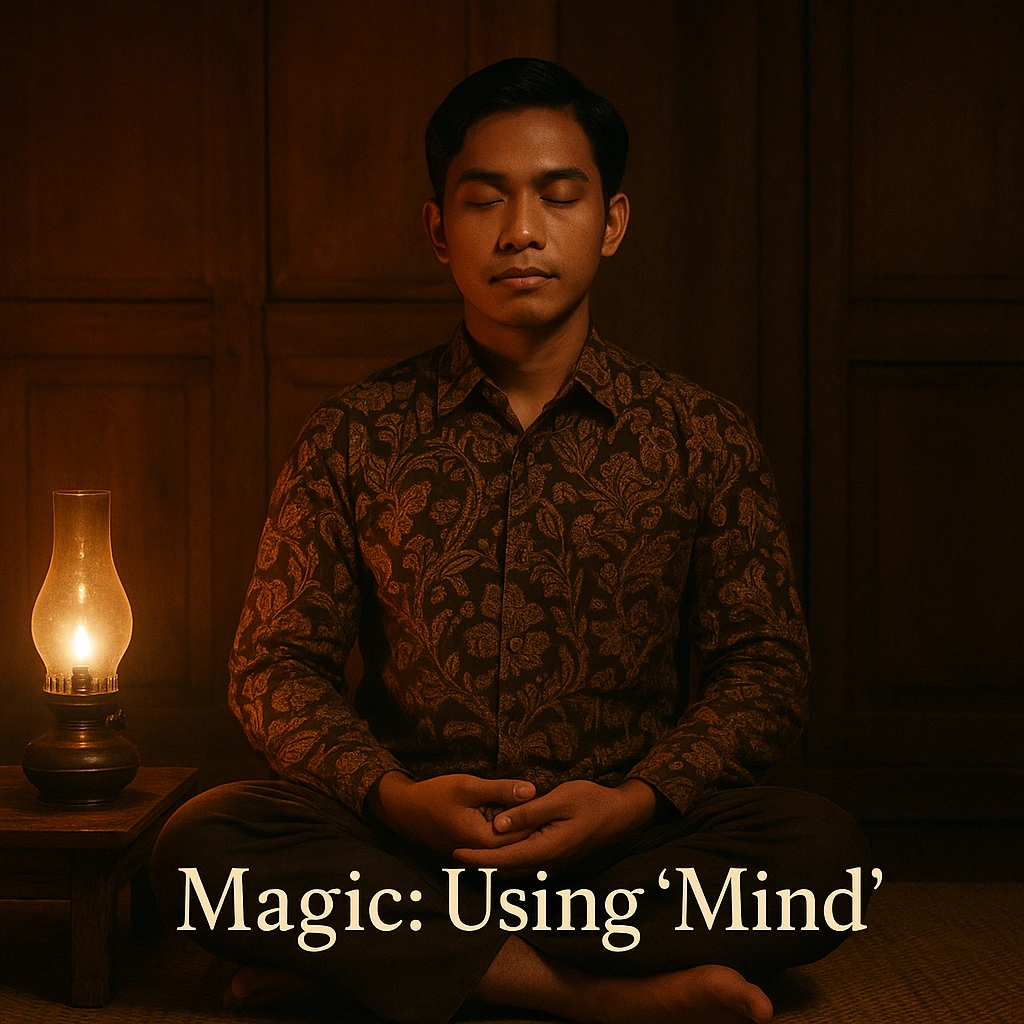
Mantra: The Voice Within Your Head
Angger, anakku (My child)…
Before we speak of ancient incantations, Paman (Uncle) wants to ask you. Have you ever realized there’s a voice speaking ceaselessly inside your head? From the moment you wake until you fall asleep, that voice never quiets. It comments, it judges, it worries about the future, it regrets the past.
Our ancestors, Angger, deeply understood the immense power of this voice. They knew that if left wild, it could become the greatest enemy to torment the soul. But they also knew that if successfully tamed and harmonized, that voice could become the strongest ally. They didn’t try to stop it. They conquered it with a sophisticated inner technology, now misunderstood as black magic: Mantra.
Deconstructing the Stigma – From Mysticism to ‘Mind Tool’
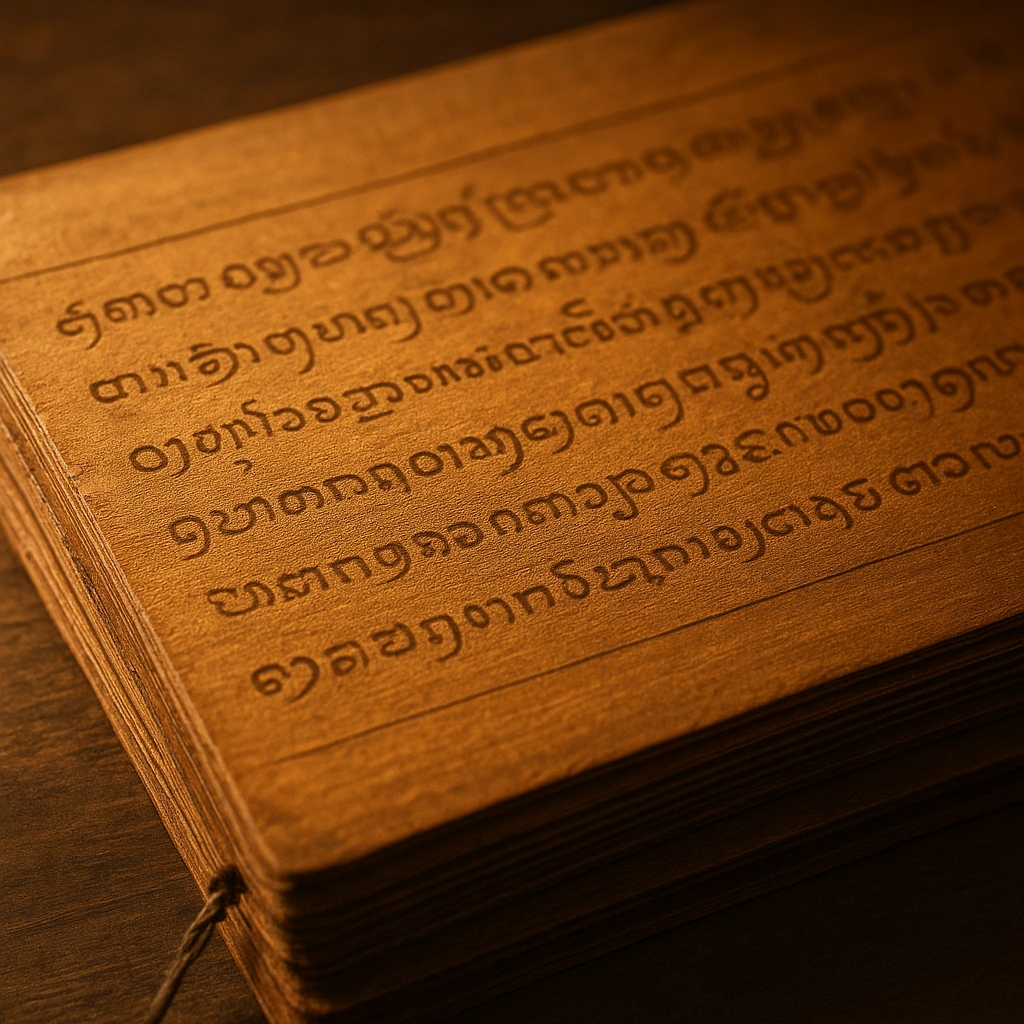
Today, the word “mantra” has been tainted. It has become synonymous with love spells, charms, or incantations to summon unseen beings. This is a very disheartening trivialization of meaning.
Let us return to its roots. In Sanskrit, the mother tongue of much wisdom in the Nusantara (Indonesian archipelago), “Mantra” originates from two words:
- Man (from the word manas): which means Mind.
- Tra: which means Tool or Instrument.
Thus, the true meaning of Mantra is “Tool for the Mind” or “Instrument of the Mind.” It is not mysticism. It is a precision technology for reorganizing, calming, and focusing the often chaotic power of our minds.
How Mantra Works – The Science Behind Sacred Vibrations

How can a series of words possess power? Our ancestors may not have used scientific terms, but they understood the principles intuitively.
The Principle of Vibration (Physics of Sound)
Every word we utter is a vibration. These vibrations affect molecules around us, including the water molecules in our bodies, which comprise more than 70%. When a “mantra” or positive affirmation is spoken repeatedly with deep “feeling” (rasa), it creates harmonious vibrational patterns that can literally “calm” the biochemical storm within the body.
The Principle of Focus (Psychology of Meditation)
Our minds are often likened to “jumping monkeys” (monkey mind). Mantra functions as the “banana” we give to the monkey. By giving it one simple, repetitive task—repeating a phrase—our wild mind becomes focused. When the mind is focused, the ego weakens, and we can access deeper, calmer layers of consciousness. This is the essence of modern mindfulness practice.
The Principle of Reprogramming (Neuroplasticity)
Our brains are highly plastic. Every time we think or say something, we are strengthening a neural “pathway.” If we constantly recite “negative mantras” (“I can’t,” “life is hard”), that pathway will become a highway. Positive mantra is how we consciously build new “highways” leading to tranquility, self-confidence, and happiness. This concept is now known in modern science as Neuroplasticity. Our ancestors were the first neuroscientists in this land.
Gallery of Nusantara Mantras – Not Just for Charms
To dismantle the stigma, we must know that “mantra” in Javanese tradition has many types and functions, like tools in a workshop.
Healing & Protection Mantras:
The most sublime example is Kidung Rumekso ing Wengi (a Javanese spiritual song or chant for protection at night) created by Sunan Kalijaga (one of the nine revered saints of Islam in Java). This is not a summoning of genies, but rather a “blanket” of protective energy woven from threads of prayer and hope, used to calm the soul before sleep.
Prosperity Mantras:
Farmers in the past had special mantras when planting seeds. This was not a magical command for rice to grow, but a way to harmonize their intentions and gratitude with the energy of Ibu Bumi (Mother Earth), so that the planting process was done with full awareness and hope.
Authority Mantras:
Leaders or dalang (puppeteers in wayang kulit, traditional Javanese shadow puppet theatre) often had “mantras” they recited inwardly before performing. The purpose was not to “bewitch” the audience, but to build self-confidence, calm nervousness, and radiate an aura of authority from within.
Laku & Practice – Creating Your Personal Mantra
Angger, you don’t need to use Sanskrit or Old Javanese to experience the power of mantra. The most powerful mantra is the one that resonates most with your soul.
Determine Your Intention:
What do you most need right now? Tranquility? Courage? Sincerity?
Formulate Your Sentence:
Create a short, positive sentence using contemporary language. Examples:
- If anxious: “Atiku tentrem, pikiranku padhang.” (My heart is peaceful, my mind is clear).
- If lacking confidence: “I am strong, I am capable, I am worthy.”
- If struggling to forgive: “I release all burdens, my heart is light.”
Engage in Repetitive Practice (Laku Repetisi):
Find a quiet time each morning or before sleep. Repeat the sentence over and over, either silently or in a whisper. Feel every vibration of the words soaking into your body and soul. Practice consistently.
Your Words Are Prayers Most Quickly Answered
Angger, anakku…
After understanding all this, we realize that every day, every moment, we are actually reciting mantras. The voice in our head, the complaints we utter, the gossip we spread—all of these are mantras we are planting in the field of our own lives.
Stop reciting mantras of fear and doubt to yourself. Begin consciously reciting mantras of strength, compassion (welas asih), and wisdom. Because your words, Angger, are prayers most quickly answered. Use this ancestral “tool of the mind” to forge the reality you desire.
Delve Deeper into Ancestral Wisdom
Discover various other wejangan (advice) and pitutur luhur (noble teachings) that can serve as a compass for your inner journey.
FAQ about Mantra
What is the true meaning of Mantra?
In Sanskrit, Mantra comes from Manas (Mind) and Tra (Tool), meaning a tool or instrument of the mind. It is not just mysticism but a method to calm, focus, and reprogram the mind.
How do Mantras actually work?
Mantras work through vibration, focus, and neuroplasticity. The repetition of sacred or positive words creates calming vibrations, focuses the restless mind, and rewires the brain toward positive pathways.
Are Mantras only about magic or spells?
No. In Javanese tradition, mantras are used for healing, protection, prosperity, authority, and self-mastery. They are more about inner strength than external magic.
Can I create my own personal Mantra?
Yes. The most powerful mantra is one that resonates with your soul. Create a short, positive affirmation that matches your current need, such as peace, confidence, or forgiveness.
Why are Mantras still relevant today?
Mantras are timeless because they function as a mindfulness tool. Just like modern affirmations or meditation techniques, they help reduce stress, build confidence, and enhance spiritual growth.
About the Author
This wejangan is presented by Ky Tutur—a symbolic figure embodying noble Javanese values such as wisdom, simplicity, and compassion. These writings are compiled by the KaweruhJawa.com team, comprising cultural researchers, academics, and spiritual practitioners dedicated to preserving and translating profound Javanese kaweruh (Javanese traditional knowledge or wisdom) into a language relevant for contemporary generations.
We believe that ancestral heritage is not merely a relic of the past, but also a living compass for life. Every article is crafted through meticulous research, intergenerational discussions, and deep contemplation, ensuring the accuracy and nobility of the values contained within.