
By Ky Tutur, Javanese Culturalist • Published on September 26, 2025
If you’re planning a trip to Indonesia, you might assume that everyone speaks… well, Indonesian. And you’d be right, for the most part. But step onto the island of Java, home to over 60% of the country’s population, and you’ll quickly realize there’s another major language in play: Javanese, a core part of Javanese culture.
Many travelers arrive confused. Are they the same language? Is one a dialect of the other? Why do people switch between them mid-sentence? Understanding these questions offers insight into Javanese culture, showing how language reflects the values and traditions of Javanese culture.
My name is Ky Tutur, and as a Javanese culturalist who grew up speaking both, I’m here to clear up the confusion. While they may sound similar to an untrained ear, Javanese (Basa Jawa) and Indonesian (Bahasa Indonesia) are two distinct languages with different origins, vocabularies, and, most importantly, roles in Javanese culture.
Understanding the difference isn’t just a linguistic exercise; it’s a window into the soul of Indonesia itself—a nation built on unity but proud of its deep cultural diversity and the rich heritage of Javanese culture. Let’s break down what sets them apart.
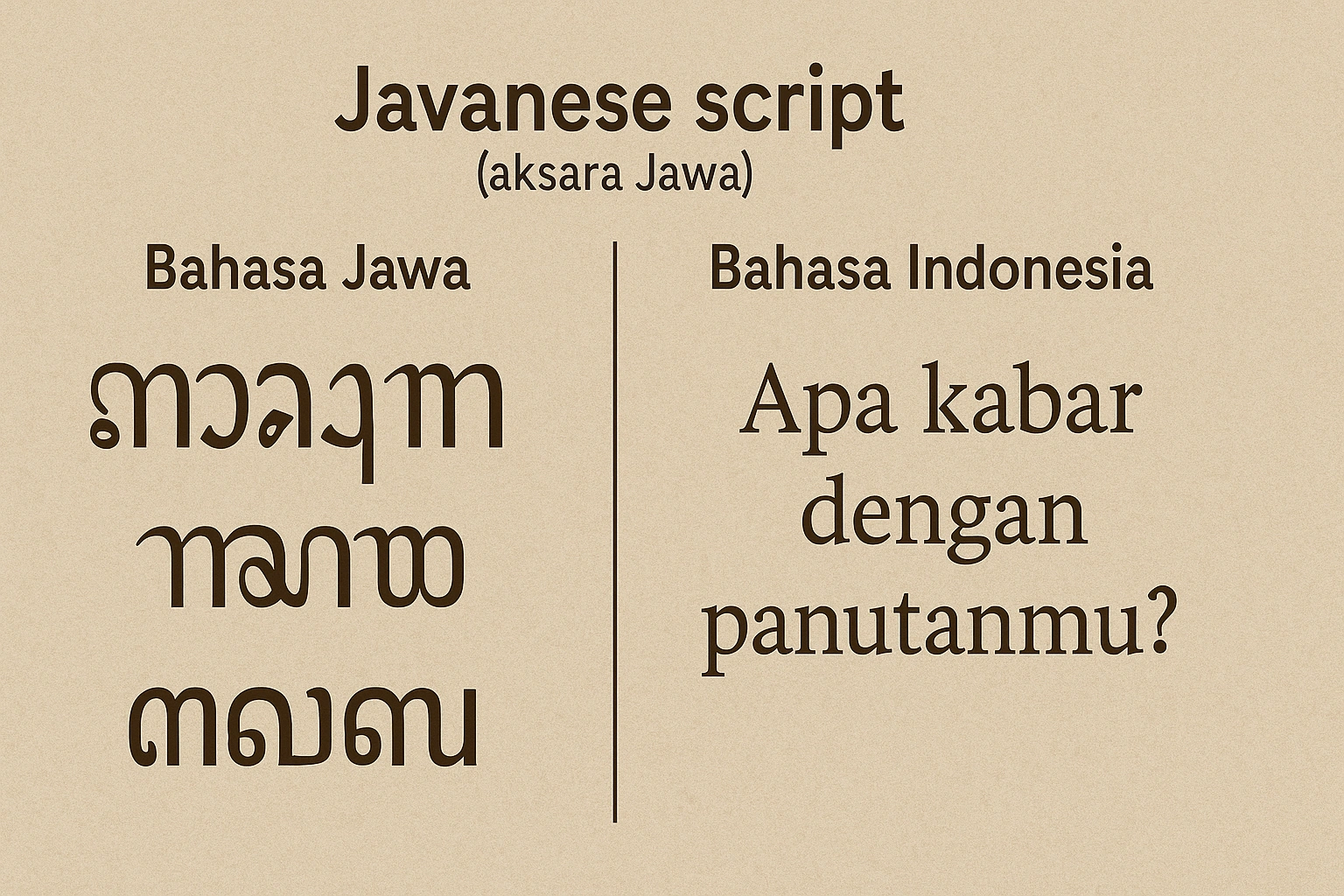
Bahasa Indonesia: The Language of Unity
First, let’s talk about Bahasa Indonesia. It is the official language of the Republic of Indonesia. Every government document, news broadcast, and school lesson is conducted in Indonesian. It’s the linguistic glue that holds together an archipelago of over 17,000 islands and hundreds of ethnic groups.
What many people don’t know is that Indonesian is a standardized form of Malay, a language that has been the lingua franca of maritime Southeast Asia for centuries. It was officially adopted as the national language during Indonesia’s independence movement in the early 20th century for a very strategic reason: it was relatively neutral.
As a study from the Max Planck Institute for the Science of Human History points out, choosing Malay avoided the potential resentment that could have arisen from selecting the language of the largest ethnic group—the Javanese. It put everyone on a more equal footing.
Key Characteristics of Indonesian:
- Purpose: The official language for national communication, education, and media.
- Structure: Relatively straightforward grammar and a simple phonetic system.
- Formality: It has formal and informal registers, but they are not as complex as Javanese speech levels.
Indonesian is the language you’ll use to book a hotel, order at a modern cafe in Jakarta, or talk to someone from another island like Bali or Sumatra. It is the language of the nation.
Basa Jawa (Javanese): The Language of Culture and Respect
Now, let’s turn to Javanese. Spoken by nearly 100 million people, it is the largest regional language in Indonesia and a central pillar of Javanese culture. If Indonesian is the language of the nation, Javanese is the language of the Javanese wong, reflecting the daily life and traditions of Javanese culture. It’s the language of family dinners, neighborhood gossip, and traditional ceremonies, all expressions of Javanese culture. Even the intricate art of wayang kulit (shadow puppetry) embodies the philosophy and history embedded in Javanese culture.
Unlike Indonesian, which is an Austronesian language from the Malayic branch, Javanese has its own distinct roots, complete with its own traditional script, Aksara Jawa.
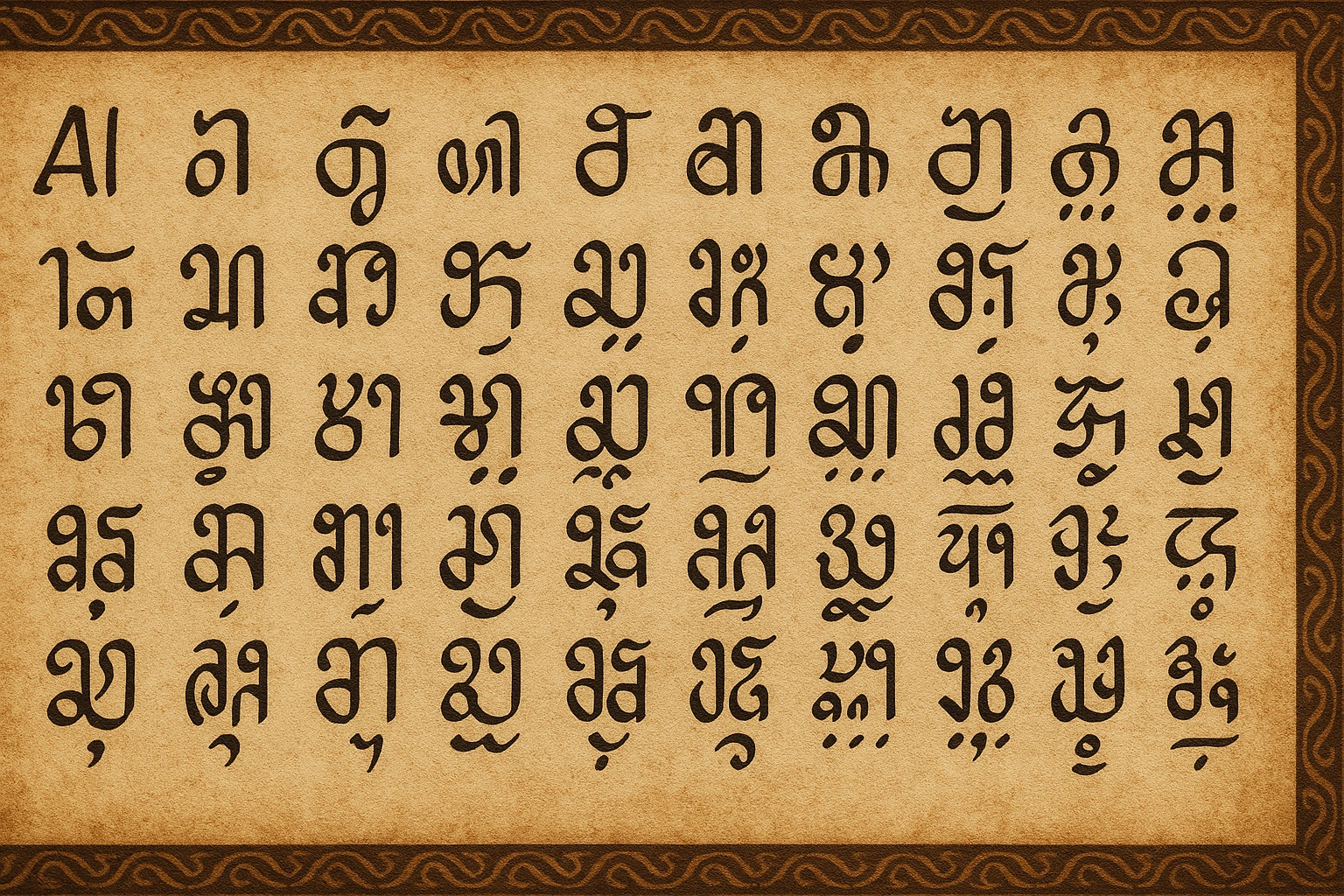
But the single most significant difference—and the one that truly defines Javanese culture—is its system of speech levels. This is not just about being formal or informal; it’s a complex grammatical system that requires a speaker to choose their words based on the age, social status, and relationship to the person they are addressing. This system is a core part of what we call unggah-ungguh, or Javanese etiquette.
The All-Important Speech Levels: Ngoko and Krama
The Javanese language is built on a foundation of respect. This is encoded directly into its vocabulary and grammar through two main levels, which are further subdivided.
1. Ngoko: The Familiar Level
*Ngoko* is the “default” or informal level of Javanese. It’s the language used between close friends, family members of the same age, or when a person of higher status speaks to someone of lower status (e.g., an elder to a child, a boss to an employee). The vocabulary is direct and familiar. For example, the word for “you” is kowe, and to “eat” is mangan.
Using *Ngoko* with a stranger or an elder would be considered extremely rude.
2. Krama: The Respectful Level
*Krama* is the polite, formal level used when speaking to elders, people of higher social status, or individuals you don’t know well. It employs an entirely different vocabulary. In *Krama*, “you” becomes panjenengan, and “to eat” becomes dhahar. Using *Krama* shows humility and respect.
There are even sub-levels:
- Krama Madya (Middle Krama): A semi-formal mix, often used among acquaintances in a market setting.
- Krama Inggil (High Krama): The most refined and respectful level, reserved for speaking to highly revered individuals like sultans or during very formal ceremonies. It involves a special set of honorifics to elevate the person being addressed.
Learning these levels is a lifelong process, even for native speakers. It’s a key part of Javanese social education, teaching a person their place in the community. You can learn more about how this politeness is embedded in our culture through our guide on Javanese speech levels.
Javanese vs. Indonesian: A Quick Comparison Table
| Feature | Bahasa Indonesia | Basa Jawa (Javanese) |
|---|---|---|
| Primary Role | National language of unity | Regional language of culture & home |
| Primary Speakers | Most Indonesians (often as a 2nd lang.) | ~100 million Javanese people |
| Origin | Standardized Malay | Distinct Austronesian language |
| Key Feature | Simplicity, serves as a unifier | Complex speech levels (Ngoko, Krama) |
| “What is your name?” | Siapa nama Anda? | Sinten asmanipun panjenengan? (Krama) |
| “Where are you from?” | Anda berasal dari mana? | Panjenengan saking pundi? (Krama) |
So, Which One Should You Learn?
For a traveler, the answer is clear: start with Bahasa Indonesia. It will allow you to communicate effectively across the entire country, from Aceh to Papua. Everyone in Java, especially in cities and tourist areas, will speak and understand Indonesian.
However, if you plan to live in Central or East Java, immerse yourself in the local culture and experience the richness of Javanese culture firsthand, or build deep relationships with Javanese people, learning some basic phrases will be deeply appreciated. Starting with polite Krama expressions like matur nuwun (thank you) instead of the Indonesian terima kasih demonstrates respect and understanding of Javanese culture. Using these phrases opens doors and shows genuine appreciation for the traditions and etiquette embedded in Javanese culture, making every interaction a reflection of Javanese culture in practice.
According to data from Indonesia’s Ministry of Education and Culture, efforts are being made to preserve regional languages like Javanese, as they are a vital part of the nation’s cultural heritage. By learning a few words, you participate in that preservation.
The Beautiful Coexistence
In a typical Javanese household, you’ll hear both languages used seamlessly. Parents might use Javanese with each other, switch to Indonesian when helping their children with homework, and then watch the national news in Indonesian.
Javanese is not a dialect of Indonesian. It is a proud, ancient language that carries the weight of a sophisticated Javanese culture built on respect and community. Indonesian is the practical, modern language that binds a diverse nation together, but Javanese culture remains a living presence in daily life. They are not in competition; rather, they reflect the dual identity of many people here, showing the harmony between Javanese culture and national unity. Embracing both languages allows travelers to experience the richness and depth of Javanese culture firsthand.
The next time you visit Java, listen closely. You’re not just hearing words; you’re hearing a beautiful dance between culture and country, tradition and modernity, spoken one sentence at a time.