By Ky Tutur, Javanese Culturalist • Updated on September 26, 2025
If you’ve ever listened to a “lo-fi beats to study to” playlist or watched a nature documentary set in Southeast Asia, you’ve almost certainly heard it: a dreamy, shimmering, percussive sound that feels both ancient and futuristic. That hypnotic music is Gamelan, the traditional ensemble music of Java and Bali. It’s a sound that has captivated everyone from Claude Debussy to the creators of the movie *Avatar*.
But what is Gamelan? Is it an instrument? A style of music? A band? As a Javanese culturalist, I’m here to tell you it’s all of that and more. It’s a philosophy, a community, and the sonic heartbeat of Javanese culture. This guide is your entry point into its mesmerizing world. We’ll break down the key instruments, explain the unique musical systems, and show you why this ancient orchestra feels so perfectly at home in the 21st century.

What is Gamelan? An Orchestra of Bronze
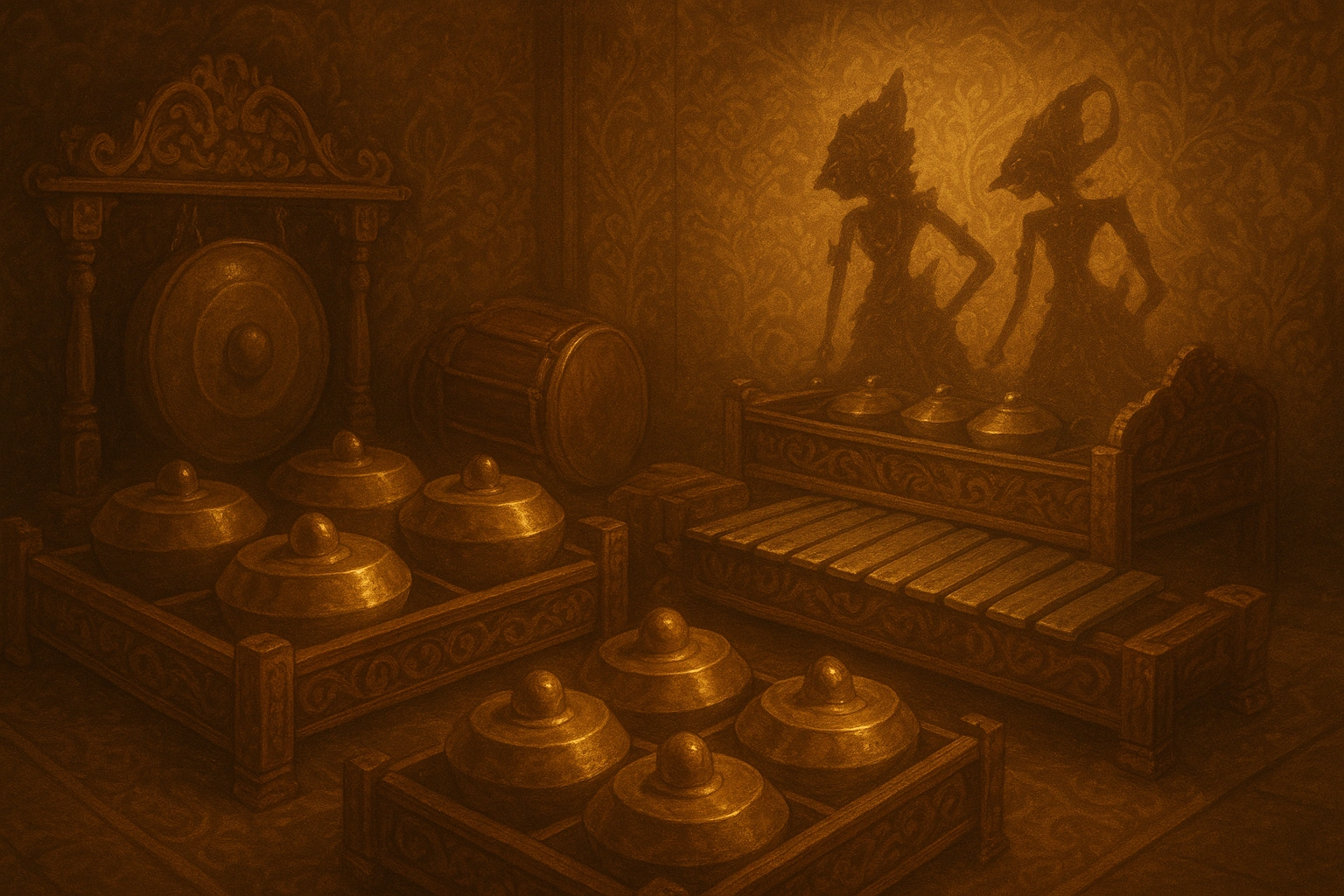
First things first: Gamelan is not a single instrument. It’s an *ensemble* or orchestra. The word itself comes from the Javanese *gamel*, meaning “to strike” or “to handle.” This is fitting, as the majority of the instruments are percussive—gongs, metallophones, and drums, most of which are crafted from bronze.
But a Gamelan is more than just a collection of instruments; it’s considered a single, unified being. Each instrument is tuned to match the others within its specific set, meaning you cannot take a gong from one Gamelan and expect it to work in another. This unity is why you’ll often see Gamelan sets given their own proper names. In Java, Gamelan is the essential accompaniment to sacred rituals, court ceremonies, community celebrations, and the famous Wayang Kulit (shadow puppet) plays. Its cultural importance is recognized by UNESCO as an Intangible Cultural Heritage of Humanity.
The Two Souls of Sound: Sléndro and Pélog
Before you can understand Gamelan music, you must understand its unique tuning systems. Unlike the 12-note chromatic scale of Western music (C, C#, D, etc.), Javanese Gamelan primarily uses two different scales, known as *laras*.
- Sléndro: This is a five-note scale. The intervals between the notes are roughly equal, giving it a bright, open, and often cheerful sound. If you’ve heard Gamelan used in a cheerful or lighthearted context, it was likely played in *sléndro*.
- Pélog: This is a seven-note scale, but typically only five of the notes are used in any given piece. The intervals are unequal, creating a sound that can feel more poignant, majestic, or somber. It has a gravity and depth that suits more formal or spiritual occasions.
A full Javanese Gamelan is actually a “double” Gamelan—it contains a complete set of instruments for *sléndro* and another complete set for *pélog*.
Meet the Instruments: The Layers of the Orchestra
A Gamelan orchestra is organized in functional layers, from the simple core melody to complex elaborations and punctuating gongs. Here are the stars of the show.
The Skeleton: Balungan Instruments
These instruments play the core melody, or *balungan* (skeleton).
Saron Family
These are bronze metallophones with thick keys played with a hard mallet. They come in three sizes, from the large *saron demung* (playing the slowest, lowest version of the melody) to the small *saron peking* (playing the melody at double or quadruple speed).
Slenthem
Similar to a saron but with thinner keys suspended over tube resonators, giving it a softer, more resonant sound. It often doubles the core melody at a lower octave.
The Punctuation: Gong Instruments
These instruments mark the cyclical structure of the music. The largest gong marks the end of a major cycle and is the most important instrument.
Gong Ageng
The largest hanging gong. Its deep, resonant sound marks the end of a major melodic cycle (*gongan*). It is considered the spiritual center of the Gamelan.
Kenong and Kempul
The *kenong* are large, kettle-like gongs that rest on a frame and subdivide the cycle. The *kempul* are smaller hanging gongs that provide further punctuation.
The Elaboration: Intricate Layers
These instruments improvise and add complex decorative patterns around the core melody.
Bonang Family
Rows of smaller kettle-gongs that play fast, interlocking patterns. They are often considered the “lead” elaborating instruments.
Gender
A multi-octave metallophone with thin keys over resonators, played with two soft, disc-shaped mallets. It produces a beautifully shimmering, sustained sound.
The Conductor: The Kendhang
Kendhang
A set of double-headed, hand-played drums. The kendhang player acts as the conductor of the ensemble, controlling the tempo and signaling transitions. This is one of the few instruments not made of bronze.

The Philosophy of the Music
Javanese Gamelan music is cyclical, not linear like much of Western music. It represents the Javanese concept of time as a recurring cycle, much like the Javanese calendar system. The music is also communal; there are no soloists or stars. Every musician plays a vital role in creating the collective sound.
Conclusion: More Than Just Music
Gamelan is far more than an exotic sound for a lo-fi playlist. It is a living, breathing art form that embodies the Javanese philosophy of harmony, community, and cyclical time. Its structured yet flexible nature allows for endless variation, creating music that is simultaneously ancient and new with every performance.
The next time you hear that shimmering bronze, listen a little closer. You might hear the skeleton melody of the saron, the deep breath of the gong ageng, and the intricate dance of the bonang. You are hearing a conversation hundreds of years in the making—a hypnotic sound that invites you not just to listen, but to experience a different way of being.