
“What’s your sign?” It’s a question that echoes from casual conversations to deep dives into personal identity. For many, the answer—be it Aries, Leo, or Pisces—comes from Western Astrology and provides a comforting framework for understanding their personality. Much like Western Astrology, it offers symbols that shape how people see themselves. But halfway across the world, another, older system has been guiding lives for centuries: the Javanese Weton, which, like Western Astrology, connects cosmic patterns to human experience. While Western Astrology relies on zodiac signs, the Weton reveals life’s rhythm through a different cultural lens.
Both Western Astrology and the Javanese Weton system seek to illuminate the invisible forces that shape our character and destiny, based on the moment of our birth. Western Astrology interprets planetary alignments, while Weton relies on the rhythm of days and cycles. Yet, Western Astrology and Weton operate on vastly different principles, each offering unique insights. One shows patterns through distant planets and constellations, and Western Astrology continues to inspire modern seekers, while the other turns to the intricate dance of earthly market days and weekly cycles.
This raises a fascinating question for the modern spiritual seeker: Are these two systems at odds? Or can they be used together to create a richer, more holistic understanding of ourselves? This guide will compare Javanese Weton and Western astrology head-to-head, explore their unique strengths, and reveal how they might not be competitors, but complementary tools in your journey of self-discovery.
The Celestial Blueprint: A Quick Look at Western Astrology
At its core, Western astrology is the study of the influence of celestial bodies on human affairs. It’s built on the position of the sun, moon, and planets at the exact moment of your birth.
- The Zodiac Signs: The twelve zodiac signs (Aries, Taurus, etc.) are determined by the section of the sky the sun was in when you were born. Each sign is associated with a specific element (Fire, Earth, Air, Water) and modality (Cardinal, Fixed, Mutable), which define its core personality traits.
- The Birth Chart: A full astrological reading goes far beyond just your sun sign. A birth chart is a snapshot of the sky at your birth, showing the positions of all the planets in various signs and “houses” (areas of life), creating a complex and unique psychological profile.
- Focus on Personality: The primary strength of Western astrology lies in its detailed description of psychological archetypes. It seeks to answer “who you are” by outlining your strengths, weaknesses, motivations, and communication style.
The Earthly Rhythm: Understanding Javanese Weton
Javanese Weton, in contrast, is rooted in a terrestrial, cyclical understanding of time. It doesn’t look to the planets, but to the intersection of two repeating calendars that were central to Javanese life. You can get a primer in our complete guide to Weton.
- Two Interlocking Cycles: Your Weton is determined by the combination of the seven-day week (*Saptawara*)—Monday, Tuesday, etc.—and the five-day Javanese market week (*Pancawara*)—Legi, Pahing, Pon, Wage, Kliwon. This creates a 35-day cycle, with each of the 35 combinations having a unique energetic quality.
- The Power of Neptu: Each day in both cycles has a numerical value called a *Neptu*. Your birth *Neptu* is the sum of these two values. This number is crucial for determining everything from your character to your compatibility with a partner and the best days to take action.
- Focus on Energetic Quality: Weton is less concerned with a fixed personality and more with the *quality of energy* you were born with. It answers “what is your energy like?” and “how does it interact with the world?” This makes it highly practical for making life decisions.
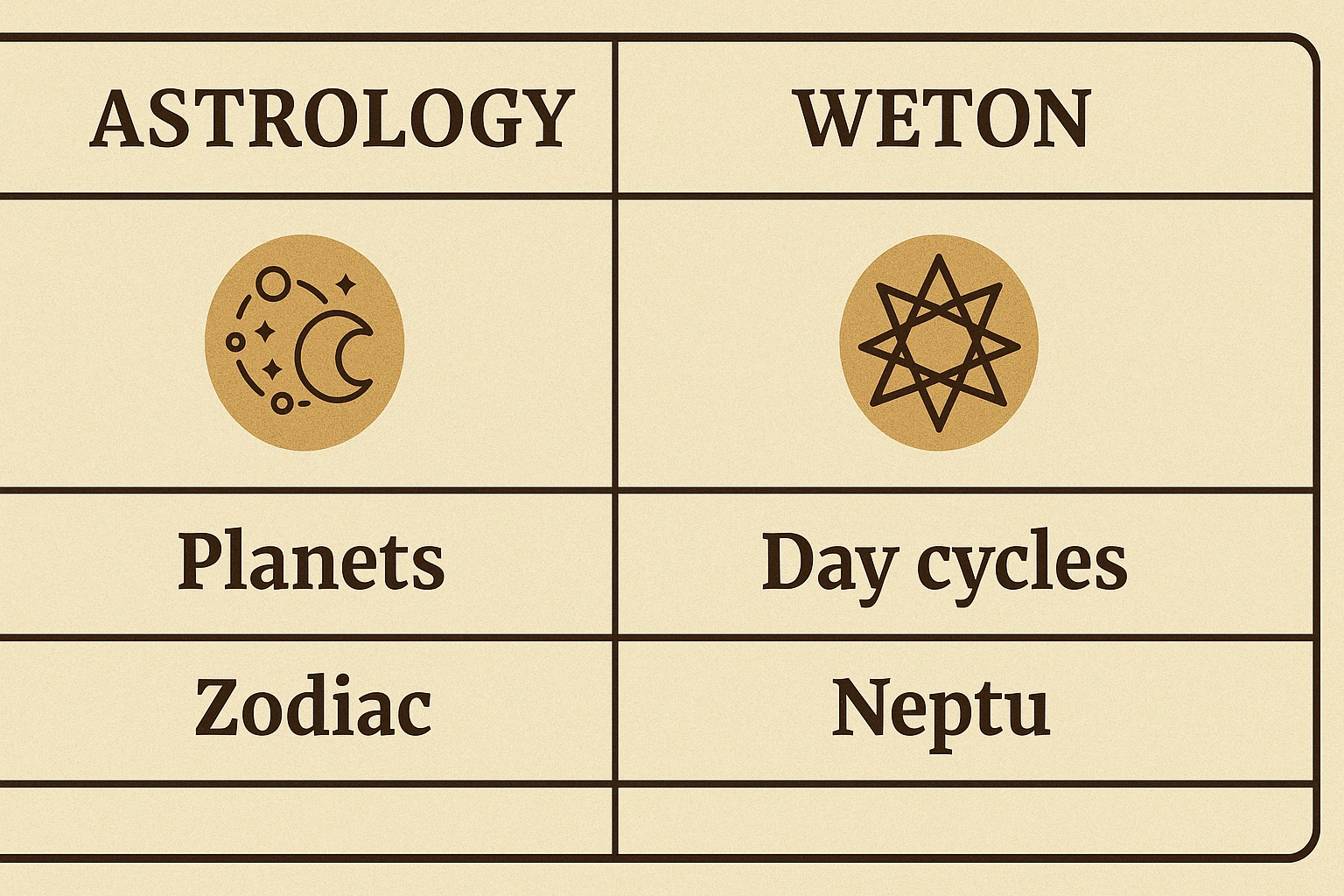
Weton vs. Astrology: Key Differences at a Glance
When placed side-by-side, the distinctions become clear. They are two different maps for navigating life.
| Feature | Western Astrology | Javanese Weton |
|---|---|---|
| Basis | Positions of the sun, moon, and planets (celestial). | Intersection of the 7-day and 5-day week cycles (terrestrial/cyclical). |
| Time Cycle | Annual (12 zodiac signs). | 35 days (7 x 5). |
| Core Concept | Psychological archetype based on planetary influence. | Energetic quality and potential based on the *Neptu* value. |
| Primary Use | Understanding personality, motivations, and inner conflicts. | Determining compatibility, choosing auspicious dates, and guiding life decisions. |
| Answers the question… | “Who am I?” | “What is my energy’s nature and when is it best applied?” |
The Synergy: Using Weton and Astrology Together
Instead of seeing them as competing systems, we can view them as complementary lenses. Astrology paints the portrait of your inner world, while Weton provides the instruction manual for how to operate that inner world in your daily life.
Astrology is the “What.” Weton is the “When” and “How.”
Imagine your astrological sign is your car model. A Porsche (Aries) is built for speed and action. A sturdy Volvo (Taurus) is built for safety and reliability. Astrology tells you what kind of car you are.
Weton, then, is the daily traffic report and the GPS. It tells you which roads are clear (lucky days), which have traffic jams (unlucky days), and the most efficient route to take to reach your destination. It provides the real-time, practical guidance for your specific “car.”
Knowing you are a “stubborn Taurus” is useful. But knowing you are a Taurus with a *Kamis Kliwon* Weton—a combination known for ambition, empathy, and a strong work ethic—gives you a much more nuanced picture. It suggests your stubbornness isn’t just for its own sake; it’s fuel for your ambitious goals, tempered by a genuine concern for others.
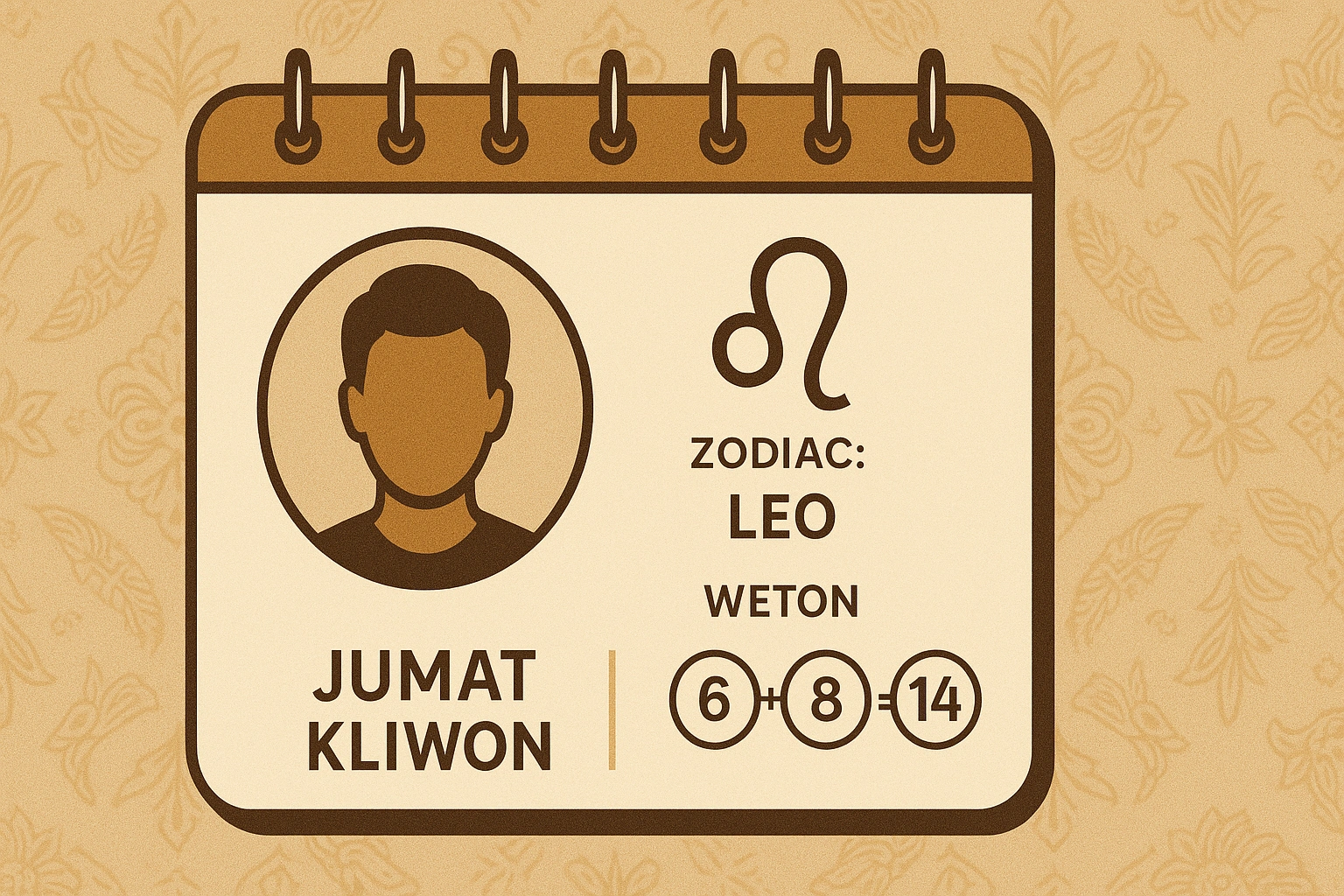
Case Study: Combining the Systems
Let’s take a person born on August 5, 1990.
- Western Astrology Lens: This person is a Leo. Leos are known for being charismatic, confident, generous, and natural leaders. They have a flair for the dramatic and thrive in the spotlight. Their potential weakness is arrogance or a need for constant validation.
- Javanese Weton Lens: Using our Weton Calculator, we find that August 5, 1990, was a Minggu Kliwon (Sunday Kliwon). The Neptu is 5 (Minggu) + 8 (Kliwon) = 13. This is a high Neptu. Minggu Kliwon is associated with a reserved nature, a strong sense of intuition, a philosophical mind, and the ability to be a guiding light for others.
The Synthesis:
This is fascinating! The bold, spotlight-loving Leo archetype is paired with the reserved, intuitive energy of Minggu Kliwon. This doesn’t create a contradiction; it creates a complete person.
This individual is likely a “quiet leader.” They possess the natural charisma of a Leo but don’t constantly seek the stage. Their confidence comes from a deep, intuitive place (*Minggu Kliwon*) rather than external praise. They lead not by being the loudest person in the room, but by offering quiet, wise counsel that others naturally trust. Their challenge is to balance their Leo desire for recognition with their Weton’s tendency towards introspection.
Conclusion: Two Toolkits for a Richer Life
Javanese Weton and Western Astrology are not mutually exclusive. They are two powerful systems of wisdom, developed by different cultures to answer the same fundamental human questions. One maps the psyche, the other maps the flow of energy.
By embracing both, you can gain a stereoscopic view of your life. You can understand your core personality through astrology, and then use the practical wisdom of Weton to navigate your days, make decisions, and interact with the world in the most harmonious way possible. Why choose one map when you can have two?
Frequently Asked Questions (FAQ)
1. Which system is more “accurate”?
This is like asking if a psychological profile is more accurate than a daily schedule. They measure different things. Astrology’s accuracy is in describing personality archetypes, while Weton’s accuracy is in its practical application for determining compatibility and timing. Their value is in how you use them.
2. How can I find my Weton and its meaning?
The easiest way is to use a digital tool. You can find your specific day and market combination with our Javanese Weton Calculator, and then explore the secrets of its numerical value in our guide to Neptu numbers.
3. Do I need to be Javanese to use Weton?
Not at all. While the Weton system is a treasure of Javanese culture, its cyclical energy is universal. Much like Western Astrology, it helps people understand life’s rhythm and make harmonious choices. Western Astrology also shows how cosmic patterns shape personal growth, and together with Weton, both guide individuals toward balance and reflection.