
A practical guide to the 35 Weton combinations, their Neptu values, and how to use them as a powerful life scheduler.
Published on September 28, 2025
If you’ve ever explored Javanese culture, you’ve likely encountered the concepts of the 7-day week (Dina) and the 5-day market week (Pasaran). Separately, they provide structure and meaning. But when they are combined, they create something far more powerful: a 35-day cycle of unique energetic patterns known as the Wetonan cycle. Each of these 35 pasaran combinations has its own specific character, potential, and numerological value (Neptu).
This isn’t just esoteric knowledge for scholars. It’s a practical, living system—a cosmic scheduler that people have used for centuries to plan everything from weddings and business launches to planting crops and personal introspection. It’s about aligning your actions with the natural energetic flow of time to maximize your chances of success and harmony.
In this comprehensive guide, we will demystify all 35 patterns. We’ll provide a complete chart of the combinations, explain the crucial concept of the neptu overlay, and offer practical examples of how you can use this ancient scheduler in your modern life.
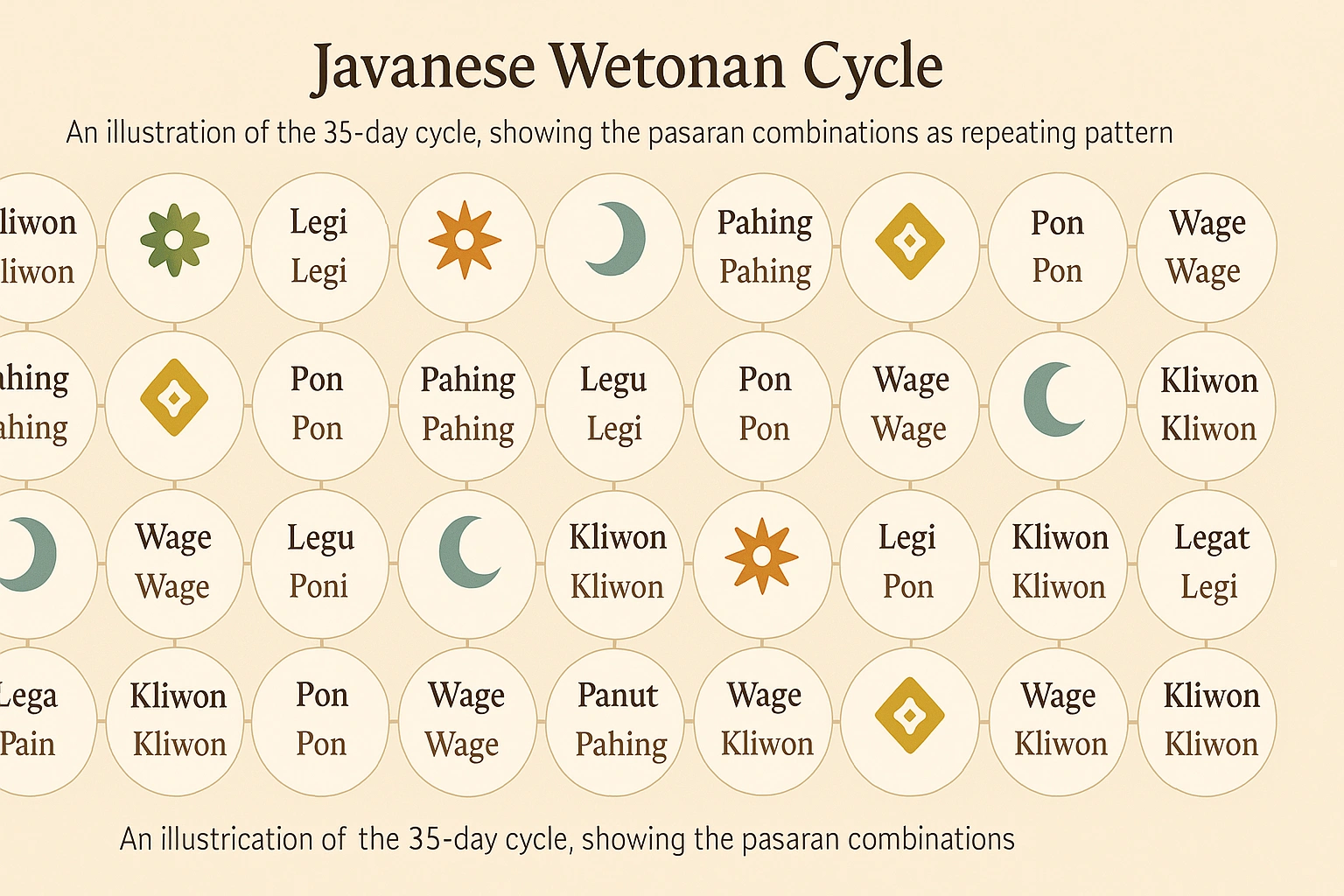
The Foundation: Understanding Dina, Pasaran, and Neptu
Before diving into the 35 combinations, let’s quickly recap the building blocks. The entire system rests on the numerical values, or Neptu, assigned to each day of the two interlocking weeks.
- Dina (7-Day Week): The familiar Monday through Sunday cycle, each day having its own Neptu (e.g., Sunday = 5, Monday = 4).
- Pasaran (5-Day Week): The Javanese market cycle of Legi, Pahing, Pon, Wage, and Kliwon, each also having a Neptu (e.g., Legi = 5, Kliwon = 8).
- Weton (The Combination): A specific day that is the meeting point of the two cycles, like ‘Selasa Kliwon’ (Tuesday Kliwon).
- Neptu Weton: The sum of the Neptu values for that combination. For Selasa Kliwon, it would be 3 (for Tuesday) + 8 (for Kliwon) = 11.
This final Neptu Weton is the key. It’s the number that reveals the day’s fundamental energy and is used in a vast array of Javanese calculations, from personality analysis to compatibility checks. For a deeper understanding of the Pasaran cycle itself, you can read our foundational guide on the Javanese Pasaran.
The Complete Chart of 35 Pasaran Combinations and Their Neptu Overlay
Here is the core of the Wetonan cycle. This table lays out all 35 unique combinations and their resulting Neptu Weton. The highest possible Neptu is 18 (Sabtu Pahing) and the lowest is 7 (Selasa Wage). This numerical value is the “Neptu overlay”—the energetic signature of that specific day.

| Day (Dina) | Legi (5) | Pahing (9) | Pon (7) | Wage (4) | Kliwon (8) |
|---|---|---|---|---|---|
| Sunday (5) | 10 | 14 | 12 | 9 | 13 |
| Monday (4) | 9 | 13 | 11 | 8 | 12 |
| Tuesday (3) | 8 | 12 | 10 | 7 | 11 |
| Wednesday (7) | 12 | 16 | 14 | 11 | 15 |
| Thursday (8) | 13 | 17 | 15 | 12 | 16 |
| Friday (6) | 11 | 15 | 13 | 10 | 14 |
| Saturday (9) | 14 | 18 | 16 | 13 | 17 |
How to Use the 35-Day Cycle as a Practical Scheduler
This is where the ancient wisdom becomes a modern tool. The core principle is simple: high Neptu days are considered to have strong, positive energy, making them auspicious for important events. Low Neptu days are weaker, better suited for rest, introspection, or routine tasks. Days with specific characters (e.g., associated with water, fire, etc.) can be chosen for corresponding activities.
Example 1: Planning a Business Launch
Let’s say you’re planning to launch a new website or open a new store. You want a day with powerful, expansive energy that signifies authority and success.
- Good Choices: You would look for days with high Neptu values. Sabtu Pahing (18) is considered the ‘king’ of Weton, possessing the highest possible energy. Kamis Legi (13) and Jumat Kliwon (14) are also very strong and spiritually significant days, ideal for launching something you want to have a lasting impact.
- Days to Avoid: You would avoid Selasa Wage (7), which has the lowest energy. It’s considered a day for ‘pulling back’ rather than ‘pushing forward’.
Example 2: Scheduling a Difficult Conversation
Imagine you need to have a challenging conversation with a colleague or family member. You need a day that promotes calm, clear communication, and emotional balance, not conflict.
- Good Choices: Rabu Pon (14) is often associated with wisdom and diplomacy. Jumat Kliwon (14), with its spiritual depth, is good for conversations that require empathy and intuition.
- Days to Avoid: You would likely avoid days with ‘fiery’ energy, such as Selasa Pahing (12), which could easily lead to arguments.
Example 3: Planning Personal Retreat and Reflection
If you want to schedule a day for journaling, meditation, or simply resting and recharging, you’d look for days with introspective energy.
- Good Choices: The low-Neptu days are perfect for this. Senin Wage (8) and Selasa Wage (7) are ideal for quiet activities and rest. Jumat Kliwon (14) is, again, a top choice for any spiritual or meditative practice.
- Days to Avoid: High-energy, outward-facing days like Sabtu Pahing (18) might feel too ‘busy’ or restless for deep introspection.
Beyond the Neptu: Deeper Layers of Meaning
While the Neptu value is the primary guide, a deeper analysis in Primbon also considers the specific character of the day. For instance, some days are associated with the element of water (good for irrigation), while others are associated with earth (good for building foundations). According to academic research published in journals like the JSTOR database, these classifications create a rich “ethno-science” that guided agricultural and social life for centuries.
This is a complex field, but starting with the Neptu overlay gives you about 80% of the practical benefit. It trains you to see time not as a uniform, homogenous line, but as a dynamic cycle of waxing and waning energy.
Conclusion: Integrating Ancient Wisdom into Modern Life
The 35 Pasaran combinations are far more than a cultural curiosity. They are a fully functional, sophisticated system for engaging with the flow of time. By understanding the Neptu overlay and the character of each Weton, you can transform your calendar from a simple list of appointments into a powerful strategic tool.
Start small. Identify the Neptu for the upcoming week. Notice how the energy of a high-Neptu day feels compared to a low-Neptu one. Try scheduling one important task on an auspicious day. By experimenting, you will begin to feel the rhythm and unlock a timeless source of wisdom to help you navigate your life with greater intention and harmony.