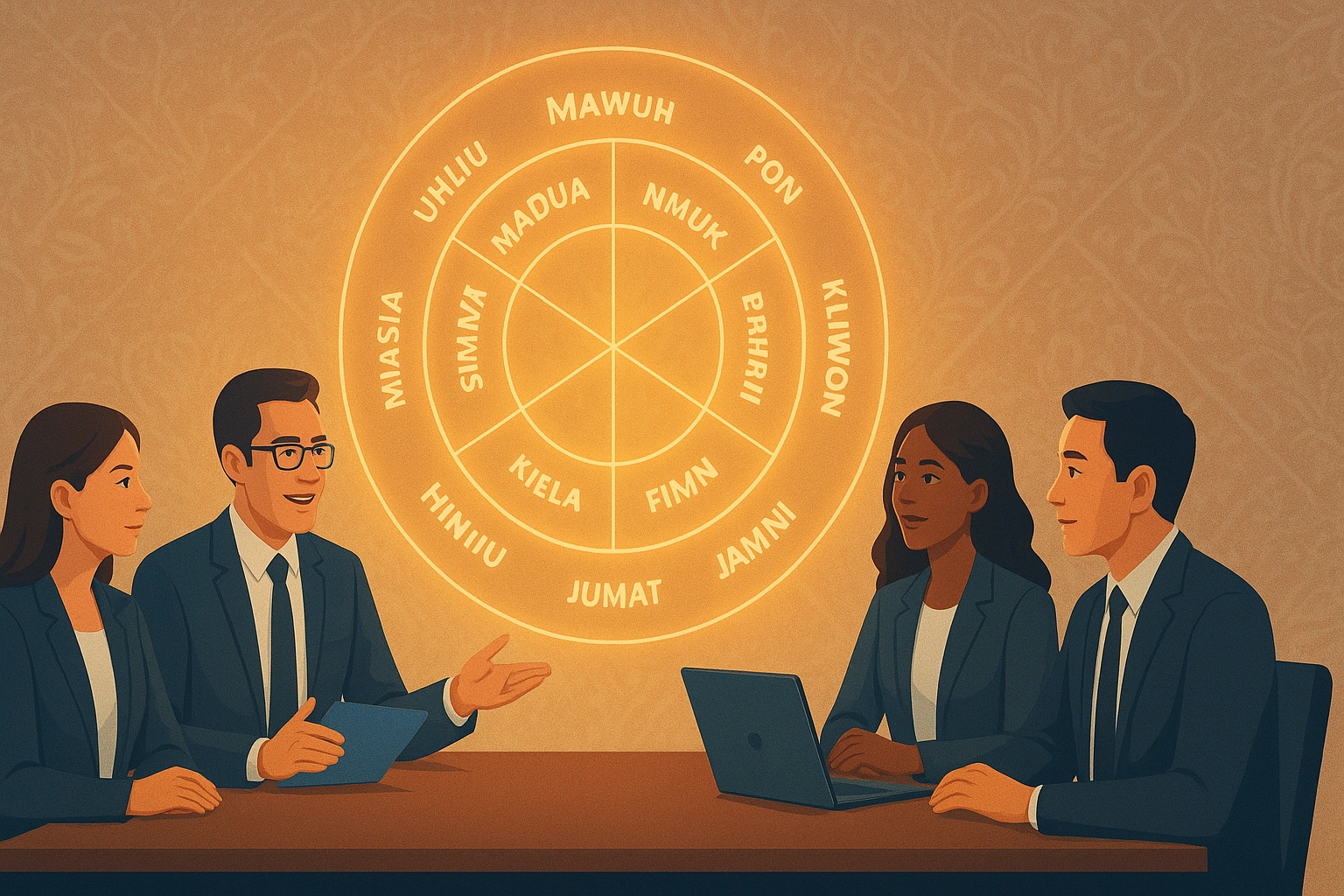
As a leader, your most critical task is managing people, and the Wuku calendar offers a unique way to understand them. You’re constantly assessing strengths, navigating team dynamics, and making high-stakes decisions about who to hire, how to build effective partnerships, and who is ready for the next level—and here the Wuku calendar can serve as a powerful guide.
We invest heavily in modern personality assessments—from Myers-Briggs to DISC and the Enneagram—all in an effort to decode the human variable that drives business success. Yet, the Wuku calendar provides an ancient but highly practical framework that brings a different dimension to these tools.
What if one of the most nuanced and insightful systems for understanding people wasn’t developed in a modern boardroom, but in the royal courts of ancient Java? The Wuku calendar carries centuries of wisdom, ready to be applied in today’s leadership and organizational challenges.
The Javanese Pawukon, or Wuku calendar, is not just a time-keeping device; it is a sophisticated 210-day cycle that offers leaders a deep well of psychological and archetypal wisdom. By looking at the Wuku calendar, each of the 30 weeks reveals a distinct personality profile, complete with inherent traits, latent strengths, and natural roles that can be applied to teamwork.
Understanding these profiles through the Wuku calendar gives leaders a powerful framework to manage people with greater clarity. It becomes easier to see which individuals are best suited for certain tasks, how to balance different energies, and where potential challenges might arise.
For modern leadership, the Wuku calendar provides more than historical insight; it serves as a practical tool to create stronger, more harmonious teams that thrive in complex environments.
This guide will introduce you to the concept of Wuku personality at work. We’ll move beyond theory and provide a practical framework to apply these ancient profiles to your modern leadership challenges. Whether you’re a startup founder building a team from scratch, a manager looking to resolve team friction, or an HR professional developing a leadership pipeline, Wuku profiles can become your new strategic advantage.

Beyond Astrology: Wuku calendar as an Archetypal System
It’s important to differentiate Wuku profiles from simple sun-sign astrology, and here the Wuku calendar plays a key role. While both are tied to birth dates, the Wuku calendar is less about predicting the future and more about revealing innate character and potential.
The Wuku calendar also functions much like an archetypal framework, similar to how Carl Jung identified universal patterns of behavior that shape human nature. Through this lens, the Wuku calendar provides leaders with insights that go deeper than personality tests, helping them understand motivations and tendencies.
Each Wuku in the Wuku calendar is connected to a specific myth, deity, and set of symbolic attributes such as a tree, bird, and weapon, all of which form a coherent personality profile. This makes the Wuku calendar a structured yet intuitive guide for leadership and team building.
This approach aligns with modern management theories which emphasize the power of cognitive diversity in teams. As a Harvard Business Review study found, teams with higher cognitive diversity solve problems faster. Wuku provides a ready-made map to identify and cultivate this diversity, ensuring you have the right mix of innovators, stabilizers, communicators, and strategists. To apply this, you first need to identify which of the 30 Wuku an individual was born in. This can be done using an online Pawukon calculator or a traditional Javanese calendar.
The Five Core Wuku Archetypes for the Modern Workplace
While there are 30 distinct Wuku, the Wuku calendar shows that they can be grouped into broader archetypes that are highly useful in a business context. By looking at the Wuku calendar this way, leaders gain a clear structure for understanding personality patterns within their teams.
Here are five core profiles drawn from the Wuku calendar, with examples of specific Wuku that embody them and how they function in a team setting. This approach makes the Wuku calendar practical and easy to apply in everyday leadership decisions.
We’ll also explore their potential shadow sides—the challenges that can arise if core traits are unbalanced—something the Wuku calendar helps to identify and manage more effectively.
1. The Innovator (The Pioneer & Disrupter)
- Exemplified by: Wuku Landep (“Sharpness”), Wuku Sungsang (“Reversed”), Wuku Gumbreg (“Resonance”)
- Core Traits: Sharp intellect, highly creative, independent, future-focused, and comfortable with risk. They are natural problem-solvers who see new possibilities where others see dead ends.
- Strengths: Driving innovation, challenging the status quo, developing new products or systems, and cutting through complexity to find a solution.
- Ideal Team Roles: R&D Lead, Product Developer, Creative Director, Strategic Consultant.
- Shadow Side: Can be impatient with process, dismissive of details, and prone to starting new projects before finishing existing ones. Their independent nature can sometimes clash with collaborative environments.
- Leadership Tip: Give them autonomy and challenging problems to solve. Pair them with a “Stabilizer” to ensure their brilliant ideas are grounded and executable. Don’t micromanage them, but do provide clear guardrails and check-in points to ensure they stay on track.
2. The Stabilizer (The Executor & Guardian)
- Exemplified by: Wuku Warigagung (“Great Lineage”), Wuku Kuruwelut (“Tenacity”), Wuku Marakeh (“Abundance”)
- Core Traits: Dependable, detail-oriented, patient, process-driven, and risk-averse. They are the bedrock of the team, ensuring consistency and quality.
- Strengths: Project management, creating and maintaining systems, quality control, and executing long-term plans with precision.
- Ideal Team Roles: Operations Manager, Project Manager, Accountant, Quality Assurance Lead.
- Shadow Side: Can be resistant to change, overly cautious, and may get bogged down in details, losing sight of the bigger picture. They can sometimes stifle creativity with their focus on “the way it’s always been done.”
- Leadership Tip: Provide them with clear goals, stable processes, and recognition for their consistency. When introducing change, explain the “why” and give them a clear roadmap for the transition. They thrive on predictability and are essential for scaling any operation.
3. The Communicator (The Ambassador & Networker)
- Exemplified by: Wuku Bala (“The Messenger”), Wuku Wugu (“The Unifier”), Wuku Wayang (“The Performer”)
- Core Traits: Charismatic, empathetic, highly articulate, and socially adept. They excel at building relationships and conveying messages with impact.
- Strengths: Sales, marketing, public relations, internal communications, and building a positive company culture.
- Ideal Team Roles: Head of Sales, Marketing Manager, HR Business Partner, Community Manager.
- Shadow Side: May prioritize harmony over honest feedback, avoid difficult conversations, and can sometimes be more focused on perception than substance. They can be sensitive to criticism.
- Leadership Tip: Put them in client-facing or team-facing roles. They are your cultural ambassadors. Encourage them to provide constructive feedback by creating a psychologically safe environment. Leverage their skills to unify teams and champion your brand’s message.
4. The Strategist (The Visionary & Planner)
- Exemplified by: Wuku Medangkungan (“High Place”), Wuku Dukut (“The Thinker”), Wuku Kulantir (“The Guide”)
- Core Traits: Analytical, forward-thinking, sees the big picture, and enjoys complex systems. They are the chess players of the organization.
- Strengths: Long-term business planning, market analysis, financial modeling, and navigating complex organizational challenges.
- Ideal Team Roles: CFO, Head of Strategy, Business Analyst, Systems Architect.
- Shadow Side: Can suffer from “analysis paralysis,” delaying decisions in search of perfect data. They may seem detached or overly theoretical, struggling to connect their grand plans to day-to-day realities.
- Leadership Tip: Involve them in high-level planning sessions. Give them access to data and the space to think, but also set clear deadlines for decisions. Pair them with a “Communicator” to help translate their complex strategies into compelling, actionable plans for the rest of the team.
5. The Facilitator (The Mediator & Team Builder)
- Exemplified by: Wuku Manahil (“Compassion”), Wuku Prangbakat (“Service”), Wuku Tambir (“Nurturer”)
- Core Traits: Diplomatic, supportive, intuitive, and focused on group harmony. They are the glue that holds a team together, especially under pressure.
- Strengths: Resolving conflict, mentoring junior members, fostering collaboration, and ensuring psychological safety within the team.
- Ideal Team Roles: Team Lead, Scrum Master, People Manager, Customer Support Lead.
- Shadow Side: May take on too much of the team’s emotional labor, leading to burnout. They can sometimes absorb negativity and may hesitate to make tough decisions that could upset the team’s equilibrium.
- Leadership Tip: Empower them to build team cohesion. Actively check in on their own well-being and provide them with the support they need. Their work is vital but often intangible, so recognize and reward their impact on team health and retention.
Practical Application: The Wuku Leadership Playbook
Understanding these profiles is the first step. The real value comes from applying them to build a balanced, high-performing team.
Case Study: Building the Balanced Product Team
Imagine a startup with a brilliant idea. The founding team consists of two Innovators (Landep, Sungsang) and a Communicator (Wayang). They are fantastic at brainstorming, pitching to investors, and creating hype. However, they consistently miss deadlines, their product is buggy, and team morale is volatile.
Using the Wuku framework, a leader can see the gaps. The team is heavy on idea generation and outward energy but lacks grounding. The solution:
- Hire a Stabilizer (Warigagung): They bring in a strong project manager who implements an agile workflow, establishes a QA process, and creates a realistic product roadmap. The Innovators are now free to create, knowing the details are being handled.
- Promote a Facilitator (Manahil): One of the early employees who shows great empathy is promoted to Team Lead. They mediate the creative friction between the two Innovators and ensure the new Stabilizer’s processes are adopted without alienating the original team.
The result is a balanced team where different energies complement each other, leading to sustainable growth. This strategic approach to team composition is a core tenet of effective management, as supported by research from institutions like Gallup on building strengths-based teams.
A Framework for Implementation
- For Hiring: During interviews, go beyond skills. Ask behavioral questions that reveal innate tendencies. “Describe a project where you had complete freedom versus one with strict guidelines. Where did you feel more energized?” This helps identify if they lean Innovator or Stabilizer.
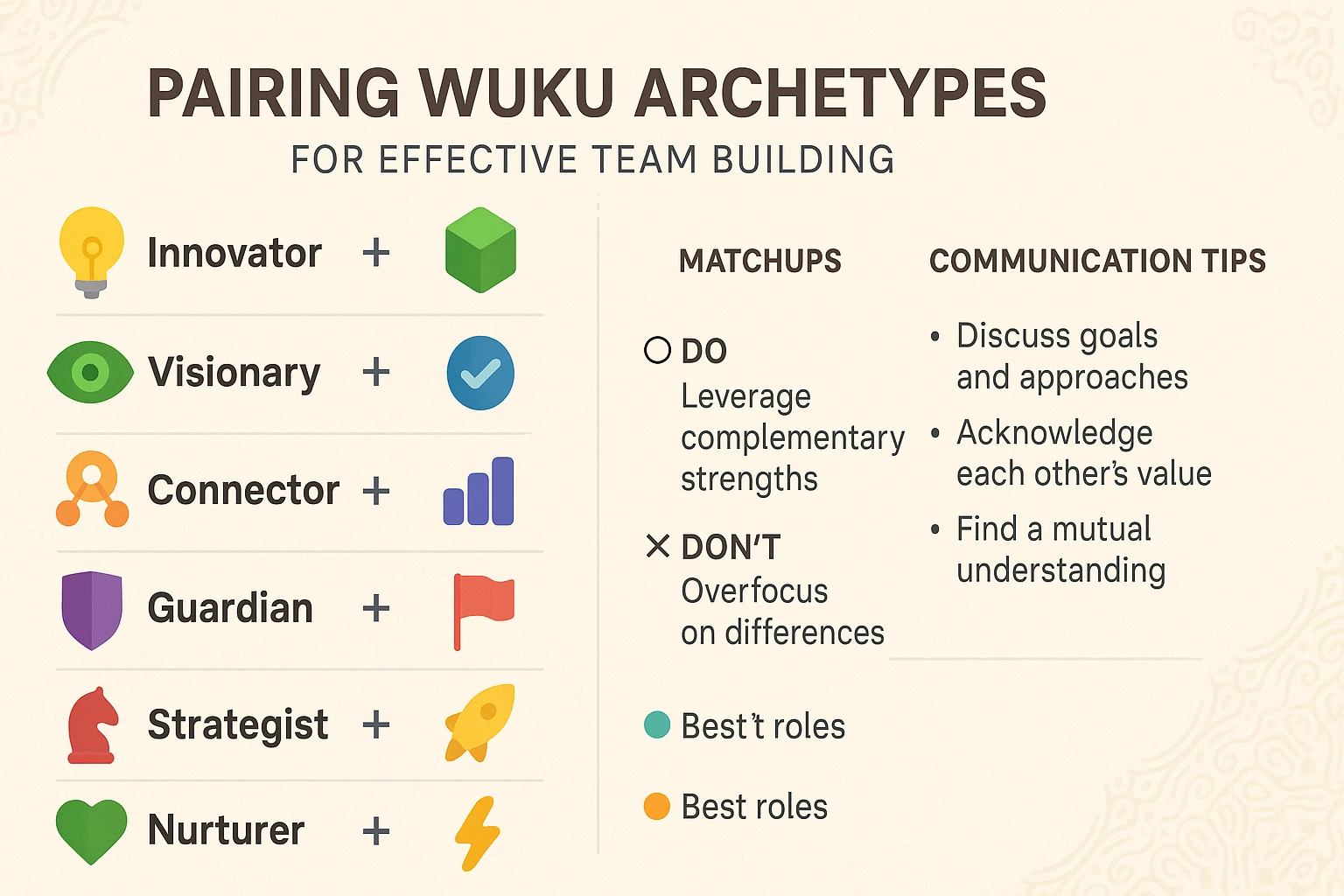
- For Pairing & Team Building: Intentionally create “power pairs.” A Strategist (Dukut) and a Communicator (Gumbreg) can effectively develop and roll out a new company vision. Awareness of these types can also explain sources of friction and provide a path to resolution. If two Stabilizers clash, it might be over process details. If two Innovators clash, it might be a battle of egos.
- For Promotions: Who is ready for leadership? A great individual contributor who is a “Stabilizer” might excel as an Operations Manager but struggle in a chaotic R&D leadership role that requires “Innovator” energy. Wuku helps you match the person’s innate strengths to the role’s demands, setting them up for success.
Ethical Considerations and Limitations
It is crucial to use this system responsibly. Wuku profiles are a tool for insight, not a box for stereotyping. An individual is far more complex than a single archetype, and their skills can be developed beyond their innate tendencies. Use Wuku as a conversation starter for personal and team development, not as a definitive label. It should always supplement, never replace, objective performance metrics, skills assessments, and fair HR practices.
Conclusion: Lead with Deeper Insight
The modern workplace is more complex than ever. Relying on a single personality system is like trying to build a house with only a hammer. By adding the ancient, nuanced wisdom of Wuku personality at work to your leadership toolkit, you gain a profound new level of insight that has been cultivated for centuries, a concept supported by anthropological studies found in academic journals on platforms like JSTOR.
It allows you to honor the unique traits of each team member through the insights of the Wuku calendar, leverage their innate strengths, manage their potential weaknesses, and place them in team roles where they can truly thrive. The Wuku calendar is not just about better management; it becomes a guide to creating a more harmonious, effective, and human-centered organization.
By applying the Wuku calendar, leaders can shape teams that balance innovation with stability, communication with strategy, and compassion with execution. This ancient framework offers modern leaders a fresh perspective to navigate today’s complex challenges.
The wisdom of the Wuku calendar has been there for centuries; now is the time to bring it into the boardroom and let its timeless guidance inspire the way you lead.