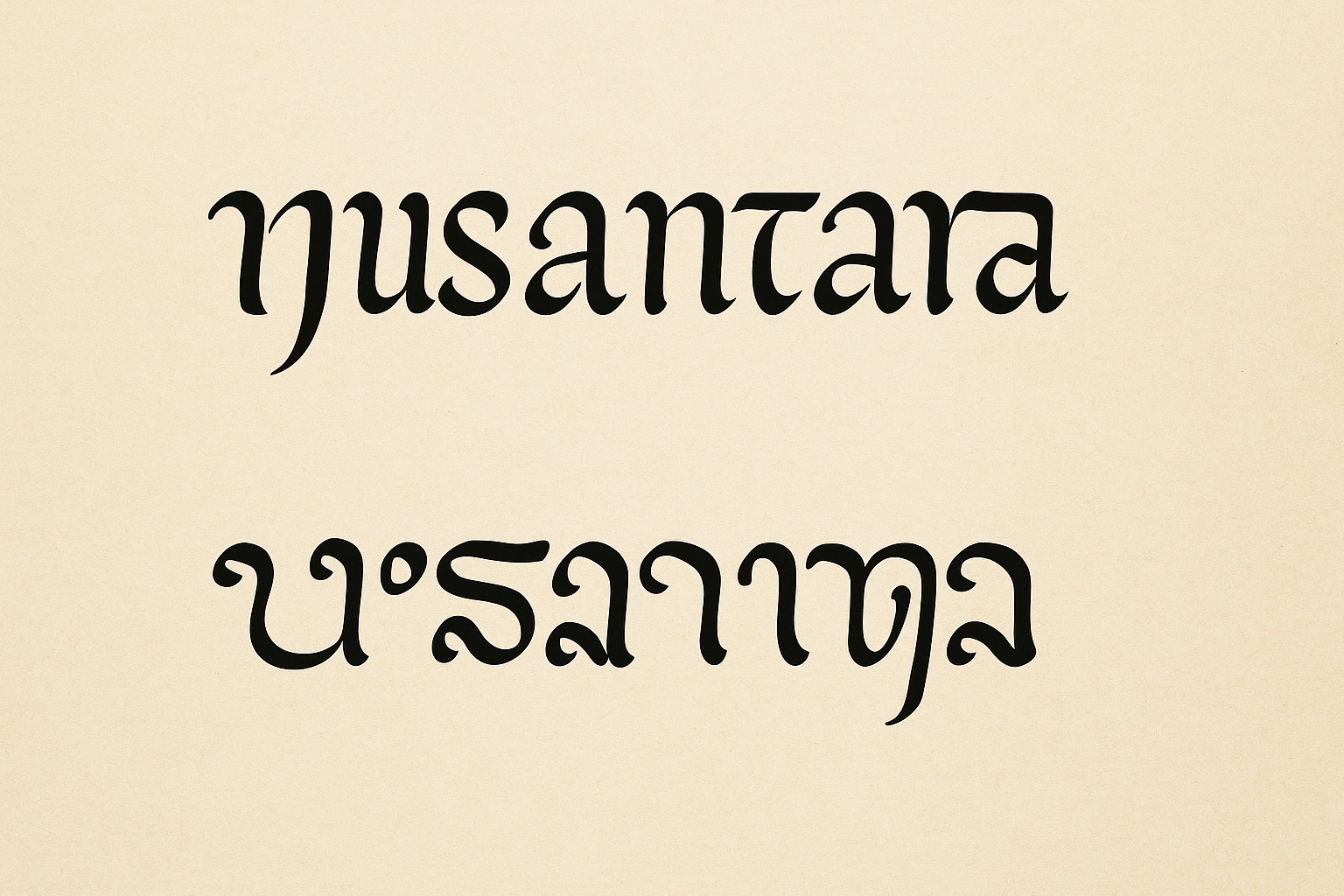
By Ky Tutur, Javanese Culturalist •
To the untrained eye, the ancient scripts of Southeast Asia can seem like a beautiful but indecipherable tangle of curves and hooks. Javanese script (Hanacaraka) and Balinese script (Aksara Bali), in particular, are often confused for one another. Add Sanskrit and its Devanagari script into the mix, and the picture becomes even more complex. Are they the same? Are they related? And which one is which?
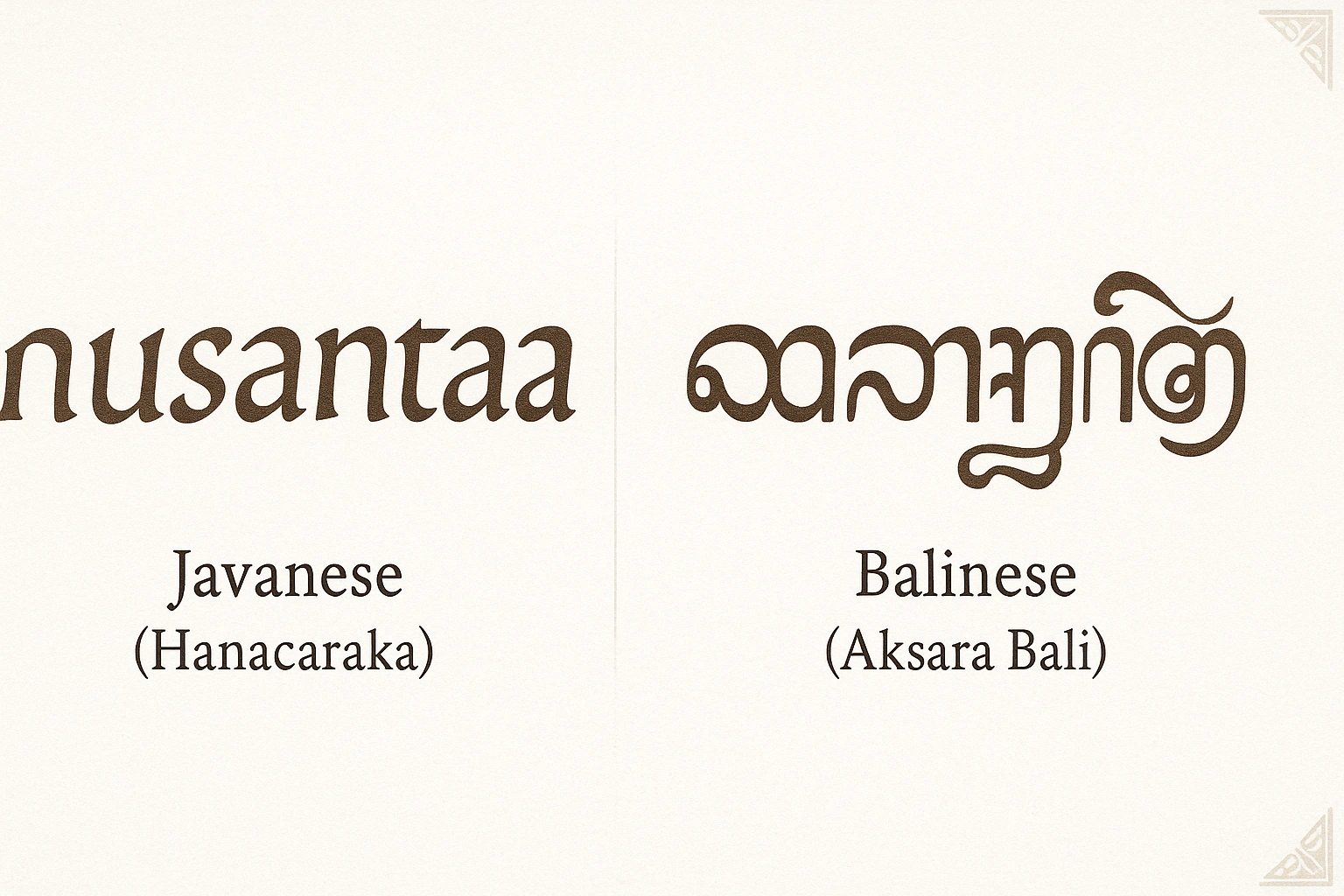
This article will unravel the mystery. We will trace their shared ancestry, highlight their distinct visual characteristics, and compare their functions, revealing a fascinating story of cultural exchange, adaptation, and identity across the islands of Indonesia and beyond.
The Family Tree: A Shared Brahmi Heritage
First, it’s crucial to understand that Javanese and Balinese scripts are not direct descendants of the Devanagari script used for classical Sanskrit. Instead, they are all part of a much larger family: the Brahmic scripts. Think of it like a family tree:
- The Great-Grandparent: Brahmi Script. This ancient script emerged in India around the 3rd century BCE and is the ancestor of hundreds of writing systems across South and Southeast Asia.
- The Grandparent: Pallava Script. As Indian cultural and religious ideas (Hinduism and Buddhism) spread to Southeast Asia, the Pallava script from Southern India came with them.
- The Parent: Kawi Script (Old Javanese). From the Pallava script, a localized version called Kawi developed in maritime Southeast Asia. It was used from the 8th to the 16th century in Java, Bali, and other parts of the region to write literature, edicts, and religious texts.
- The Siblings: Javanese and Balinese Scripts. Both modern Javanese (Hanacaraka) and Balinese (Aksara Bali) scripts evolved and diverged from this common Kawi ancestor. They are sisters, not mother and daughter.

Sanskrit, the language, was written in Kawi script during this period. The use of Devanagari for Sanskrit is a more recent development in the grand scheme of history. Therefore, comparing Javanese to Sanskrit is comparing a script to a language, while comparing Javanese to Balinese is comparing two sister scripts.
Javanese Script (Hanacaraka): The Philosophical Scribe
The Javanese script, as we know it today, was standardized in the Sultanate of Mataram era. It is characterized by its relatively clean, flowing, and rounded forms. It feels more “grounded” as the letters sit neatly on a baseline.
- Core Set: It is built around a core set of 20 consonants, immortalized in the Hanacaraka legend of Aji Saka. This philosophical foundation gives the script a unique narrative layer.
- Structure: Like its sister scripts, it is an abugida where each consonant has an inherent ‘a’ vowel, modified by diacritics (sandhangan).
- Aesthetic: The script avoids excessive ornamentation, giving it a more streamlined and elegant appearance.
Balinese Script (Aksara Bali): The Ornate Offspring
While descended from the same Kawi parent, the Balinese script took a different aesthetic path. Visually, it is more complex and ornate than its Javanese counterpart.
- More Letters: Aksara Bali contains more letters than Javanese. It retains a full set of 33 consonants needed to accurately write Sanskrit and Old Javanese loanwords used in religious Hindu texts. The everyday conversational language uses a core set of 18 consonants (known as Aksara Wreastra).
- Visual Style: The letters are often more angular, with more prominent upward and downward strokes (tedung). This gives the script a more “hanging” and dynamic look, with many diacritics placed above the characters.
- Complexity: It employs a wider array of diacritics and conjunct forms (gantungan and gempelan) to represent the complex phonology of the Balinese and Sanskrit languages.
Side-by-Side Comparison: Javanese vs. Balinese Script
The easiest way to see the differences is to put them side-by-side. While they share many root forms, the execution and details vary significantly.
| Feature | Javanese Script (Hanacaraka) | Balinese Script (Aksara Bali) |
|---|---|---|
| Origin | Evolved from Kawi script, standardized in the Mataram Sultanate era. | Evolved from Kawi script, with strong preservation of forms for writing Sanskrit. |
| Visual Style | Rounded, flowing, sits on a baseline. More minimalist and streamlined. | More angular and ornate, with prominent vertical strokes. Has a “hanging” appearance. |
| Base Consonants | 20 core consonants (Aksara Nglegena) based on the Aji Saka legend. | 18 core consonants for everyday use (Wreastra) and a full set of 33 for literary/religious use (Swalalita). |
| Example Letter (Na) | ꦤ (na) – A simple, rounded shape. | ᬦ (na) – More complex, with an initial upward stroke. |
| Vowel ‘u’ Diacritic | A hook placed underneath the letter: ꦤꦸ (nu). | A loop placed underneath the letter: ᬦᬸ (nu). |
| Consonant Conjuncts | Uses pasangan, subscript forms that sit below and often to the right. | Uses gantungan (hanging below) and gempelan (attached to the side), which can look visually different. |
| Modern Usage | Cultural and artistic revival. Taught in schools in Central/East Java but limited daily use. Seen on street signs and in traditional contexts. | Stronger connection to living religious practice (Balinese Hinduism). More widely used in ceremonial and religious documents. Also taught in schools. |
Conclusion: A Tale of Two Sisters
Javanese and Balinese scripts are not the same, but they are undeniably family. They are sister scripts born from a common Kawi ancestor, shaped by the distinct philosophical, religious, and aesthetic currents of their respective islands. Javanese script evolved into a streamlined system tied to a foundational myth, while Balinese script retained more complexity to serve its role as the guardian of sacred Hindu texts.
Understanding their differences is to appreciate the rich diversity within Indonesian culture. Each curve and stroke tells a story of identity. While one might explore its past through the philosophical poem of Javanese Weton, the other finds its rhythm in the sacred chants of a Balinese temple. They are two beautiful languages, two beautiful scripts, and one shared, magnificent heritage.