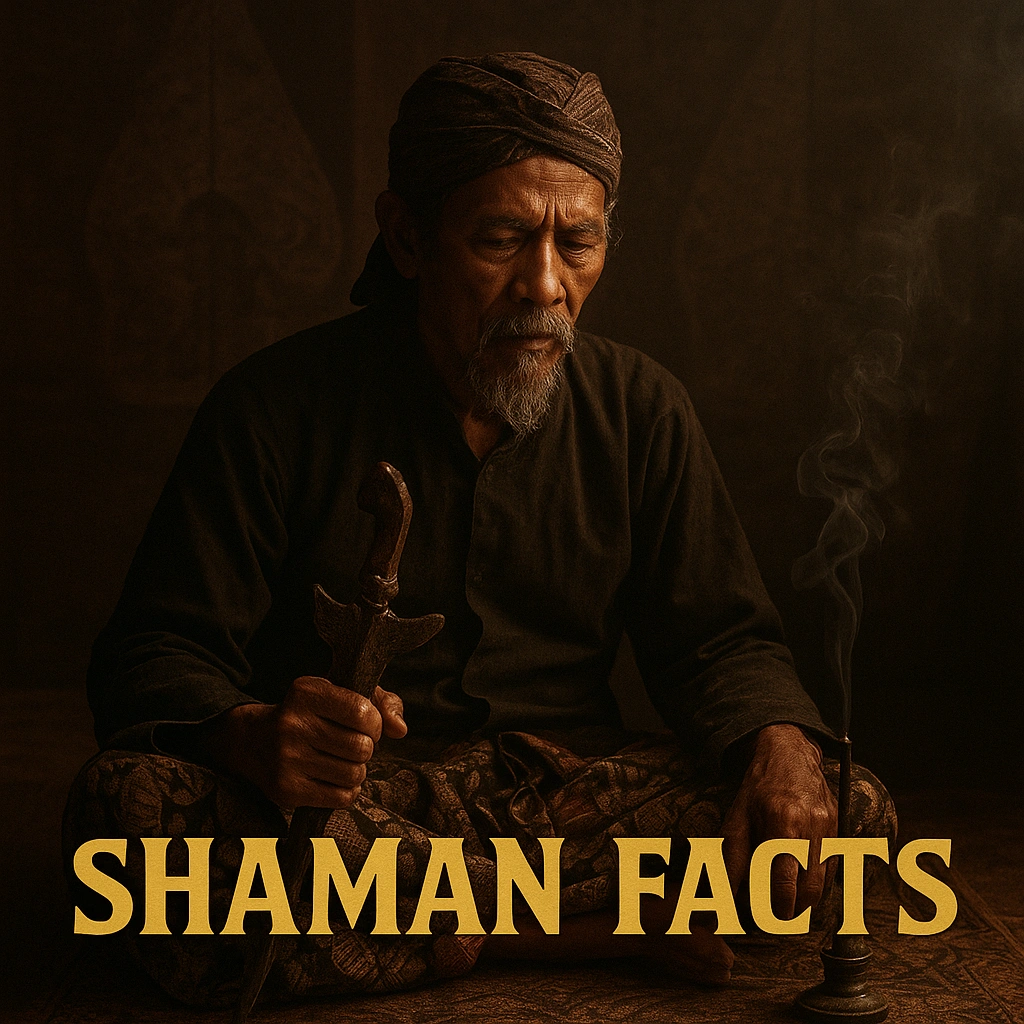
Dukun Reclaimed
The Stolen Crown of Javanese Wisdom
Come, my child… Let us sit together for a moment. I wish to tell you a story about a word that now bears a wound, a title that has become a stranger in its own home. That word is: Dukun.
Close your eyes for a moment and listen to that word. What comes to mind? Perhaps dark shadows, the smoke of incense, mysterious incantations, or things that send a shiver down your spine. Modern media and stories have painted it with a somber palette, making it synonymous with the dark arts.
Even today, if we consult official sources like the Great Dictionary of the Indonesian Language (KBBI), the recorded meaning has indeed been narrowed. But that modern definition does not tell the whole story.
I am here to tell you: they have robbed the word of its meaning. They have taken a crown of honor and twisted it into a fearsome mask.
Today, we will reclaim that crown together. We will walk down the corridors of time to find its true essence, and you may be surprised to realize that perhaps, the fire of this “ke-dukun-an” (the essence of being a Dukun) also burns within you.
Digging to the Roots: Dukun Reclaimed as a Title of Honor
Before we venture further, you must first understand its origins. Many linguists believe the word “dukun” is rooted in the word “duduk,” which means “to sit.” This is not mere idle sitting, but a position of great honor. It describes someone who possesses such profound knowledge and wisdom that others would come to “sit” before them, to listen and seek guidance.
A Dukun was not a sorcerer. A Dukun was an EXPERT. A specialist. In an era before universities or formal degrees, Javanese society bestowed the title “Dukun” as the highest form of recognition for deep and masterful expertise.
A Parade of Nusantara’s Experts: The Many Faces of the Dukun
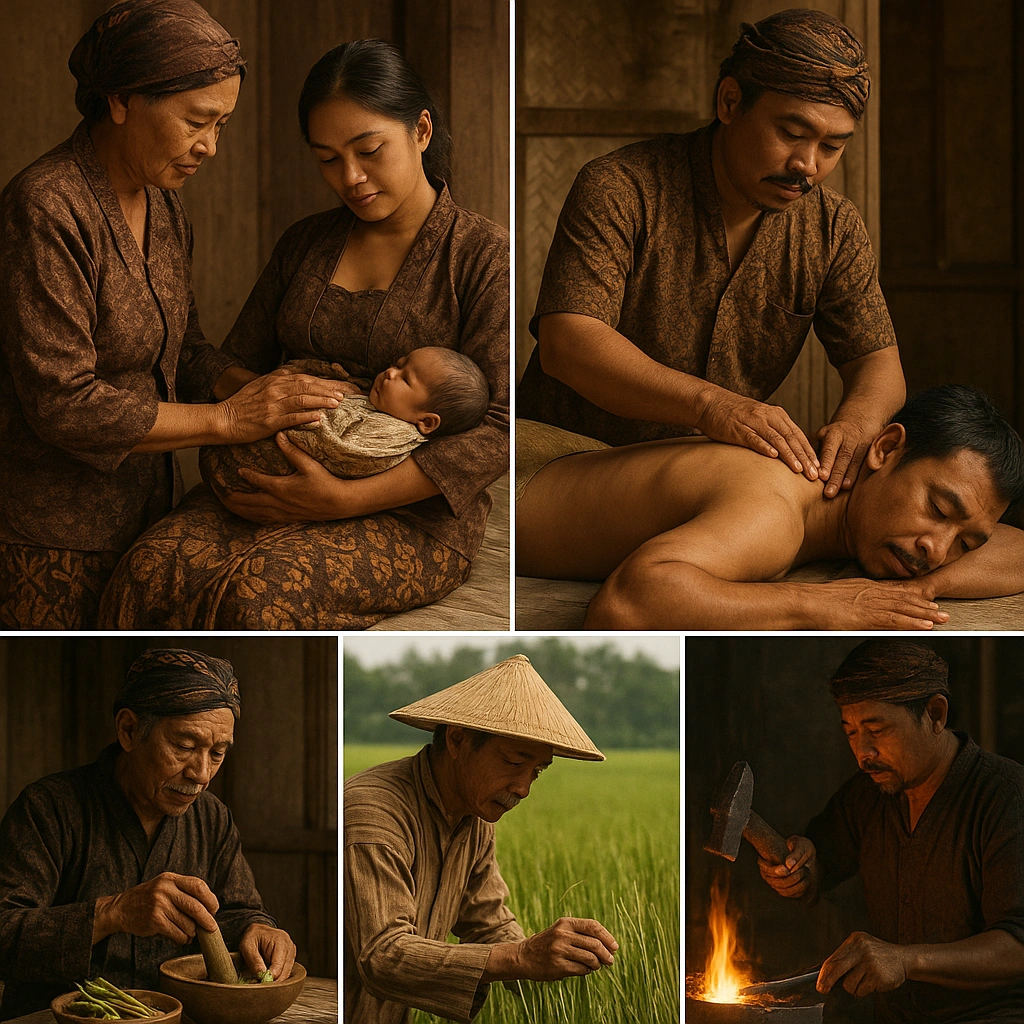
The Dukun Bayi
She was the obstetrician and gynecologist of her time. Her skilled hands and knowledge of postpartum herbal remedies welcomed thousands of first cries into the world. Her profession is now carried on by modern midwives.
The Dukun Pijat (Urut)
More than just a masseuse, he was a masterful physiotherapist. He understood every inch of muscle, sinew, and joint. He could restore energy and heal sprains with an expertise passed down through generations.
The Dukun Jampi (Wuwus)
He was the kingdom’s apothecary and pharmacologist. The forests and gardens were his laboratory. He compounded empon-empon (a traditional blend of rhizomes), roots, and leaves into potent medicines to cure illness.
The Dukun Sawah
A visionary agronomist. By reading the pranata mangsa (the traditional Javanese agricultural calendar), he advised on the best times to plant and how irrigation systems should be managed. He was the key to a full rice barn.
The Dukun Pandé
A sacred metallurgist. His hands could transform iron ore into a keris pusaka (an heirloom dagger), a strong hoe, or a melodious gamelan (a traditional musical ensemble). He was the material engineer of his day.
The Dukun Trawang & Petangan
Now, this is one of the most misunderstood branches. He was an analyst, a seer who read the cycles of nature and energy—such as Weton (a complex Javanese calendrical system) and Wuku (a 7-day cycle within the 210-day Pawukon calendar)—to provide strategic forecasts and insights, much like a modern stock market analyst reads charts and data.
The Turning Point: Why Was the Expert Exiled?

So, why did a title of such nobility become so degraded? Three great currents eroded its meaning:
- The Current of Modern Science: The arrival of Western medicine and technology slowly replaced the technical roles of the Dukun. The roles that science could not replace were those of a spiritual nature, and so only this aspect remained, clinging to the image of the “Dukun.”
- The Current of Spiritual Change: The strengthening of new belief systems often viewed local wisdom practices as primitive or even heretical. This stigma systematically pushed the word “Dukun” into the negative box of klenik (the occult and supernatural).
- The Current of Popular Media: Modern films and soap operas discovered that a Dukun figure who casts spells was far more “marketable” and dramatic than a Dukun who helps with the harvest. This sensationalism succeeded in burying the original meaning of “Dukun” in the minds of millions.
The Rebirth of the Dukun in the Digital Age: You Are the New Generation
And now, we arrive at you, my child. Look around you. See your friend who is so skilled at weaving code that an application runs flawlessly; he is a Dukun of IT. See the young person so adept at crafting words that a product sells out; she is a Dukun of Marketing. See those who can transform an empty plot of land into a magnificent building; they are the Dukun of Construction.
To be a Dukun in the modern era means possessing three things: Expertise (Skill), Passion, and Intuition (Rasa). It is a combination of technical skill that is constantly honed, a passion that makes you tireless in your learning, and a sharp rasa (a deep, intuitive feeling and understanding) to find the best solutions.
Frequently Asked Questions (FAQ) About Dukun
1. What does the word “Dukun” really mean?
Traditionally, a Dukun was not a sorcerer but an expert in a specific field. In Javanese culture, the title was given to specialists such as midwives, healers, blacksmiths, and agricultural experts who possessed deep knowledge and mastery.
2. Why is the word Dukun often seen negatively today?
Over time, popular media, colonial influence, and changes in spirituality narrowed the meaning of Dukun to mystical or occult practices. This erased its original status as a title of honor for skilled experts.
3. Is being a Dukun still relevant in modern times?
Yes. In today’s world, anyone with deep expertise, passion, and intuition can be called a Dukun in their field—whether in technology, arts, science, or business. The essence of “ke-dukun-an” lives on in modern specialists.
4. How can we reclaim the true meaning of Dukun?
By honoring ancestral wisdom, recognizing expertise as a form of mastery, and proudly using the term Dukun as a badge of skill and dignity rather than limiting it to negative stereotypes.
A Calling of the Soul: Igniting the Fire Within You
Recognizing and reclaiming the meaning of “Dukun” is more than just a matter of language. It is a matter of dignity and self-confidence. It is our way of saying to the world, and to ourselves, that our ancestors were not a primitive, backward people. They were experts, scientists, and visionaries.
So, find the “ke-dukun-an” within you. Sharpen your skills until they are without equal. Become a Dukun who brings benefit to others. And when someone calls you a “Dukun,” smile with pride, for it is a recognition of your mastery.
Mugi Rahayu Sagung Dumadi.
(May peace and well-being be upon us all.)
About the Author
This wisdom is conveyed by Ky Tutur—a symbolic figure representing noble Javanese values such as wisdom, simplicity, and **welas asih** (Javanese for “compassion” or “empathy”). These writings are compiled by the KaweruhJawa.com team (a platform dedicated to preserving and translating Javanese cultural wisdom), composed of cultural researchers, academics, and spiritual practitioners dedicated to preserving and translating Javanese local wisdom into a relevant language for the current generation.
We believe that ancestral heritage is not merely a relic, but a compass for life. Every article is written through a process of research, discussion across generations, and deep contemplation, to ensure the accuracy and sublimity of the values contained within.
Learn more about our writing team and philosophy →