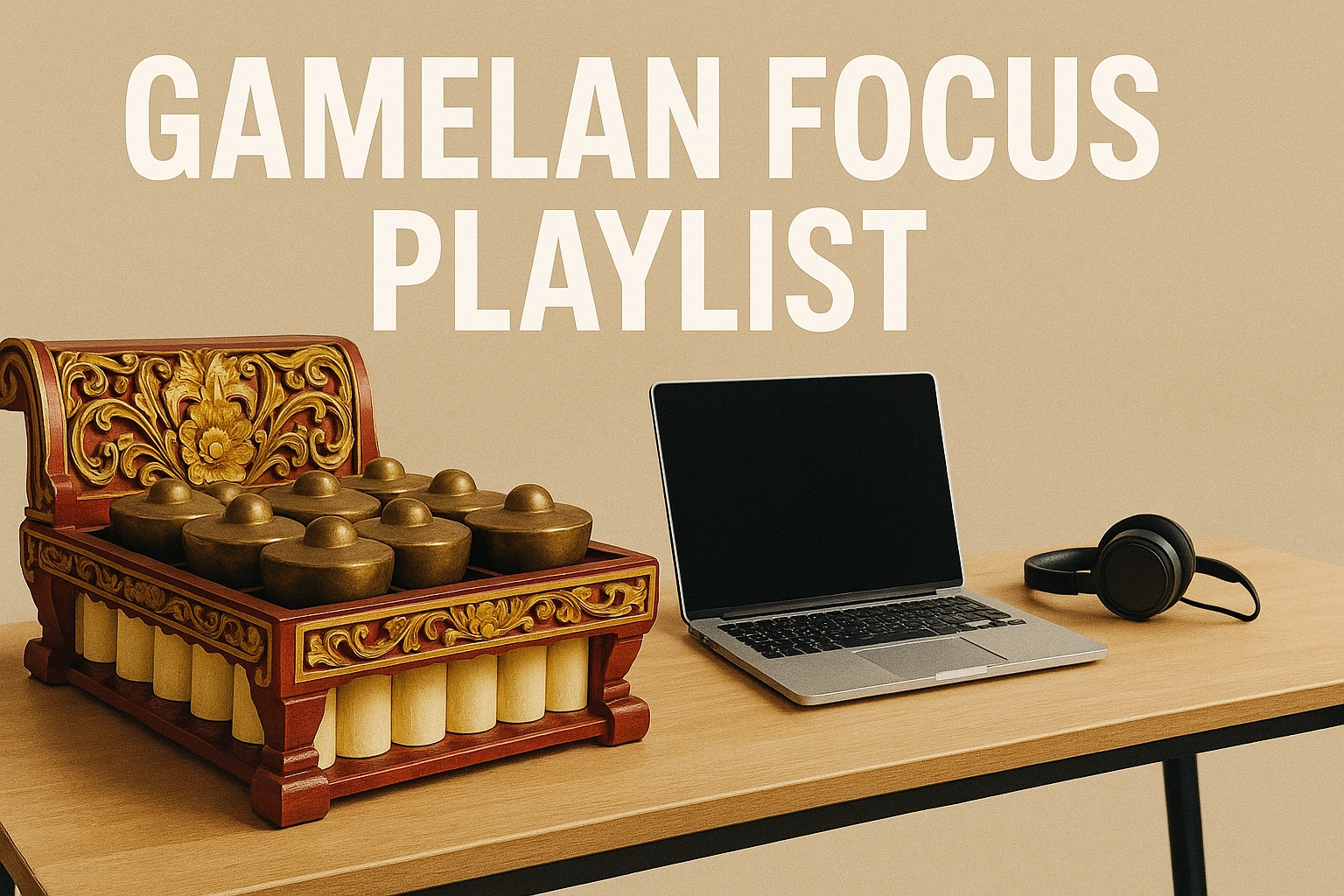
The endless search for the perfect focus music ends here. Discover why the ancient, cyclical sound of a Javanese gamelan focus playlist is a powerful tool for productivity, meditation, and deep study.
In our hyper-distracted world, the quest for focus is a modern-day holy grail, and many now turn to a gamelan focus playlist to find clarity. We curate playlists of lo-fi hip-hop beats, classical concertos, and binaural soundscapes, yet a gamelan focus playlist offers a depth that feels timeless. All this effort to silence the noise and enter a state of “deep work” is mirrored in the steady rhythms of a gamelan focus playlist, which guides attention without strain. What if one of the most effective tools for concentration wasn’t created in a modern studio, but has been refined over centuries in the royal courts of Java, much like the enduring power of a gamelan focus playlist?
A gamelan focus playlist brings the timeless sound of Javanese percussion into modern life, turning ancient rhythms into tools for focus. With its cyclical patterns and layered textures, a gamelan focus playlist can quiet the mind and support deep study. More than background sound, a gamelan focus playlist offers clarity for work, reflection, or meditation. Creating your own gamelan focus playlist is a simple way to connect with tradition while boosting productivity.
Why Gamelan Works for Focus: The Science & Philosophy
The effectiveness of gamelan as focus music isn’t a coincidence. It’s a result of its fundamental structure, which is radically different from most Western music.
- It’s Cyclical, Not Linear: Western music is often linear—it has a clear beginning, a rising tension, a climax, and a resolution. This narrative structure can subconsciously pull your attention away from your work as you anticipate what’s next. Gamelan music, however, is cyclical. It’s built around a repeating rhythmic cycle, punctuated by a deep gong. This creates a stable, non-distracting soundscape that you can sink into, rather than actively follow.
- Complex Texture, Simple Core: The music has many layers. Fast, interlocking patterns on some instruments create a shimmering, complex texture that can gently occupy the part of your brain that is prone to distraction. However, beneath this, the core melody (the *balungan*) is often very slow, calm, and predictable. This combination of complexity and stability is ideal for focus.
- No Distracting Lyrics: The vast majority of traditional gamelan music is instrumental, which is a key component of effective study music, as confirmed by numerous studies on cognitive load.
- An Ancient Tool for Meditation: Gamelan music has been used for centuries to accompany rituals, ceremonies, and meditation. It is designed to foster a state of calm concentration and inner composure (batin tenang). This intentional design makes it a perfect aid for modern deep work. The steady, repeating patterns can help entrain brainwaves to a more relaxed, focused state, similar to the goals of binaural beats, a topic explored in publications like Psychology Today.

The Building Blocks of Your Gamelan Focus Playlist
Not all gamelan music is created equal when it comes to focus, which is why a gamelan focus playlist can make all the difference. A piece meant to accompany a battle scene in a Wayang Kulit performance will be loud, fast, and exciting—the opposite of what you want in a gamelan focus playlist. Instead, you need to seek out the calm, atmospheric, and majestic pieces that form the heart of a gamelan focus playlist. Here are the key terms and concepts to look for when building your own gamelan focus playlist.
Key Search Terms for Calm Gamelan:
- “Klenengan”: This is the most important term. It refers to a gamelan performance for its own sake, purely for listening, without dance or drama. Searching for “Klenengan Javanese Gamelan” will give you excellent results.
- “Gendhing”: This is the general term for a gamelan composition.
- “Ketawang”: A specific musical structure with a 16-beat gong cycle. These pieces are often calm and majestic. A great starting point for any playlist.
- “Ladrang”: A 32-beat gong cycle, also very common and often majestic in tone.
- “Gendhing Bonang”: These pieces feature the *bonang* (a set of small, horizontally-mounted gongs) and often have a spacious, contemplative feel.
- “Gendhing Rebaban”: These pieces feature the *rebab* (a two-stringed fiddle) and are often lyrical, introspective, and beautiful.
- Avoid: Terms like “gamelan for dance,” “gamelan for wayang,” or anything described as “energetic,” “fast,” or “soran” (loud-playing style).
Understanding the Mood: Pathet
In Javanese music, *pathet* is a concept similar to a musical mode. It’s a set of rules that governs which notes can be emphasized and which melodic patterns are used. More importantly, each pathet has a specific mood and is associated with a time of day, making it a perfect tool for curating your playlist.
- Pathet Nem: Associated with the early evening (6 PM – 9 PM). The mood is calm, serene, and relatively simple. Excellent for winding down your workday or for tasks requiring a calm, clear mind.
- Pathet Sanga: Associated with the late evening (9 PM – midnight). The mood is more profound, introspective, and often melancholic. Perfect for deep, creative thinking, writing, or late-night study sessions.
- Pathet Manyura: Associated with the time from midnight to dawn. The mood is often brighter, more majestic, and sometimes more complex, representing the coming of the light. Good for starting your day with focus or for tackling complex problems.
When searching, you can add the pathet to your search term, for example, “Ladrang Wilujeng Pathet Sanga.”

A Curated Starter Playlist for Different Tasks
To get you started, here is an expanded list of classic Javanese gamelan pieces, categorized by the type of work they are best suited for. You can find excellent recordings of these on YouTube, Spotify, and Apple Music by searching for their names.
For Deep Analytical Work & Studying
(Steady, majestic, non-intrusive)
| Composition (Gendhing) | Mood & Why It Works |
|---|---|
| Ketawang Puspawarna | Majestic, grand, and very steady. It was traditionally played to announce the entrance of a prince. Its regal pace creates a sense of calm importance, perfect for serious work. |
| Ladrang Wilujeng | The name means “safe” or “secure.” It’s a very peaceful and calming piece, often played at the beginning of ceremonies to create a serene atmosphere. Its gentle, predictable melody is never distracting. |
| Gendhing Tirtakencana | “Golden Water.” A beautiful, flowing piece that is calm but has a subtle forward momentum, helping to keep you engaged without being distracting. |
For Creative Thinking & Brainstorming
(Spacious, atmospheric, inspiring)
| Composition (Gendhing) | Mood & Why It Works |
|---|---|
| Gendhing Kemanak | This piece uses an ancient, minimalist instrumentation. It’s spacious, atmospheric, and almost hypnotic, making it ideal for clearing the mind and allowing new ideas to surface. |
| Ladrang Asmaradana | Named after the god of love, this piece has a sweet, slightly melancholic, and beautiful melody, often led by the rebab. It’s excellent for late-night work, writing, or when you need a gentle, encouraging soundscape. |
| Gendhing Laler Mengeng | “The Buzzing Fly.” Despite the name, this is a beautiful, introspective piece. Its interlocking patterns are intricate but the overall mood is calm and contemplative, perfect for getting lost in thought. |
How to Search on Spotify, YouTube, and Apple Music
Finding authentic recordings is key. Here are some practical tips:
- Use the Right Keywords: Start with the terms above, like “Klenengan,” “Ladrang Wilujeng Pathet Sanga,” or “Javanese court gamelan.”
- Look for Reputable Ensembles: Search for recordings by institutions like ISI Surakarta, ISI Yogyakarta (the Indonesian Institutes of the Arts), or renowned Western groups like the Southbank Gamelan Players. These will be high-quality, authentic recordings.
- Be Wary of “Spa Music”: Many playlists labelled “gamelan” are actually new-age electronic music with synthesized sounds. While relaxing, they lack the acoustic complexity and structure of a real ensemble. Look for recordings that sound like real, acoustic instruments.
- Explore Labels: Record labels like Smithsonian Folkways have released incredible archives of authentic field recordings of gamelan music. These are often exceptionally high quality.
The Gamelan Mindset for Productivity
Beyond the playlist, the philosophy of gamelan itself offers powerful lessons for productivity:
- The Gong Cycle: Think of the gong cycle as your own personal Pomodoro Technique. Work steadily through a cycle (a *gongan*), and when the great gong sounds, it’s a natural moment to pause, take a breath, and reset before the next cycle begins. It builds a natural, sustainable rhythm for your work.
- Interlocking Parts (Imbal): In the gamelan, simple individual parts come together to create a complex, beautiful whole. This is a perfect metaphor for teamwork. Trust that if you focus on your part, and your colleagues focus on theirs, the result will be harmonious and effective. You don’t have to do everything yourself.
- Playing with Rasa: *Rasa* is a core Javanese concept meaning “feeling” or “essence.” It’s about performing a task not just mechanically, but with the right feeling and intention. Apply this to your work: are you just completing tasks, or are you doing them with care, attention, and the right spirit?

Conclusion: Ancient Sounds for a Modern Mind
A gamelan focus playlist offers a calm rhythm that helps shut out distractions and guide the mind with ease. More than background sound, a gamelan focus playlist can support study, meditation, or creative work by creating balance and flow. Through its steady patterns, a gamelan focus playlist becomes a gentle tool for productivity, while also connecting us to ancient wisdom. Bringing a gamelan focus playlist into daily life is a simple way to find focus and harmony.
We invite you to build your own playlist today and discover the profound focus that this music can bring. And if listening inspires you to learn more, explore our guides on Javanese culture, from understanding royal titles to the philosophy of Primbon.