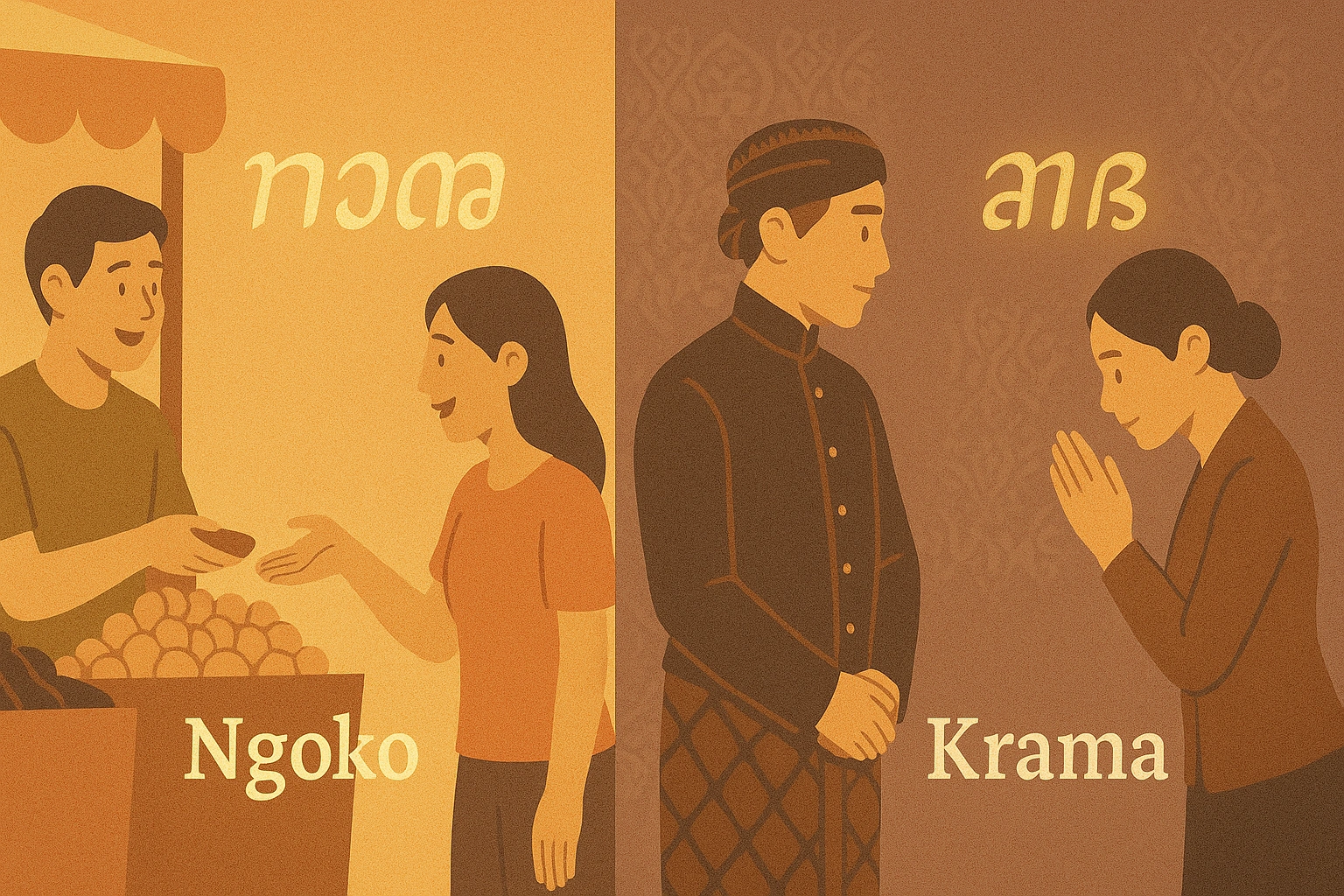
Imagine this: you’ve been practicing your Javanese. You approach a kind, elderly woman at a market stall in Yogyakarta and, wanting to ask the price, you use the phrase you learned from your younger friend: “Regane pira?” The woman’s smile tightens. She answers you, but there’s a sudden coolness in the air. In Javanese Culture, this is a classic, albeit innocent, mistake. You used the language of friends with an elder. Within Javanese Culture, Ngoko belongs to equals or the young, while Krama shows respect. In daily Javanese Culture, choosing the wrong level feels like ignoring deeply rooted values. This moment reminds you that Javanese Culture is not just about words, but about the way respect is expressed.
In English, politeness comes with words like “please” and “thank you.” In Javanese Culture, it is built into the grammar itself. This system, called Undha-usuk Basa, is a core part of Javanese Culture. The main levels are Ngoko (informal) and Krama (formal). In Javanese Culture, choosing the right level is about respect and social awareness. This guide offers a simple phrasebook to help you use Krama and Ngoko naturally in everyday Javanese Culture.
The Philosophy Behind Javanese Culture: Why Two “Languages”?
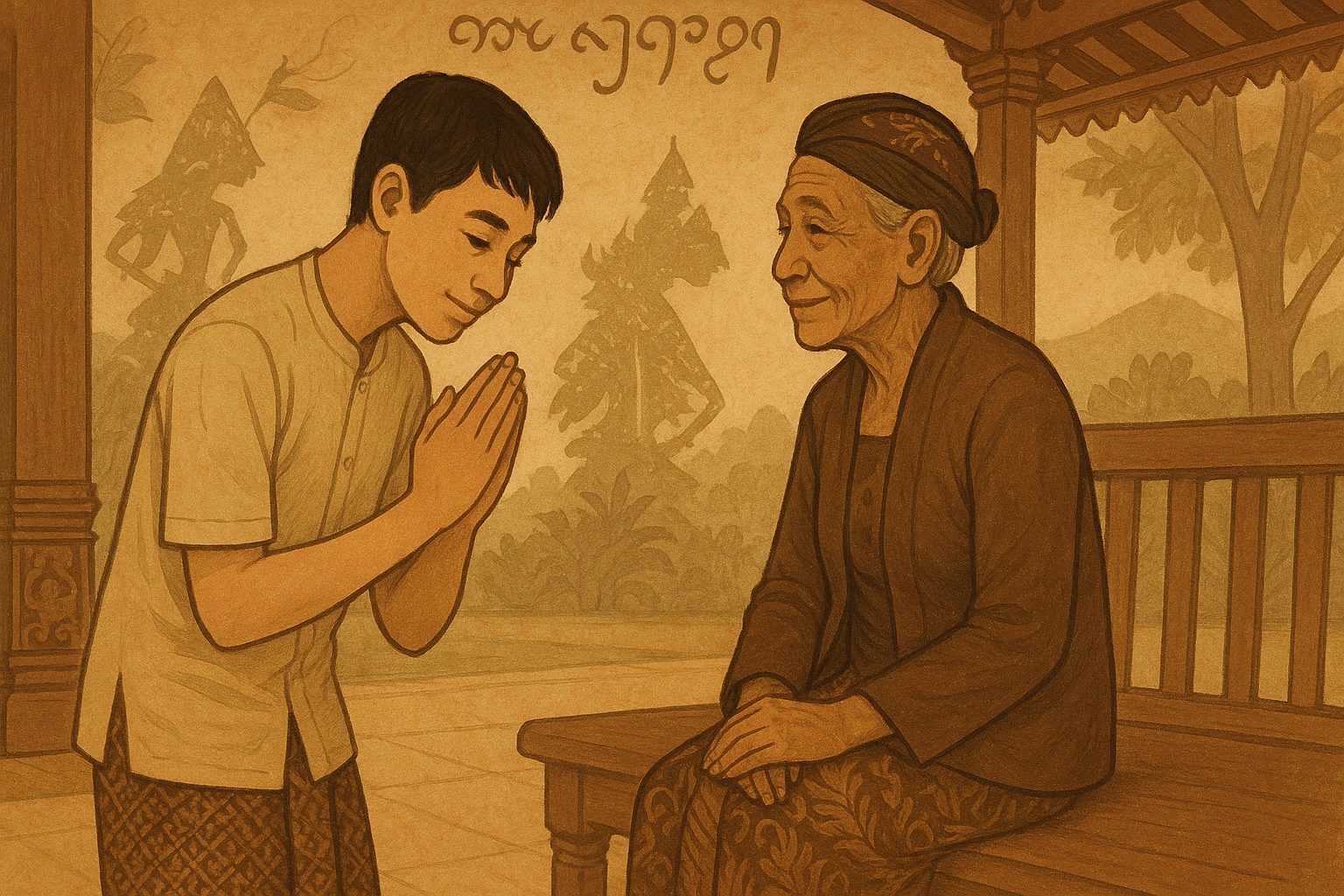
To a Western learner, the idea of having completely different words for “you,” “eat,” or “house” depending on the listener can seem daunting. But it’s rooted in a deep cultural philosophy of social harmony and respect. The goal is to show respect (hormat) and avoid causing offense. It reflects the core Javanese cultural values of humility (andhap asor) and empathy (tepa slira—literally “to feel with one’s own body”). Choosing the correct speech level is a way of acknowledging the other person’s age, social status, or your relationship with them. It’s a constant, active demonstration of social awareness.
Essentially, the system can be broken down into two main poles with gradations in between:
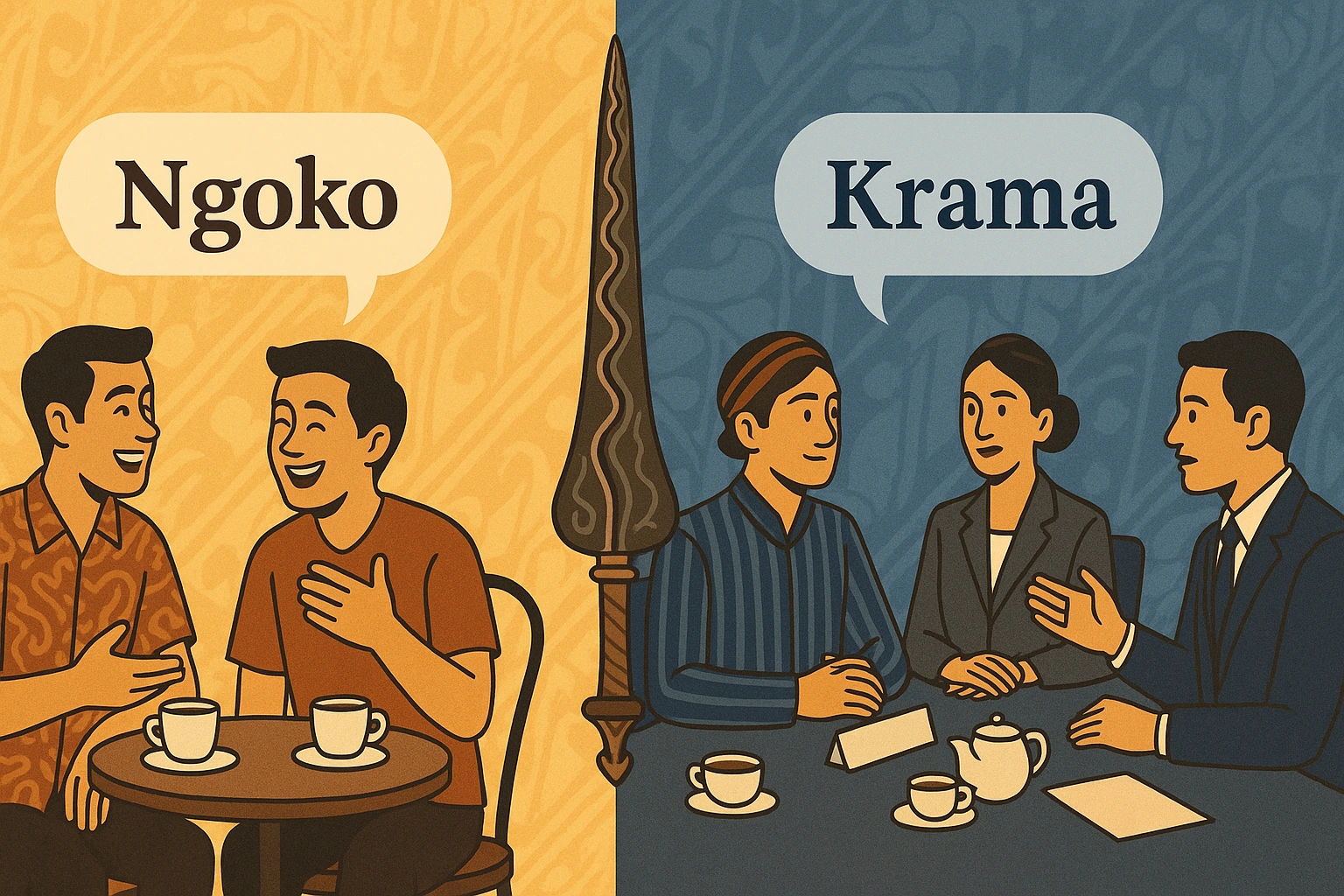
- Ngoko: The Language of Intimacy and Immediacy. This is the default, the base language. It’s used with people you are very close to (close friends, siblings), people of the same age or younger, or when talking to yourself. It signals familiarity, equality, and a lack of social distance. It can also be used to show anger or to speak down to someone.
- Krama: The Language of Respect and Formality. This is the polite, formal language. It’s used with elders, parents, teachers, people of higher status (like the nobles we discuss in our Javanese titles guide), strangers, and in formal settings like ceremonies or business meetings. It creates a respectful distance and elevates the person being spoken to.
Using Ngoko with an elder is like using slang and overly casual language with a CEO in a board meeting—it’s jarring and shows a lack of respect. Conversely, using Krama with your childhood best friend can feel cold, distant, and create an awkward, unnecessary barrier.
A Spectrum of Politeness: Beyond Just Two Levels
While we focus on Ngoko and Krama, it’s helpful to know they are part of a spectrum:
- Ngoko Lugu: The most basic, informal level. Used with very close friends.
- Ngoko Alus: A slightly more polite form of Ngoko, where you might mix in some Krama words to show respect when talking *about* a third person (e.g., your mother) to a friend.
- Madya: A “middle” ground, often heard in markets, that mixes Krama words with Ngoko grammar. It’s less formal than full Krama.
- Krama Lugu: The standard form of polite speech. The vocabulary is Krama, but the affixes are still Ngoko-like.
- Krama Inggil (or Krama Alus): The highest level of politeness. This level uses a special, deferential vocabulary set to talk about the actions or possessions of the person you are honoring. For instance, you use a different word for “eat” if you are talking about the Sultan eating versus yourself.
For a beginner, mastering the clear difference between base Ngoko and base Krama is the most important goal.
The Krama vs. Ngoko Phrasebook
The best way to learn is by seeing direct comparisons. The following tables provide common phrases and vocabulary in both levels. Notice that some words change completely, while others stay the same.
Core Vocabulary: The Most Important Words to Know
| English | Ngoko (Informal) | Krama (Formal) |
|---|---|---|
| I | Aku | Kula |
| You | Kowé | Panjenengan |
| He/She | Dèkné | Piyambakipun |
| Yes | Iya | Inggih |
| No | Ora | Boten |
| What | Apa | Menapa |
| Where | Ngendi | Wonten pundi |
| When | Kapan | Kapan |
| How | Piyé / Kpriyé | Pripun / Kadospundi |
| Name | Jeneng | Asma |
| House | Omah | Griya |
| Eat | Mangan | Dahar |
| Drink | Ngombé | Ngunjuk |
| Sleep | Turu | Sarè |
| Go | Lunga | Tindak |
| Come | Teka | Rawuh |
| Want | Arep / Gelem | Kersa / Pados |
| Can / Able | Isa | Saged |
| Know | Ngerti | Ngertos |
| Give | Awèh | Maringi |
| Have | Duwé | Gadhah |
Greetings and Common Courtesies
| English | Ngoko (Informal) | Krama (Formal) |
|---|---|---|
| How are you? | Piyé kabaré? | Pripun kabare? / Sugeng? |
| Thank you | Matur nuwun | Matur nuwun |
| You’re welcome | Padha-padha | Sami-sami |
| Excuse me / Pardon | Nuwun sèwu | Nuwun sèwu |
| Please (asking for something) | Jaluk tulung | Nyuwun tulung |
| Good morning | Sugeng énjing | Sugeng énjing |
Note: Greetings and “Matur nuwun” are often polite enough for both levels, though in the highest Krama Inggil, one might say “Matur sembah nuwun” to royalty.
Asking and Answering Common Questions
| English | Ngoko (Informal) | Krama (Formal) |
|---|---|---|
| What is your name? | Jenengmu sapa? | Asmanipun sinten? |
| My name is… | Jenengku… | Nami kula… |
| Where are you from? | Asalmu ngendi? | Panjenengan saking pundi? |
| I am from… | Aku saka… | Kula saking… |
| Do you have…? | Ana …? | Wonten …? |
| How much is this? | Regané pira? | Regine pinten? |
| Have you eaten? | Wis mangan? | Sampun dahar? |
The Golden Rule for Learners: When in Doubt, Use Krama
For non-native speakers, the golden rule in Javanese Culture is simple: when in doubt, use Krama. In Javanese Culture, being overly polite is always appreciated. Krama is the safe default with strangers, elders, or those in authority. Over time, people may invite you to use Ngoko, which in Javanese Culture shows friendship and acceptance—but let them initiate the shift.
This principle of defaulting to formality is a common piece of advice in many structured societies, a concept that linguistic experts at institutions like the Max Planck Institute for Psycholinguistics often study in the context of sociolinguistics and politeness theory.
Common Scenarios and What to Use
- At the market in Solo: You are buying batik from a middle-aged woman. Use Krama. “Niki regine pinten, Bu?” (How much is this, Ma’am?).
- With your university friend: You are talking about weekend plans with your Javanese classmate. Use Ngoko. “Dina Setu kowé arep lunga ngendi?” (Where are you going on Saturday?).
- Meeting your partner’s parents for the first time: You are introduced to your Javanese girlfriend’s father. Use Krama Inggil if you can, but at minimum, full Krama. “Sugeng sonten, Bapak. Kula rencangipun…” (Good evening, Sir. I am a friend of…).
- Asking for directions from a stranger: You are lost in Semarang and stop someone on the street. Use Krama. “Nuwun sèwu, badhé tanglet. Dalan menyang stasiun wonten pundi?” (Excuse me, I want to ask. Where is the road to the station?).
Conclusion: Speak with Respect and Confidence
Understanding the difference between Krama vs Ngoko phrases is arguably the single most important step in learning to speak within Javanese Culture respectfully and effectively. It moves you from simply knowing words to understanding the deeper values of Javanese Culture in which they exist. This is not just a grammar rule; in Javanese Culture it becomes a social tool that demonstrates your awareness and respect. Mastering this shows how Javanese Culture is lived through language and daily interaction.
Use this phrasebook as your starting point. Practice the Krama phrases. Use them when you travel or speak with Javanese people. They will appreciate your effort and respect for their rich and nuanced culture. Once you are comfortable with speaking, you can even learn to write these phrases down by following our guides on reading the script and handwriting it.