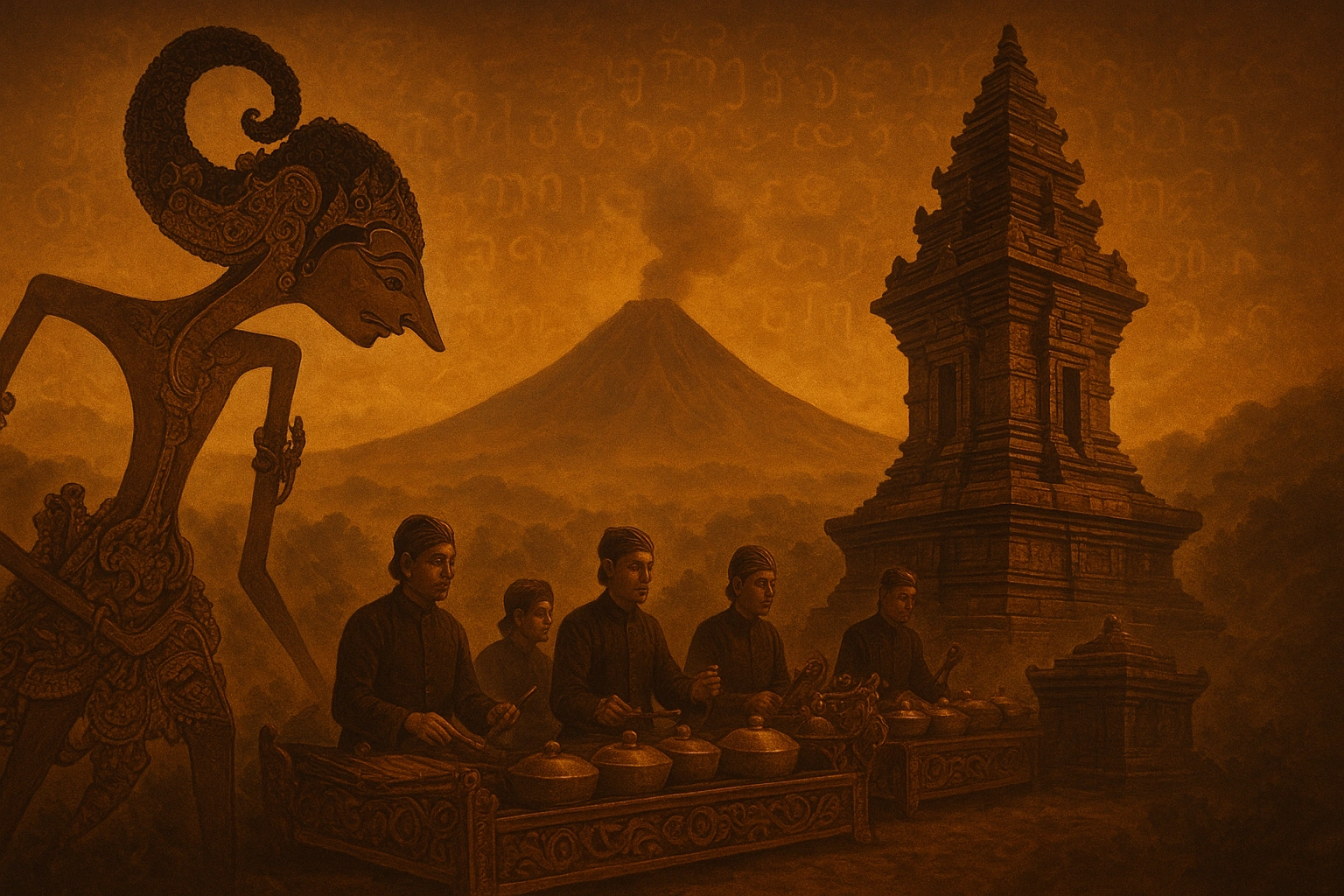
When you hear the word “Java,” what comes to mind? For most people in the Western world, it’s either a morning cup of coffee or a ubiquitous programming language. But what if I told you that these associations barely scratch the surface of Javanese culture, a living tradition that has shaped one of the world’s most populous nations? Javanese culture is not only about art or rituals—it is the heartbeat of the island. To understand Indonesia at its core, one must first look at Javanese culture, where philosophy, harmony, and spirituality meet. It is through Javanese culture that the island’s stories, values, and way of life reveal their depth.
My name is Ky Tutur, and as a Javanese culturalist, I’ve dedicated my life to understanding the intricate tapestry of Javanese culture and heritage. Java is the heart of Indonesia—an island of volcanoes, ancient temples, and sprawling cities where Javanese culture continues to shape daily life. It’s home to over 150 million people, making it the most populous island on Earth, and Javanese culture gives this vast population a shared sense of identity. At its core are the Javanese people, an ethnic group with traditions so deep and nuanced that Javanese culture can take a lifetime to fully grasp.
This isn’t just another travel guide. We’re going on a journey to the soul of Java, where Javanese culture shapes every layer of life. We’ll explore the philosophical underpinnings of our society, because Javanese culture is built on harmony, respect, and a deep connection to the unseen. We will decode the symbols in our art, where Javanese culture finds expression through shadow puppets, music, and intricate patterns. And we’ll understand the spiritual systems that guide our daily lives, for Javanese culture is not just tradition—it is a way of seeing the world. Forget the coffee for a moment. You’re about to meet the Javanese culture you’ve been missing.

Java vs. Javanese: Clearing Up the Common Confusion
First, let’s get a crucial distinction out of the way. It’s one of the most common points of confusion for newcomers to Indonesian culture.
- Java is the island. It’s a geographical and political hub in the vast archipelago of Indonesia. While it’s the center of the country’s economy and government (the capital, Jakarta, is on its northwest coast), not everyone from Java is ethnically Javanese.
- Javanese refers to the largest ethnic group originating from the central and eastern parts of the island. We have our own language (Basa Jawa), our own script, distinct social etiquette, arts, and belief systems.
The island of Java is also home to other major ethnic groups, like the Sundanese in the west and the Madurese off the northeast coast, each with their own unique languages and traditions. So, when we talk about Javanese culture, we are specifically referring to the rich heritage of the Javanese people. Understanding this difference is the first step to appreciating the incredible diversity of Indonesia itself.
The Philosophical Core: Harmony, Respect, and the Unseen World
To understand Javanese traditions, you must first understand the Javanese worldview. It’s not built on rugged individualism but on a deep-seated desire for social and spiritual harmony. Several core concepts guide our way of life:
- Rukun (Social Harmony): This is perhaps the most important social principle. Rukun is the state of peaceful coexistence and cooperation within a community. It means avoiding open conflict, showing mutual respect, and prioritizing the group’s well-being over individual desires. This is why Javanese people often appear polite, indirect, and measured in their interactions.
- Hormat (Respect): Respect is deeply embedded in our social structure and language. It’s not just about being polite; it’s about acknowledging a person’s age, status, and position. This is most evident in our language, which has complex speech levels that encode politeness and respect. You use different words when speaking to a close friend versus an elder or a person of high standing.
- Alus vs. Kasar (Refined vs. Coarse): Javanese culture places a high value on refinement (alus). This applies to behavior, speech, and even art. An alus person is one who is patient, graceful, and emotionally controlled. The opposite, kasar, describes behavior that is rude, crude, and disruptive to harmony.
Underpinning these social values is a spiritual foundation known as Kejawen (Javanism). It’s not a formal religion but a syncretic belief system that blends animism, Hinduism, Buddhism, and Sufi Islam. Kejawen focuses on an internal quest for spiritual enlightenment and a connection to the universe. It teaches that there is a spiritual dimension to everything, from a mighty banyan tree to the ringing in your ear, which can be interpreted as omens or messages from the unseen world.
A Tapestry of Traditions: Javanese Arts and Performance
The Javanese soul finds its most beautiful expression in its arts. These are not mere entertainment; they are vehicles for storytelling, moral education, and spiritual connection.
Wayang Kulit: More Than Just Shadow Puppets
Declared a Masterpiece of Oral and Intangible Heritage of Humanity by UNESCO, Wayang Kulit is the quintessential Javanese art form. It’s a mesmerizing performance where a master puppeteer, the dhalang, manipulates intricately carved leather puppets behind a screen, casting shadows to tell epic tales.
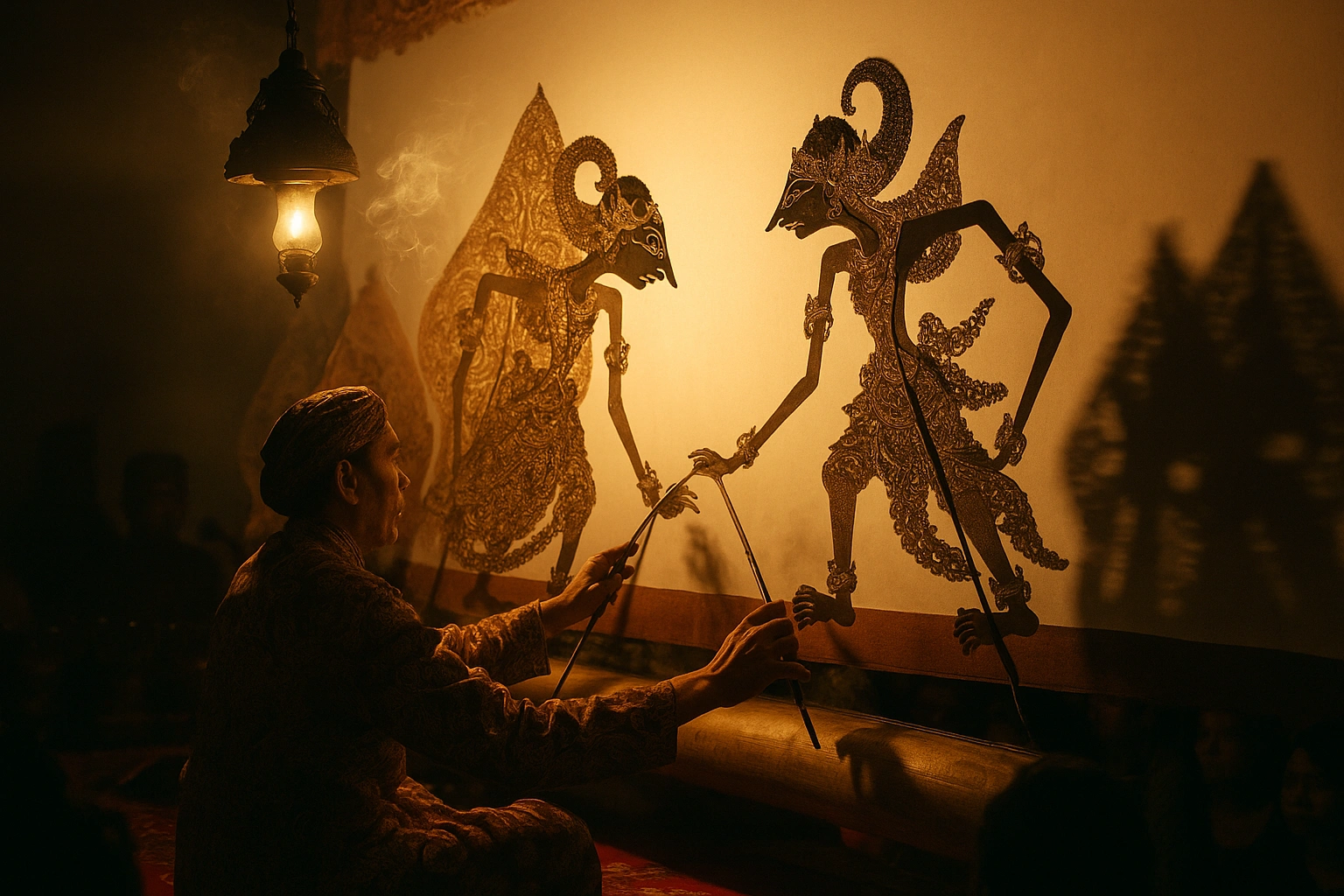
These stories are usually drawn from the Hindu epics, the Ramayana and Mahabharata, but they are infused with Javanese philosophy and contemporary social commentary. A single performance can last all night, serving as a communal gathering, a moral lesson, and a spiritual rite. The characters themselves are archetypes of human nature, not unlike the heroes you might see in modern Marvel comics, teaching us about virtue, vice, and the complexities of the human condition.
Gamelan: The Hypnotic Sound of Java
No Javanese ceremony is complete without the resonant, shimmering sound of the Gamelan. A Gamelan is not a single instrument but a complete orchestra of metallophones, gongs, drums, and sometimes stringed instruments and flutes. The music is cyclical, layered, and deeply meditative.
Each Gamelan set is considered a unified entity with its own spirit, and it’s often given a proper name. Playing in a Gamelan is a perfect exercise in rukun (harmony); each musician must listen intently to the others to create a seamless whole. The music is the heartbeat of Java, accompanying everything from royal court dances to village weddings.
The Javanese Calendar: Navigating Time and Destiny
One of the most fascinating and complex aspects of our culture is the Javanese calendar system. It’s not one calendar but a fusion of several, used to determine auspicious moments for every major life event, from planting rice to getting married.
The system’s core is the Wetonan, an astrological framework far more personal than the Western zodiac. Your Weton is determined by the intersection of two cycles on your day of birth:
- The seven-day week (Saptawara), inherited from the Gregorian calendar.
- The five-day market week, the Pasaran cycle (Pancawara).
This combination creates a 35-day cycle, and each day has a specific character and numerical value (neptu). A Javanese person’s Weton is central to their identity, believed to reveal their personality, strengths, weaknesses, and even their compatibility with a potential partner.
Want to know your Javanese birthday? You can use a Javanese Weton calculator to find out.
This is just the beginning. The Wetonan system is part of a larger cosmic map that includes:
- Wuku: A 210-day cycle made of 30 different seven-day weeks, each with its own name and characteristics, like Wuku Sinta or the final king, Wuku Watugunung.
- Pranata Mangsa: An ancient seasonal calendar based on astronomical observations, dividing the year into 12 seasons that guide agriculture and fishing. It’s a powerful tool for living in harmony with nature’s rhythms.
- Neptu: The numerical values assigned to days and Pasaran, which are used in complex calculations to find lucky days and avoid unlucky ones. These numbers hold powerful secrets to one’s fate and fortune.
For Javanese people, this calendar is a practical guide. It informs decisions both big and small, from choosing a wedding date to determining the best day to launch a business for maximum success. It’s a living tradition that connects us to the wisdom of our ancestors.
Language as a Map of Society
As mentioned earlier, the Javanese language (Basa Jawa) is a direct reflection of our social structure. The use of different vocabularies and grammatical structures based on who you’re speaking to is not optional—it’s a fundamental part of communication.
The main levels are:
- Ngoko: The informal, “low” level. Used with close friends, family, and people of equal or lower status.
- Krama: The formal and polite, “high” level. Used when addressing elders, strangers, or people of higher status. It is further divided into sub-levels for extreme refinement.
Mastering these levels is a sign of a well-raised Javanese person. It demonstrates an understanding of one’s place in society and a commitment to maintaining rukun. Even a few powerful Javanese phrases can open doors and show deep respect.
Alongside the spoken language is our traditional script, Aksara Jawa or Hanacaraka. This beautiful and complex script has a fascinating history and structure. While its daily use has declined in favor of the Latin alphabet, it remains a powerful symbol of our cultural identity and is still taught in schools in Javanese-majority regions. Learning about its seven fascinating facts reveals its philosophical depth.
Javanese Culture in the Modern World
Is this rich cultural heritage fading in the face of globalization? Not at all. While life in big cities like Yogyakarta or Surabaya is thoroughly modern, these traditions remain deeply ingrained.
You will see Gamelan played at university graduation ceremonies. Families still consult the Javanese calendar for important dates. The principles of rukun and hormat continue to shape Indonesian politics and business negotiations. As a study from the Journal of Ethnic and Cultural Studies highlights, local wisdom like this plays a vital role in maintaining social cohesion.
The government of Indonesia, through its Ministry of Education and Culture, actively works to preserve these traditions, recognizing them as a core part of the national identity. The challenge, as with any ancient culture, is to adapt and find relevance for new generations while preserving the authenticity of the old ways.
A World Beyond a Word
Javanese culture is a universe contained within an island. It’s a worldview that prioritizes community over the individual, harmony over conflict, and the spiritual over the material. Javanese culture sees time not as a linear arrow but as a repeating cycle of cosmic energy, and views art not as decoration but as a vital conduit for meaning and morality.
So, the next time you hear “Java,” I hope you’ll think of more than just a beverage or a line of code. Instead, remember Javanese culture through the haunting echo of a Gamelan orchestra, the flickering shadows of a Wayang puppet telling an age-old story, and a philosophy of life that has guided millions for centuries.
You’ve now taken the first step into a larger world. I invite you to explore Javanese culture further, to ask questions, and to see the profound beauty that lies just beneath the surface of Javanese culture itself.