Planning a wedding, launching a business, or making a big change in 2025? In Javanese culture, decisions are guided by Javanese lucky days, a tradition ensuring harmony and success. No house is built or marriage arranged without consulting the Primbon to find a Javanese lucky day. Aligning with Javanese lucky days helps balance practical outcomes and spiritual energy.
This system, far from being mere superstition, calculates the energetic quality of a day using Javanese lucky days, based on overlapping cycles of time. For those in Europe or the Americas, understanding Javanese lucky days can be confusing. The Javanese day changes at sunset, so even familiar dates carry different energies. Observing Javanese lucky days helps align actions with these subtle rhythms.
This guide helps bridge the gap for anyone curious about Javanese lucky days. You can use an interactive tool to convert any 2025 date into its Javanese equivalent and explore Javanese lucky days in your own time zone. The guide also explains the principles behind Javanese lucky days, including the Wuku cycle, and highlights the most auspicious Javanese lucky days of 2025 to plan your important moments with confidence.
The Gears of Time: What Makes a Javanese Day Lucky?
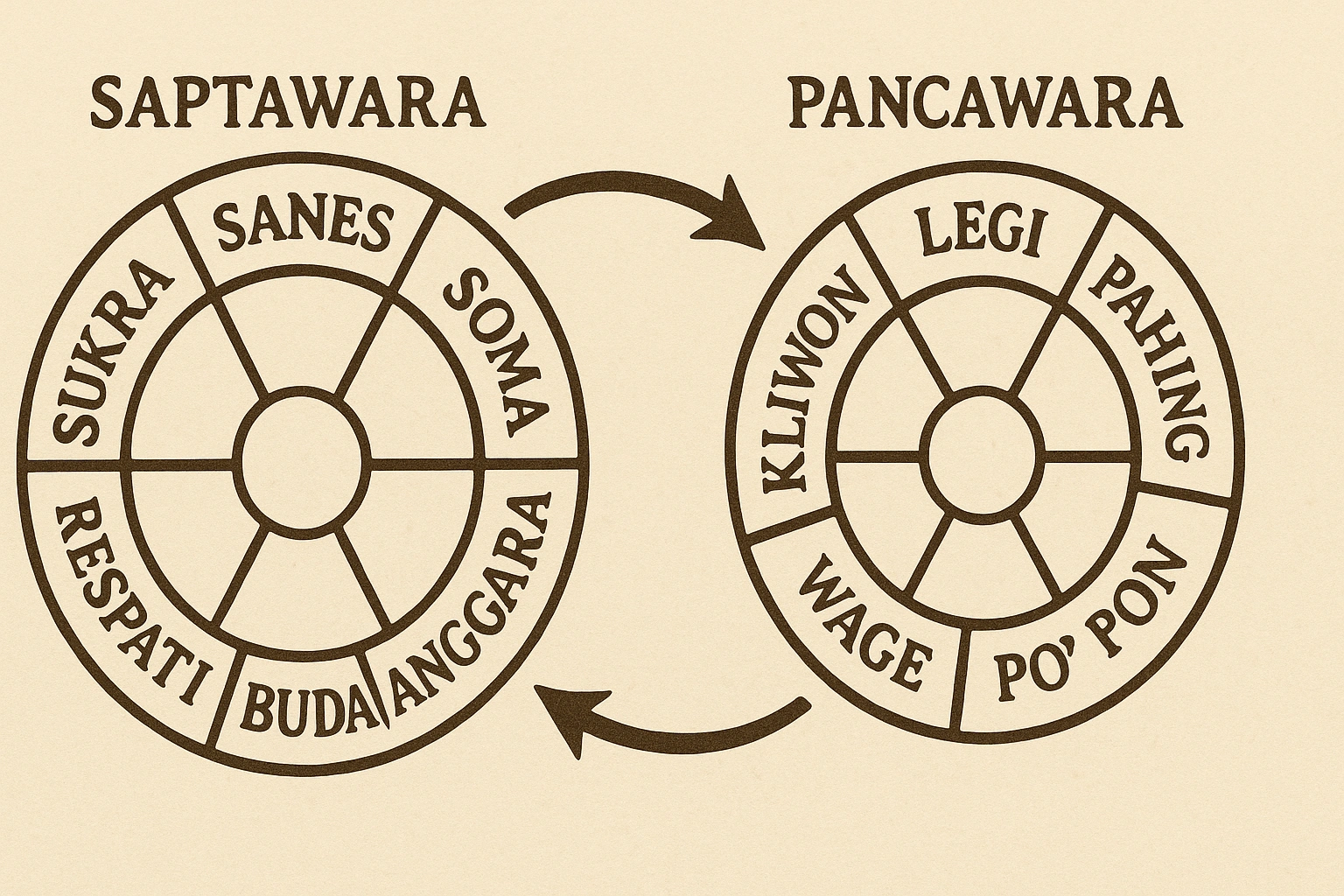
A “lucky day” in the Javanese tradition isn’t about random chance; it’s about favorable energy. This energy is determined by the intersection of multiple cosmic cycles. The most fundamental of these are the two cycles that create a person’s *Weton*.
- The 7-Day Cycle (Saptawara): This is the weekly cycle we all know (Monday, Tuesday, etc., or *Soma, Anggara, Budha…* in Javanese). Each day has a specific numerical value, or *neptu*, representing its energetic weight.
- The 5-Day Market Cycle (Pancawara/Pasaran): This is a uniquely Javanese cycle of five “market days”:
Legi,Pahing,Pon,Wage, andKliwon. Each of these days also has a *neptu* value and a philosophical meaning tied to cardinal directions and colors, representing different aspects of life’s energy.
The combination of these two cycles creates your Weton—your Javanese spiritual birthday. The luck of any given day is determined by adding the *neptu* of the 7-day cycle and the 5-day cycle. This sum is the day’s total Neptu Dina.
Formula: Neptu Saptawara + Neptu Pancawara = Neptu Dina (Day’s Power)
A higher Neptu Dina generally signifies a more powerful day with more potent energy, suitable for major undertakings. A lower Neptu suggests a time for introspection, rest, or routine tasks. Here are the values:
Saptawara (7-Day) Neptu
- Sunday (Minggu): 5
- Monday (Senin): 4
- Tuesday (Selasa): 3
- Wednesday (Rabu): 7
- Thursday (Kamis): 8
- Friday (Jumat): 6
- Saturday (Sabtu): 9
Pancawara (5-Day) Neptu
- Legi: 5
- Pahing: 9
- Pon: 7
- Wage: 4
- Kliwon: 8
The Bigger Picture: The 210-Day Wuku Cycle
Beyond the daily Neptu, the Javanese calendar incorporates a much larger cycle: the 210-day Pawukon, or Wuku cycle. This calendar consists of 30 weeks (*wuku*), each lasting 7 days. Every *wuku* has a unique name, a guardian deity, and a distinct set of characteristics, defining the general “theme” or quality of that week.
Think of the Neptu Dina as the daily “weather”—the immediate energy. The *Wuku* is the overarching “season”—the broader energetic climate. A day with a high Neptu falling within a favorable *wuku* is considered exceptionally auspicious. Conversely, even a high-Neptu day can be problematic if it falls within a calamitous *wuku* like *Wuku Wayang*, a week considered prone to accidents and misfortune. You can explore the characteristics of all 30 weeks in our guide to Wuku meanings.
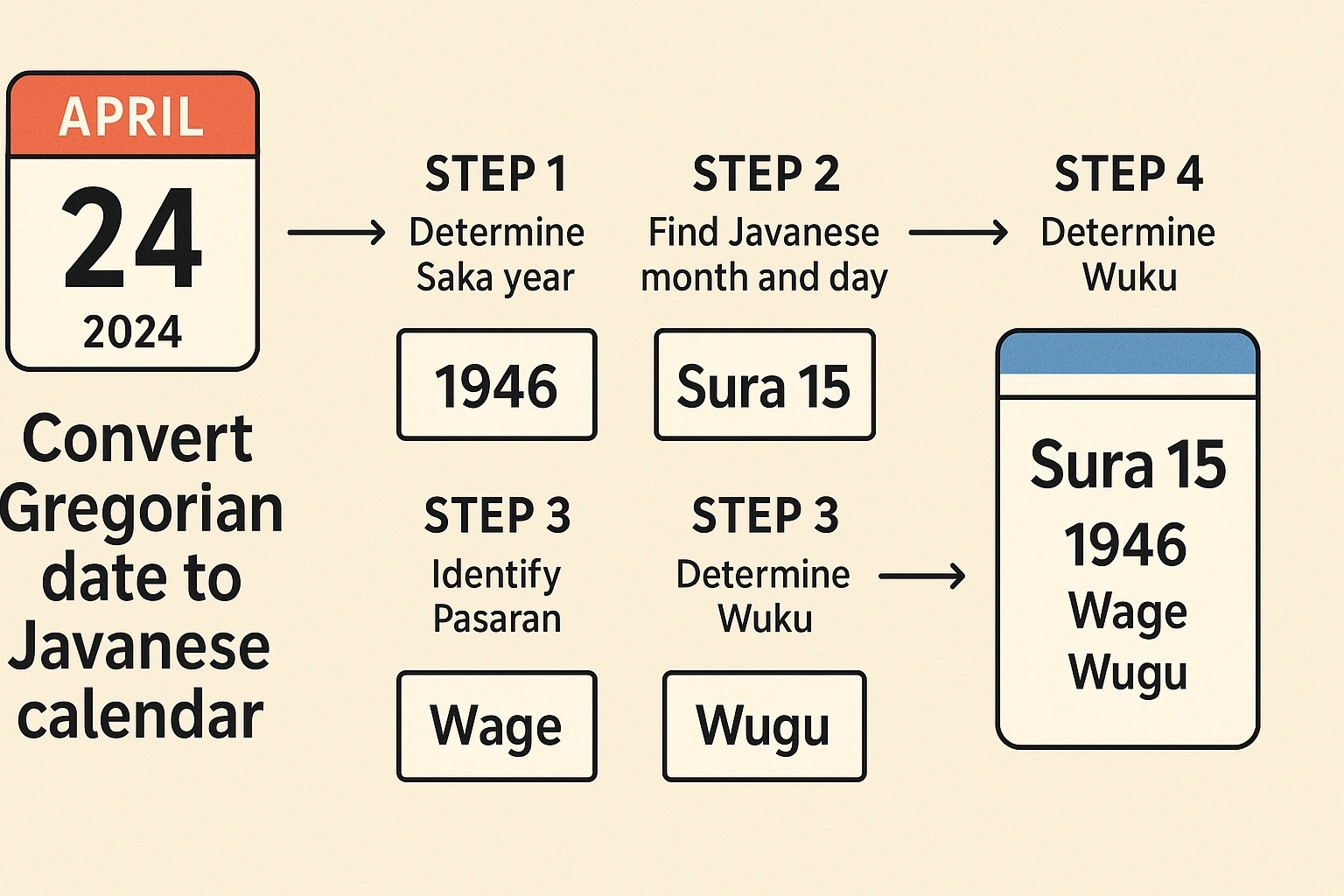
Javanese Day Converter for 2025
Because the Javanese day changes at sunset in Java (approx. 18:00 WIB / UTC+7), a date that is Tuesday in New York might already be Wednesday in Javanese reckoning. Use this tool to find the correct Javanese day and its Neptu for any date in 2025 from your local time zone.
Key Javanese Lucky Days in 2025
While the tool above lets you check any day, some days are universally considered powerful based on high Neptu values or special spiritual significance. Here are some of the most auspicious dates to watch for in 2025.
(Note: These correspond to the Javanese day, which may start on the previous evening in Western time zones.)
The dates marked with (Highest Neptu) like Sabtu Pahing (Neptu 18) represent the peak of cosmic energy, ideal for the most significant undertakings where you need a powerful push for success. Dates marked Anggara Kasih are spiritually potent and best used for reflection.
| Month | Auspicious Dates & Notes |
|---|---|
| January | 1 (Rabu Kliwon, Neptu 15), 10 (Jumat Kliwon, Neptu 14), 11 (Sabtu Legi, Neptu 14), 20 (Senin Pon, Neptu 11), 21 (Selasa Kliwon, Neptu 11 – Anggara Kasih), 30 (Kamis Pon, Neptu 15). A powerful start to the year. |
| February | 2 (Minggu Kliwon, Neptu 13), 8 (Sabtu Pahing, Neptu 18 – Highest Neptu), 11 (Selasa Wage, Neptu 7), 17 (Senin Legi, Neptu 9), 26 (Rabu Legi, Neptu 12). |
| March | 7 (Jumat Kliwon, Neptu 14), 15 (Sabtu Wage, Neptu 13), 17 (Senin Kliwon, Neptu 12), 26 (Rabu Pon, Neptu 14), 28 (Jumat Wage, Neptu 10). |
| April | 3 (Kamis Kliwon, Neptu 16), 12 (Sabtu Kliwon, Neptu 17), 22 (Selasa Pon, Neptu 10), 25 (Jumat Kliwon, Neptu 14). Good for new beginnings and planting seeds, both literally and metaphorically. |
| May | 1 (Kamis Pahing, Neptu 17), 10 (Sabtu Pon, Neptu 16), 19 (Senin Wage, Neptu 8), 28 (Rabu Kliwon, Neptu 15), 30 (Jumat Legi, Neptu 11). |
| June | 6 (Jumat Pahing, Neptu 15), 15 (Minggu Pon, Neptu 12), 24 (Selasa Kliwon, Neptu 11 – Anggara Kasih). A spiritually significant month for inner work. |
| July | 3 (Kamis Legi, Neptu 13), 4 (Jumat Pahing, Neptu 15), 12 (Sabtu Legi, Neptu 14), 22 (Selasa Wage, Neptu 7). Focus on relationships and community building. |
| August | 1 (Jumat Pon, Neptu 13), 9 (Sabtu Kliwon, Neptu 17), 18 (Senin Pahing, Neptu 13), 27 (Rabu Pon, Neptu 14), 29 (Jumat Wage, Neptu 10). |
| September | 5 (Jumat Kliwon, Neptu 14), 6 (Sabtu Legi, Neptu 14), 15 (Senin Pon, Neptu 11), 23 (Selasa Kliwon, Neptu 11 – Anggara Kasih), 25 (Kamis Legi, Neptu 13). A month of harvest and gratitude. |
| October | 3 (Jumat Pahing, Neptu 15), 11 (Sabtu Pon, Neptu 16), 21 (Selasa Pahing, Neptu 12), 24 (Jumat Kliwon, Neptu 14), 31 (Jumat Legi, Neptu 11). |
| November | 8 (Sabtu Pahing, Neptu 18 – Highest Neptu), 17 (Senin Kliwon, Neptu 12), 18 (Selasa Legi, Neptu 8), 26 (Rabu Pon, Neptu 14). A very powerful month for ambitious goals. |
| December | 4 (Kamis Kliwon, Neptu 16), 6 (Sabtu Legi, Neptu 14), 13 (Sabtu Pahing, Neptu 18 – Highest Neptu), 22 (Senin Kliwon, Neptu 12), 31 (Rabu Pahing, Neptu 16). End the year with strong, decisive energy. |
Conclusion: Planning with Intention
The Javanese calendar is not a tool for predicting a fixed future, but a guide for acting in harmony with the present cosmic energies. It invites a deeper awareness of time itself. By understanding the Neptu of a day and the character of its reigning Wuku, you can choose to align your actions with the prevailing rhythm of the universe. A high-Neptu day can provide a powerful tailwind for a new venture, while a low-Neptu day might be the perfect time for quiet reflection and planning.
Use the converter and calendar to explore Javanese lucky days and how they influence your energy. Notice how Javanese lucky days with high Neptu feel expansive, while other Javanese lucky days encourage reflection. Over time, observing Javanese lucky days builds intuition, helping you align your actions with the rhythm of Javanese lucky days. This practice allows you to move through life with mindfulness, intention, and harmony with the cosmos.
Frequently Asked Questions (FAQ)
1. Why does the Javanese day change at sunset?
This is rooted in ancient lunar-solar calendar traditions where the new day begins with the sighting of the new moon at dusk. It reflects a worldview where the evening is the start of a new period of time, not the end of the old one. Our converter tool automatically accounts for this based on your time zone.
2. Can I use this to pick a wedding date?
Yes, this is a very common use. A “lucky day” provides a favorable energetic foundation for the marriage. However, a full Javanese wedding date consultation also involves calculating the Weton compatibility between the bride and groom and ensuring the chosen date does not fall within certain unlucky Wuku cycles for either partner.
3. What does “Anggara Kasih” mean?
Anggara Kasih is the name for any Tuesday (*Selasa*) that falls on a Kliwon market day. It is considered an exceptionally sacred and spiritually potent day, perfect for meditation, prayer, visiting sacred sites, and honoring ancestors, but generally avoided for worldly affairs like business or parties.
4. What if a day is “unlucky”?
In Javanese thinking, few days are truly unlucky, especially when considering Javanese lucky days. A low-Neptu day on the Javanese lucky days calendar isn’t bad; it simply calls for rest or routine. Observing Javanese lucky days helps guide when to pause, reflect, or plan, while high-Neptu Javanese lucky days mark the best moments for major projects. Following Javanese lucky days ensures decisions align with favorable energy.Truly unlucky days, known as *dina ala*, are often identified by their position within a difficult *Wuku* or other complex calculations. You can find more details in our guide to Javanese unlucky days.