By Ky Tutur, Javanese Culturalist • Last Updated: 2025-09-26
Want to start learning Javanese? Forget complicated grammar for a minute. The absolute best place to start is with the numbers. Why? Because **Javanese numbers** are logical, filled with easy-to-spot patterns, and immediately useful. Whether you’re trying to buy something at a market or understand a date on the Javanese calendar, numbers are your first step to practical fluency.
This isn’t your average, boring vocabulary list. This cheat sheet is made to help you understand Javanese numbers and learn the patterns so you can memorize Javanese numbers quickly. We’ll explore how Javanese numbers work from 1 to 100 and cover the essential building blocks for Javanese numbers in everyday use.
For this guide, we focus on the Ngoko (informal) level, which is the most common way to use Javanese numbers in conversation. By starting here, you’ll get comfortable with Javanese numbers that you’ll actually hear and use every day.
The Building Blocks: Counting from 1 to 10
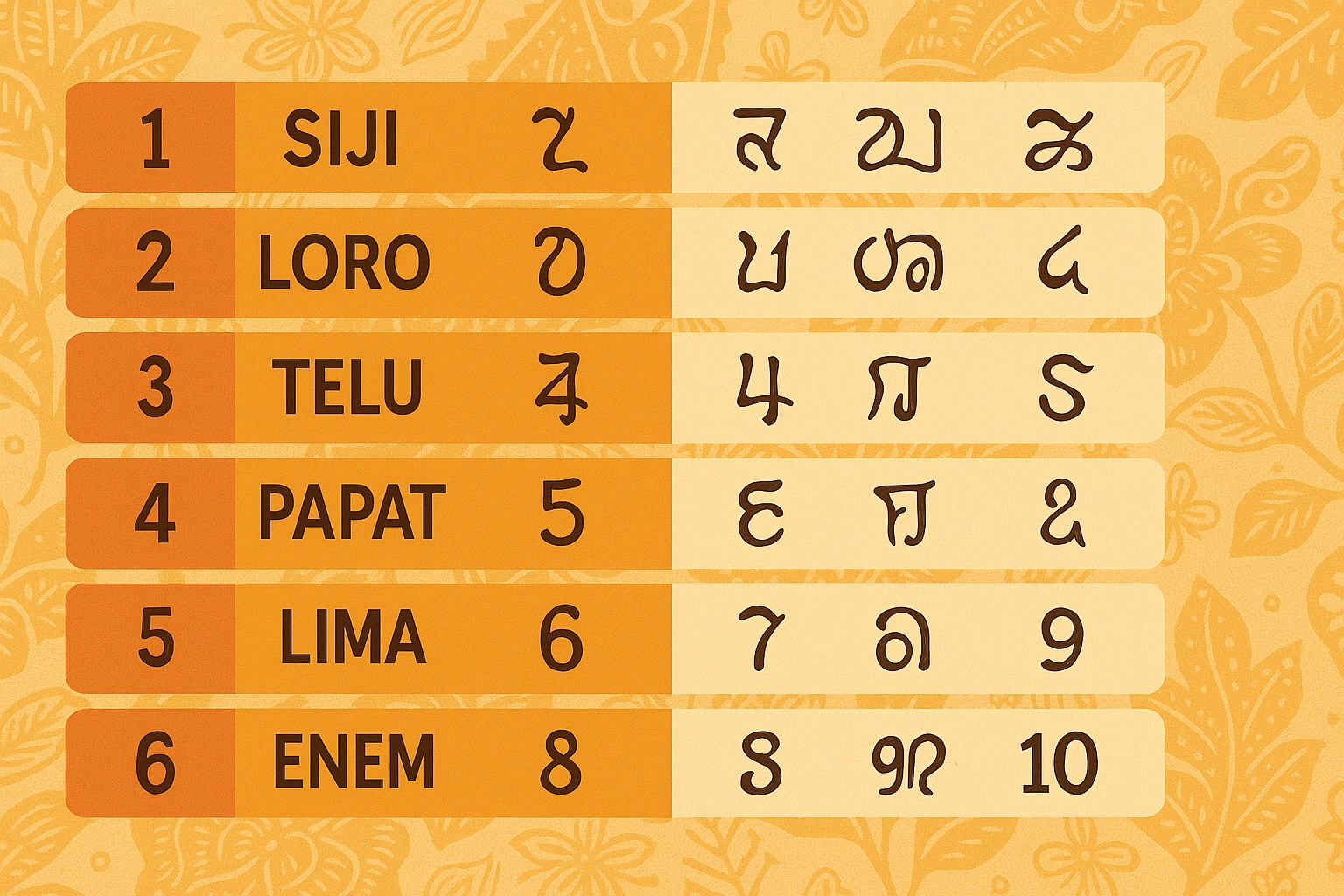
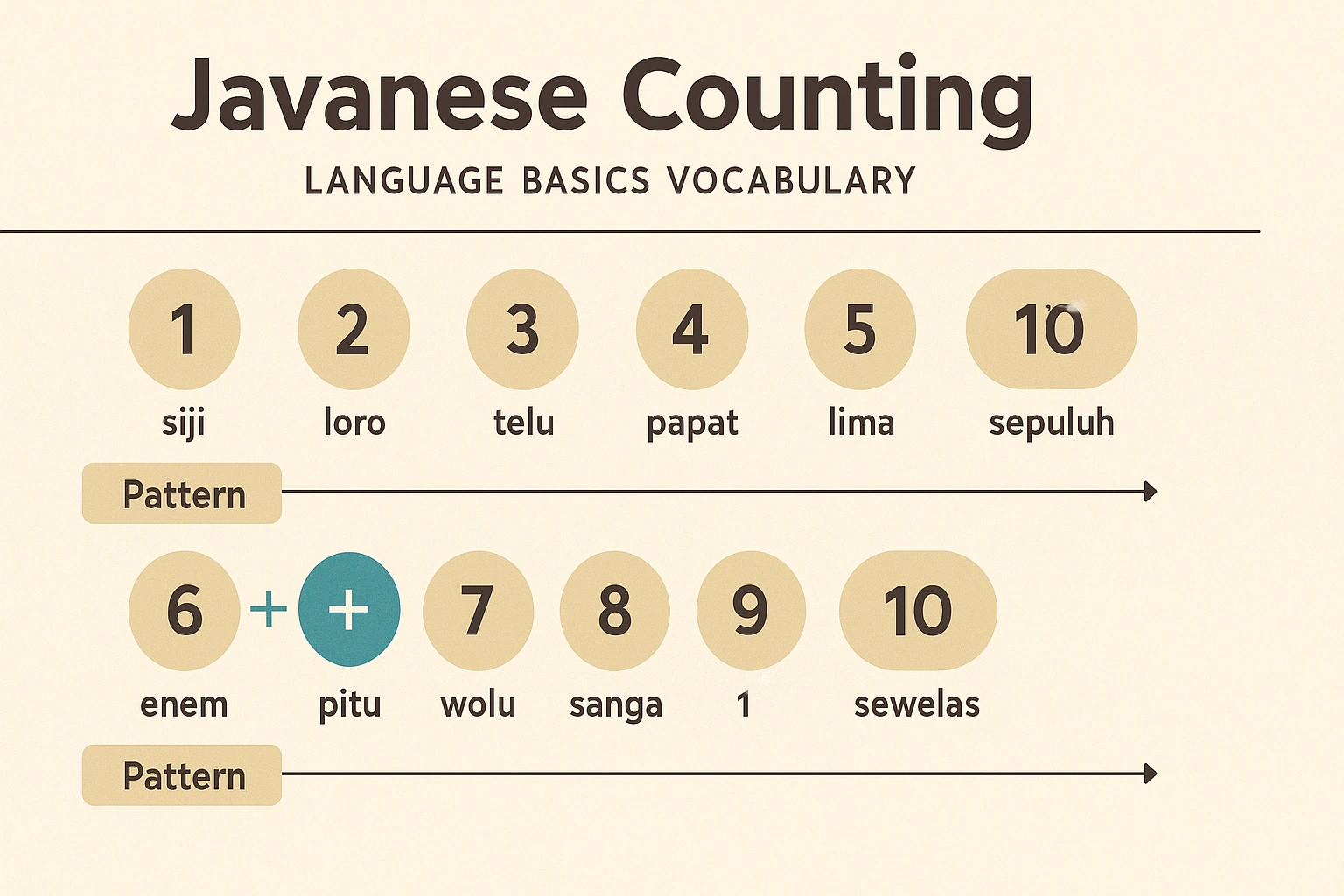
Everything starts here. Once you master these first ten numbers, you have the foundation for almost every other number. Memorize them, write them down, say them out loud. These are your keys to the system.
| Number | Javanese (Ngoko) | Pronunciation Guide |
|---|---|---|
| 1 | Siji | (see-jee) |
| 2 | Loro | (lo-ro) |
| 3 | Telu | (te-loo) |
| 4 | Papat | (pa-pat) |
| 5 | Lima | (lee-mo) |
| 6 | Enem | (e-nem) |
| 7 | Pitu | (pee-too) |
| 8 | Wolu | (wo-loo) |
| 9 | Sanga | (so-ngo) |
| 10 | Sepuluh | (se-poo-looh) |
The Teens: Numbers 11 to 19
The “teens” in Javanese follow a beautiful pattern. You simply take the root number (from 2 to 9) and add the suffix **-welas**. Think of “-welas” as the Javanese equivalent of “-teen.” There’s only one special number here: 11.
| Number | Javanese (Ngoko) | Breakdown |
|---|---|---|
| 11 | Sewelas | *Special form* |
| 12 | Rolas | Loro + welas |
| 13 | Telulas | Telu + welas |
| 14 | Patbelas | Papat + welas |
| 15 | Limalas | Lima + welas |
| 16 | Nembelas | Enem + welas |
| 17 | Pitulas | Pitu + welas |
| 18 | Wolulas | Wolu + welas |
| 19 | Sangalas | Sanga + welas |
The Roaring Twenties: Numbers 20 to 29
The twenties have their own unique and interesting system. Instead of using the number for “two,” it uses a special prefix `rong-` for 20. The numbers from 21 to 29 then use another special suffix: **-likur**. This is a unique feature of Javanese counting.
| Number | Javanese (Ngoko) | Breakdown |
|---|---|---|
| 20 | Rongpuluh | *Special form for 20* |
| 21 | Selikur | Siji + likur |
| 22 | Rolikur | Loro + likur |
| 23 | Telulikur | Telu + likur |
| …and so on up to 29… | ||
| 25 | Selawe | *Very special form* |
| 29 | Sanga likur | Sanga + likur |
The Tens: 30, 40, 50… All the Way to 100
From 30 onwards, the pattern becomes much more regular. You combine the root number with the word for ten, **puluh**. The formula is simple: **(Number) + puluh**. However, just like English has “thirty” instead of “three-ten,” Javanese has some contractions. There are also two more very special numbers to learn: 50 and 60.

| Number | Javanese (Ngoko) | Breakdown |
|---|---|---|
| 30 | Telung puluh | Telu + puluh |
| 40 | Patang puluh | Papat + puluh |
| 50 | Sèket | *Special form* |
| 60 | Sewidak | *Special form* |
| 70 | Pitung puluh | Pitu + puluh |
| 80 | Wolung puluh | Wolu + puluh |
| 90 | Sangang puluh | Sanga + puluh |
| 100 | Satus |
Putting It All Together: Counting from 31 to 99
This is where it all clicks into place. To say any number from 31-99 (that isn’t a special form), you just combine the “ten” with the “unit.” The formula is:
**(The Ten)** + **(The Unit 1-9)**
Let’s see some examples:
- 31 is Telung puluh siji (30 + 1)
- 45 is Patang puluh lima (40 + 5)
- 78 is Pitung puluh wolu (70 + 8)
- 99 is Sangang puluh sanga (90 + 9)
A Quick Note: Ngoko vs. Krama (Politeness Levels)
Javanese is famous for its politeness levels, and this also applies to Javanese numbers. The numbers we’ve learned are Ngoko, the informal Javanese numbers used with friends and family. There is also a formal version called Krama, which has its own set of Javanese numbers for elders or people of high status. You don’t need to memorize Krama numbers right away, but it’s helpful to know that Javanese numbers can change depending on context. For example, the Ngoko number loro (two) becomes kalih in Krama, showing how Javanese numbers reflect both counting and social respect.