
By Ky Tutur, Javanese Culturalist • Published on
At first glance, it’s a dagger. An asymmetrical blade, often wavy, with an ornate hilt. But to call a Javanese Keris just a weapon is like calling a cathedral just a building. It’s a profound understatement. The Keris is a spiritual object, a status symbol, a family heirloom, and a masterpiece of metallurgical art. Exploring the Keris meaning reveals its deeper purpose. Understanding the Keris meaning helps uncover the layers of Javanese philosophy and spirituality. Each piece carries its own Keris meaning, connecting social status, ancestry, and culture. Truly appreciating the Keris meaning is to see it not just as a blade, but as a living symbol of Javanese heritage.
This iconic Javanese dagger is not merely an artifact confined to museums; it is a living piece of heritage that continues to hold immense power and significance in modern Indonesia. Recognized by UNESCO as a Masterpiece of the Oral and Intangible Heritage of Humanity, the Keris is a physical manifestation of the soul of Java. This guide will take you beyond the blade to explore its true essence, from its ancient origins to its place in the modern world.
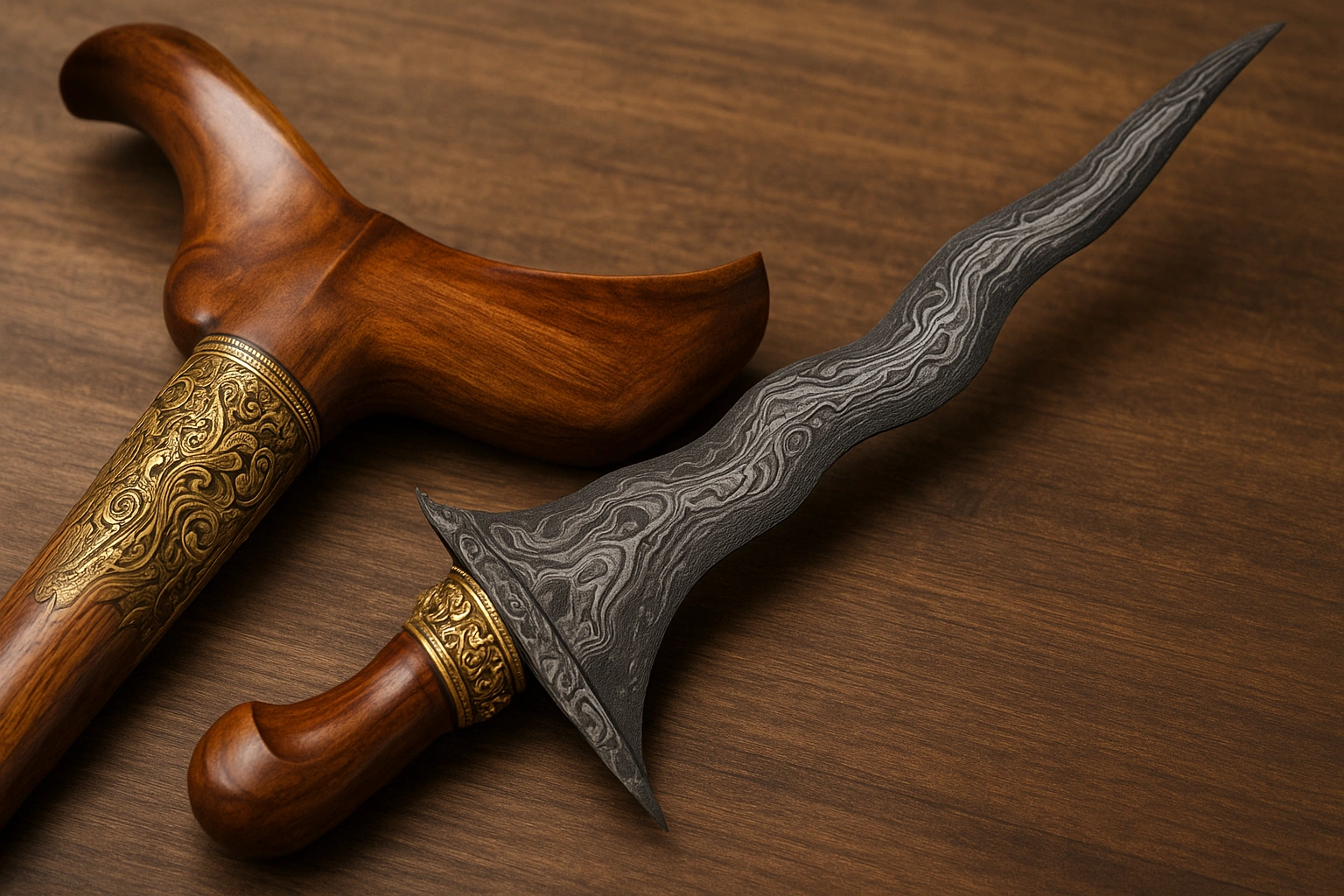
A Weapon Forged in Legend: The Origins of the Keris
The history of the Keris is shrouded in myth, its origins tracing back to the great Javanese kingdoms. While early dagger forms existed, the Keris as we know it is believed to have gained prominence during the Majapahit Empire (c. 1293–1527), a golden age of Javanese culture and power. Legends speak of celestial blacksmiths and powerful rulers whose fates were tied to these mystical blades. One of the most famous tales is that of Mpu Gandring, a legendary *empu* who forged a cursed Keris that led to the rise and fall of a dynasty.
Archaeological evidence, such as carvings on temples like Borobudur and Prambanan, depicts early versions of the dagger, suggesting its roots are even deeper. The Keris evolved from a simple tool of combat into a complex spiritual and social object, a process that mirrored the increasing sophistication of Javanese civilization itself. It became a marker of identity, connecting its owner to their ancestors, their social rank, and their spiritual destiny.
The Anatomy of Power: Deconstructing the Keris
To truly grasp the keris meaning, you must understand its parts. Each component is a canvas for symbolism and craftsmanship, a language unto itself.
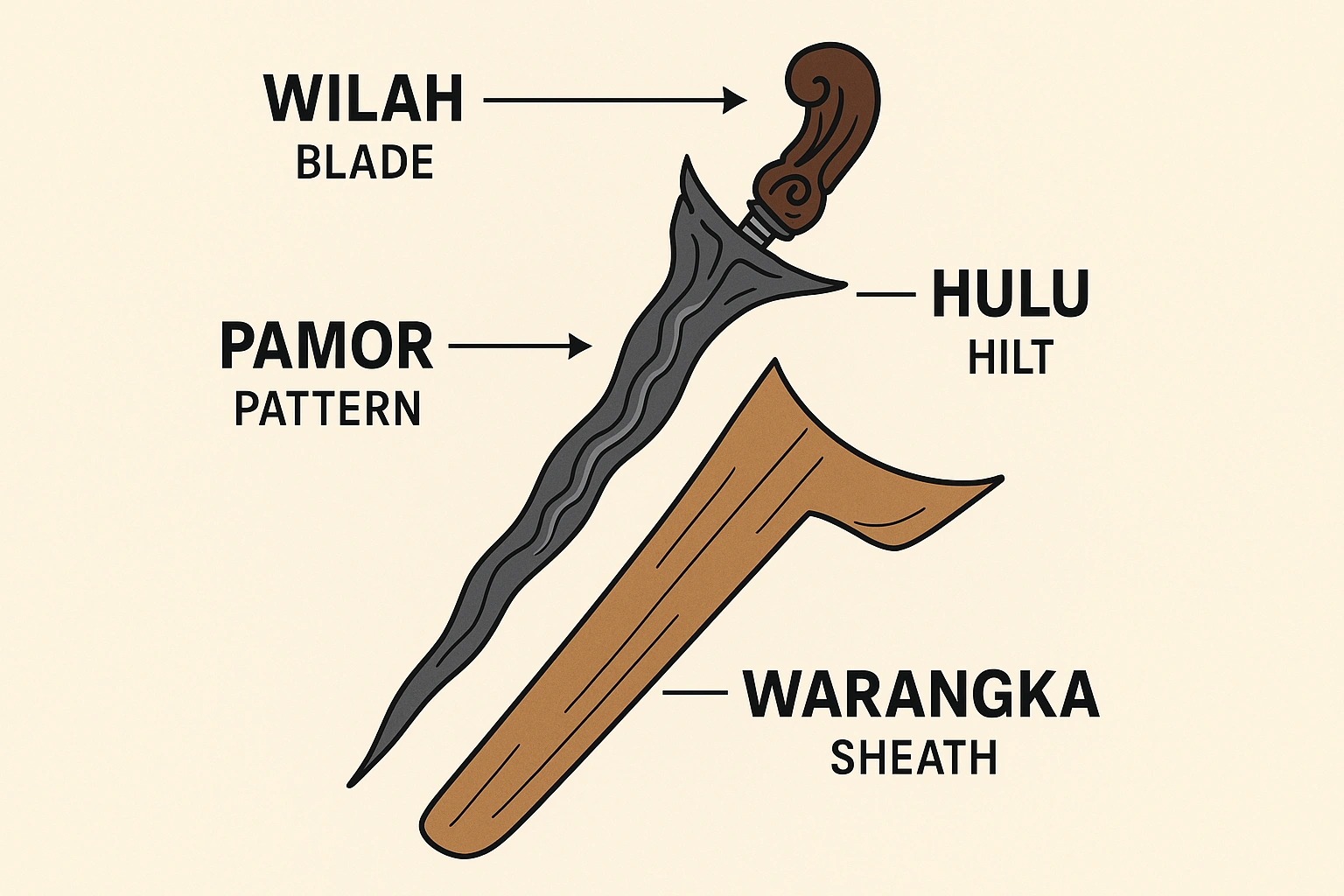
1. The Blade (Wilah) – The Soul
The blade is the Keris’s core. It can be straight (*dapur bener*) or wavy (*dapur luk*). This is not an aesthetic choice; it’s deeply symbolic:
- Straight Blade: Represents stability, discipline, single-mindedness, and devotion. It symbolizes a person at rest, in meditation, or firm in their convictions. It is the embodiment of spiritual tranquility and focus.
- Wavy Blade: The number of waves (*luk*) is always odd (from 3 to 29) and highly significant. A wavy blade symbolizes action, dynamism, and a serpent in motion (*naga*), representing worldly life and ambition. Each number of *luk* carries a specific meaning: *Luk 3* can symbolize success in endeavors, *Luk 7* charisma and authority, and *Luk 13* stability in power. A higher number of *luk* often denoted higher status for the owner.
2. The Pattern (Pamor) – The Spirit
The most magical aspect of the Keris is its *pamor*, the intricate, watered-steel pattern on the blade. This is not etched or engraved. It is created by forge-welding layers of different metals, typically iron and nickel-rich iron (historically sourced from meteorites, which was believed to add a celestial element). The *empu* folded these layers hundreds or even thousands of times, a process that creates patterns with specific meanings and supposed magical properties. According to a study on the metallurgy of Keris blades published in the journal *Archaeometry*, this technique is a highly sophisticated form of pattern welding.
There are two main categories of pamor creation: *Pamor Mlumah* (flat patterns) and *Pamor Miring* (angled or tilted patterns), the latter requiring immense skill. Each pattern is a prayer in metal.
Popular Pamor Meanings:
– Beras Wutah (“Spilled Rice”): The most common pattern, believed to bring prosperity, contentment, and ensure the owner never lacks for basic needs.
– Wengkon (“Frame”): A pattern that runs along the edge of the blade, thought to protect the owner from danger, bad luck, and extravagance.
– Udan Mas (“Golden Rain”): A sought-after, complex pattern of circles, believed to attract wealth and fortune, making it popular among merchants.
– Naga Rangsang (“Aroused Dragon”): Believed to enhance the owner’s authority and command respect.
3. The Hilt (Ukiran) and Sheath (Warangka)
The hilt and sheath complete the Keris’s identity. The hilt (*ukiran*) could be made from wood, ivory, or precious metals and was often carved into symbolic figures (though rarely human forms, in adherence to Islamic principles). Hilt styles vary by region, with the elegant, slender hilts of Yogyakarta differing from the fuller forms of Surakarta (Solo). The sheath (*warangka*) protects the blade and its spirit. Its shape often indicated the owner’s social context. The large, boat-shaped *Ladrang* style was for formal court occasions, while the simpler, kidney-bean-shaped *Gayaman* style was for daily wear. To learn more about Javanese symbolism, exploring Javanese batik meanings can provide deeper cultural context.
The Mystical Empu: A Blacksmith and a High Priest
A Keris is only as powerful as its maker. The *empu* is not just a blacksmith; he is a spiritual leader, a mystic who channels divine energy into the blade. In traditional Javanese society, the *empu* held a status comparable to a priest or scholar. The process of creating a Keris (*nempa*) is a deeply spiritual act involving:
- Ritual Cleansing: The *empu* often fasts, prays, and meditates for days or weeks to achieve a state of spiritual purity before starting.
- Astrological Calculation: A favorable day and time are chosen using the complex Javanese calendar system to ensure the Keris is born under auspicious cosmic influences.
- Offerings (*Sajen*): Flowers, incense, and food are offered to appease spirits and ask for blessings upon the work.
- Infusion of Intent: As the *empu* hammers and folds the metal, he whispers prayers (*mantra*) and focuses his intention, embedding a specific purpose or “spirit” (*isi*) into the blade—be it for protection, authority, or prosperity.
This sacred process is why a true Keris is considered a *pusaka* (heirloom) with a soul, distinct from a factory-made souvenir.
The Living Blade: Caring for a Keris
Owning a Keris is a responsibility, and understanding the Keris meaning deepens that awareness. Because it is believed to have a spirit, proper care reflects the Keris meaning. This care is both physical and spiritual, embodying the Keris meaning in daily practice. Once a year, typically during the month of Suro (the Javanese New Year), the Keris undergoes a ritual cleansing known as Jamasan Pusaka, which highlights the Keris meaning. The blade is carefully washed with coconut water and lime juice to remove rust and old oil, then re-examined. Afterward, it is anointed with special aromatic oil, a blend often containing sandalwood and jasmine, to nourish its spirit and honor the Keris meaning.
These rituals are not just about preservation; they are about maintaining the relationship between the owner and the heirloom. It is an act of respect for the ancestors who passed it down and for the spirit believed to reside within.
The Keris Today: From Battlefield to Wedding Hall
While no longer used in combat, the Keris remains a potent symbol in Javanese society. It is a mandatory part of the formal attire for men at significant events, especially weddings. The groom, dressed like a king for a day, will have a Keris tucked into his back, symbolizing his readiness to protect his new family. For insights into these traditions, see our article on magical Javanese wedding traditions.
Today, the Javanese dagger is also a highly prized collector’s item, and understanding the Keris meaning adds depth to its value. Antique and masterfully made pieces reflect the Keris meaning through their design and symbolism. Each blade carries a unique Keris meaning, connecting the owner to their ancestors and cultural heritage. The craft of the empu continues to embody the Keris meaning, and renewed interest among younger generations ensures this art form survives and thrives into the future.
Conclusion: More Than an Object
The Keris meaning transcends its physical form and goes deeper into art, science, and spirituality. Understanding the Keris meaning helps reveal the Javanese worldview: a balance between the physical and the metaphysical, the practical and the symbolic. Each blade carries its own Keris meaning, telling a story of power, status, and philosophy. Exploring the Keris meaning allows you to sense the deep spiritual currents flowing through the heart of Java.
So the next time you see a Keris, think about its Keris meaning beyond the sharp edge. See the prayers of the empu captured in the steel, the lineage of a family in its worn hilt, and the soul of a culture in its elegant, asymmetrical form. It is not just an object; it is a key to understanding the Javanese soul itself.