
Rasa Jawa is a philosophical concept transcending mere emotion. Understand how inner silence opens the gateway to true consciousness and the profound spiritual wisdom of the Nusantara.
The Unheard Voice
“Rasa is not a word. It holds no sound, yet it can bring the world to silence.”
— Ky Tutur
We live in an age overflowing with sound. A deluge of information floods our senses every second. There’s a cacophony of opinions echoing, and a riot of reactions sparking commotion. Yet, amidst this ceaseless hustle and bustle, one voice is slowly fading: the voice of rasa (a profound Javanese concept that transcends mere emotion or feeling; it refers to an inner sense, a deeper understanding, intuition, and spiritual awareness).
In Javanese culture, rasa is not merely a fleeting emotion or temporary sensation that comes and goes. Rasa Jawa (the philosophical concept of ‘Rasa’ deeply rooted in Javanese culture and wisdom) is a philosophical concept far deeper and more fundamental. It is a doorway, not a destination. A gateway to higher understanding, to wisdom, and most importantly, to true consciousness. Those who are able to feel with clarity, without bias, without prejudice, are the ones who will discover the path to self-enlightenment.
Javanese ancestors taught that external noise often prevents us from hearing our inner voice. Therefore, it is essential to cultivate silence, both outwardly and inwardly. Only in this profound stillness can true rasa emerge and speak. This is a practice, a laku (a Javanese term referring to spiritual practice, discipline, or an inner journey often involving austerity and introspection), that demands patience and profound sensitivity. Those who can cultivate this Rasa Jawa are believed to possess extraordinary inner tranquility, unshaken by the world’s turbulence.
This page will guide you to understand what Rasa Jawa is, how it is divided into several layers, and most importantly, how it can be the key to unlocking the consciousness that may have been hidden beneath life’s clamor. Prepare to delve into dimensions of stillness and feel the voice that has never been heard, yet is most meaningful.
What is Rasa in Kawruh Jawa?
Understanding the Essential Meaning of Rasa in Kawruh Jawa
Elder Javanese often used to say, “dirasakna, aja mung dipikir.” This translates to: “don’t just think about it, but feel it.” This simple phrase encapsulates the essence of Rasa Jawa philosophy. It is not merely an invitation to use one’s heart, but to activate a higher inner sense, capable of capturing subtle vibrations unseen by the eye or unheard by the ear.
In Javanese philosophy, rasa is not a singular concept. It is divided into three interconnected layers, reflecting the depth of human understanding about existence and its relationship with the universe. Understanding these three layers of Rasa Jawa is the key to achieving harmony in life:
Three Layers of Rasa Jawa: From Self to Cosmos
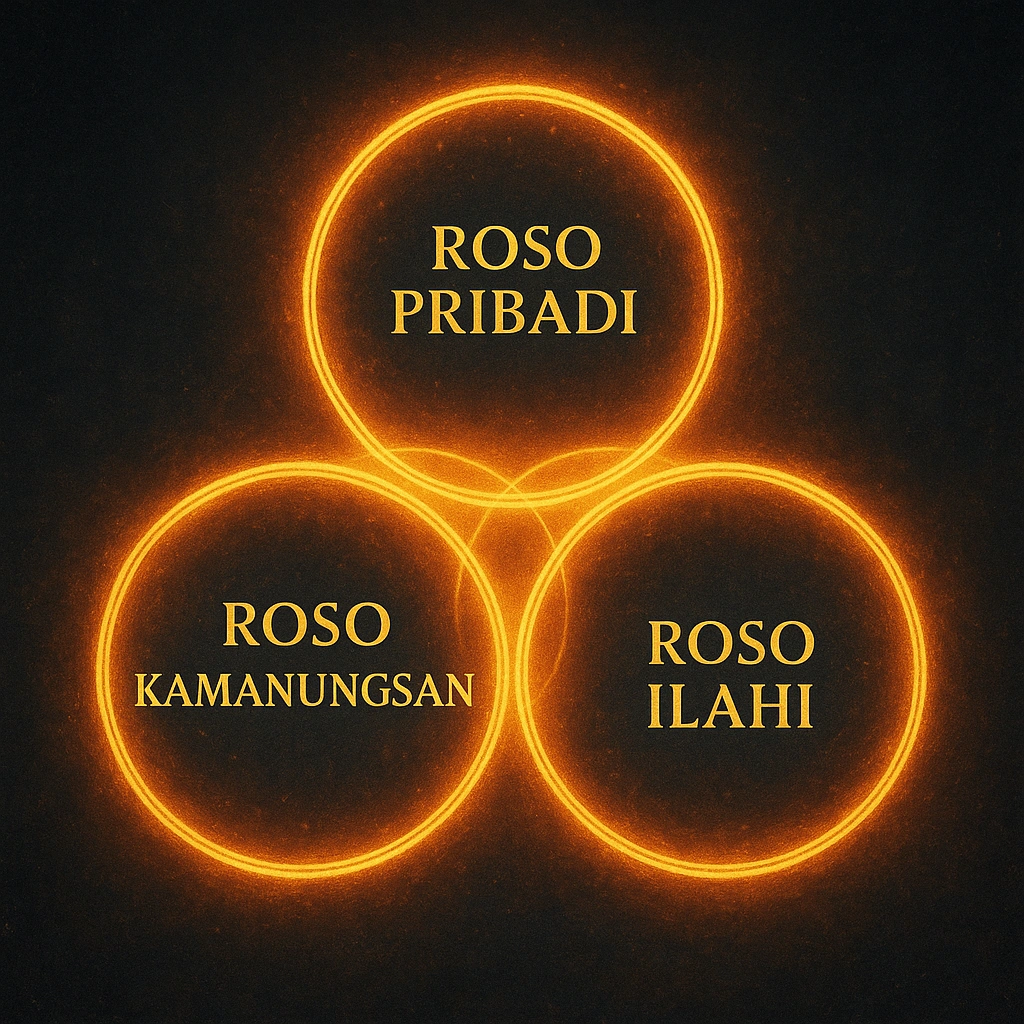
- Roso Pribadi (Rasa that is Subtle Within the Heart): This is the most basic and personal layer of rasa. It is pure intuition, the deepest voice of conscience, a whisper of truth that we often overlook. Roso pribadi emerges from internal silence, from the ability to shed ego and noisy thoughts. When roso pribadi is honed, one becomes more sensitive to their own truth, more authentic, and more honest with themselves.
- Roso Kamanungsan (Empati Towards Fellow Humans): This layer is the manifestation of rasa that extends beyond the self, referring to the ability to empathize, feel the suffering of others, and understand different perspectives. Roso kamanungsan is the foundation of humanitarian values, such as compassion, gotong royong (mutual cooperation), and tolerance. This is the Rasa Jawa that connects individuals with the community, builds social harmony, and prevents conflict. Without roso kamanungsan, humans would live selfishly and in isolation.
- Roso Ilahi (Rasa that Connects with the Universe/Divine): This is the highest layer of rasa, connecting the individual with the universal energy, with God, or with a greater cosmic force. Roso ilahi cannot be explained with words; it can only be felt. It is a transcendental experience of unity with nature, with life, and with the Creator. When one attains roso ilahi, they feel peaceful, enlightened, and understand their place in the cosmic order. This is the pinnacle of true Rasa Jawa understanding.
It is important to note that rasa does not arise from reading books or theories alone. It emerges from silence, from sensitivity, from one’s ability to listen to what is unsaid. This is a laku (spiritual practice), not merely knowledge. Honing Rasa Jawa means training inner sensitivity, not accumulating information. This is the core of profound Javanese spirituality.
When Rasa Unlocks Consciousness
How Rasa Jawa Becomes the Gateway to True Consciousness
True consciousness is not something that suddenly arrives like a bolt of lightning on a clear day. It is a process, similar to the growth of a sprout that requires the right conditions. First, it needs fertile, silent ground. Second, it requires unceasing waters of patience. And most importantly, it needs the pure light of rasa.
Have you ever sat alone in the afternoon, without sound, without disturbance, and suddenly felt an extraordinary peace? As if something was guiding you, even though nothing spoke, no striking visuals appeared? That is Rasa Jawa at work. That is the moment when rasa opens the gateway to your consciousness, bringing an understanding that transcends logic and physical senses.
In kawruh Jawa (Javanese knowledge or wisdom, often related to esoteric or spiritual understanding), rasa is the gateway. Once a person can truly feel—not just know or surmise—a consciousness will grow that cannot be explained by logic or proven scientifically. It can only be felt. This is a profound subjective experience, an insight that transforms one’s perspective on the world and themselves.
The consciousness that arises from this rasa is different from intellectual knowledge. Knowledge can be memorized, tested, and disseminated. However, true consciousness can only be internalized through inner experience. It is the fruit of silence and sensitivity, not the accumulation of information. Therefore, ancestors often emphasized the importance of laku (spiritual practice).
This phenomenon is often called “ngrasaake” (to truly feel or internalize something deeply, beyond just intellectual understanding) or “feeling it.” This is the stage where knowledge does not merely stop in the mind but has permeated the soul. Thus, Rasa Jawa becomes an important foundation for self-development and enlightenment.
Consciousness Does Not Come from Books
Why True Consciousness Does Not Come Solely from Books
Knowledge can be gained from reading. You can memorize thousands of theories, master various concepts, and even write thick books on philosophy. However, true consciousness? It comes from feeling. From humbling oneself. From touching the unseen. Rasa Jawa teaches that the most valuable knowledge is not that which is stored in memory, but that which is manifested in inner experience.
Many people study philosophy, read spiritual texts, or engage in intellectual discussions about the meaning of life. However, none of them truly touch rasa. Why? Because rasa is not a theory that can be learned from books. Rasa is laku (a practice). It is present when we stop talking and start listening—not just listening to external sounds, but especially to the sound of stillness within ourselves.
“Kang krasa ora katon,
kang katon ora krasa.”What is felt is not seen,
what is seen is not felt.
This wise quote encapsulates the essence of Rasa Jawa. What is most essential often cannot be seen with the naked eye or measured with scientific instruments. It can only be felt, experienced personally. Consciousness is an internal shift, not an addition of external information. Therefore, pursuing true consciousness requires a different method than merely academic learning.
The practices of eling (a Javanese spiritual concept meaning mindfulness, remembrance, or constant awareness of truth) and waspada (a Javanese spiritual concept meaning vigilance, caution, or alertness, especially in a spiritual sense) are part of the laku Rasa Jawa. This involves the process of shedding ego, patience, and the ability to be fully present in every moment. Only then can rasa develop and guide us towards a deeper understanding of ourselves and the universe. This is a journey that demands humility and perseverance.
The Process of Cultivating Rasa Jawa: From Stillness to Consciousness
Practical Steps to Cultivate Rasa Jawa in Life
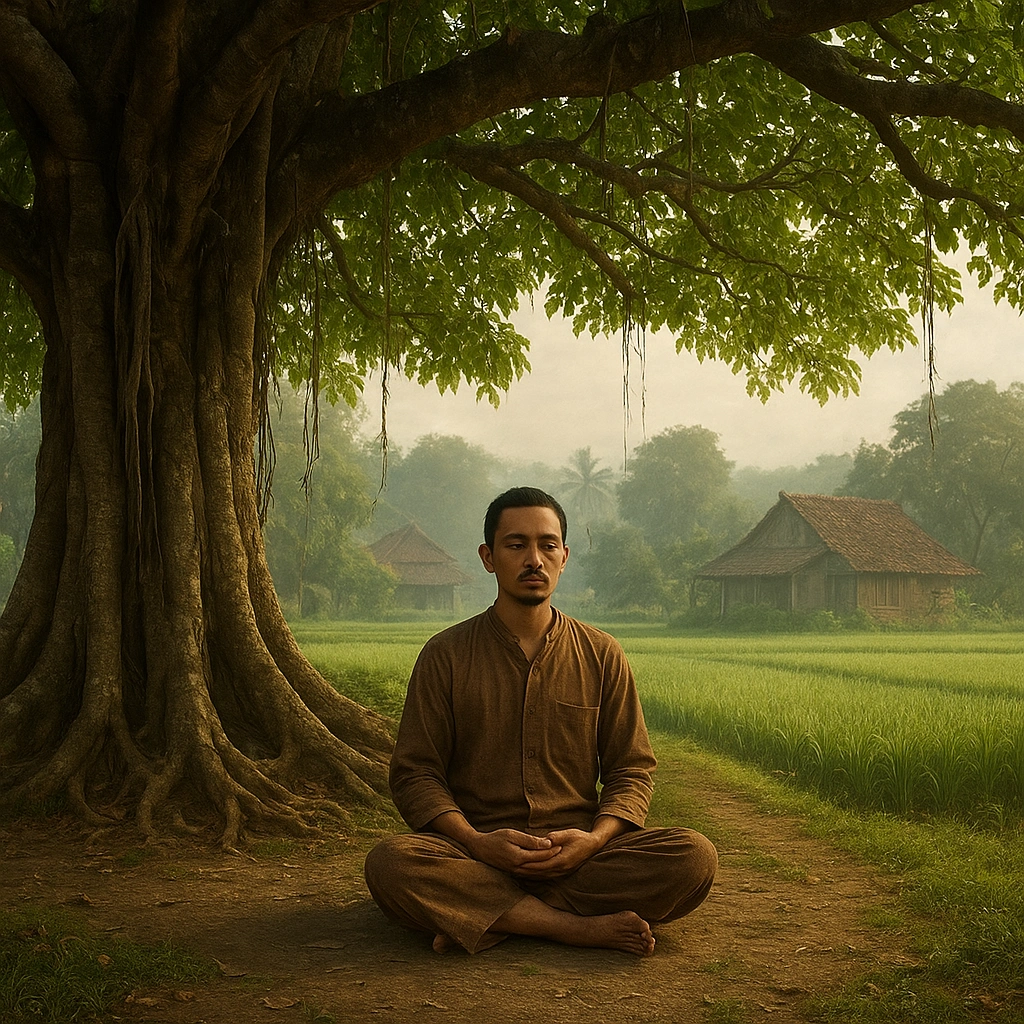
Cultivating Rasa Jawa is not an instant process, but a journey that requires commitment and continuous practice. It involves inner exercises that gradually open our senses to the subtler dimensions of existence. Here are some practical steps you can take to begin cultivating Rasa Jawa within yourself:
1. Creating Stillness (Sepi Ing Pamrih, Rame Ing Gawe)
- Meditation and Contemplation: Set aside time each day to sit in silence. This can be formal meditation or simply sitting quietly and listening to your breath. The goal is to quiet the noisy mind and create space for rasa to emerge.
- Reducing External Stimuli: In an increasingly digital world, we are constantly bombarded with information. Try to reduce time on social media, turn off notifications, or spend time without gadgets. This helps to clear the “noise” that prevents Rasa Jawa from flourishing.
- Returning to Nature: Spend time in nature (rice fields, mountains, beaches, forests). Nature has a calming frequency and helps us reconnect with a more natural rhythm, which is the foundation of Rasa Jawa.
2. Sharpening Sensitivity (Ngrasaake)
- Mindfulness Practice: Be fully present in every moment. When eating, feel every bite. When walking, feel your footsteps. This trains your senses to be more sensitive to the details and subtle vibrations of life.
- Listening with the Heart: When interacting with others, try to listen not only to their words but also to their emotions, intentions, and the energy behind them. This is an exercise in sharpening roso kamanungsan and opening deeper understanding.
- Honest Introspection: After experiencing an event, take time to honestly reflect on what you felt, without judgment. This helps you understand your roso pribadi and your inner responses.
3. Harmonizing Practice (Laku Lampah)
- Simple Living: Reducing material needs can help lessen anxiety and attachment, allowing Rasa Jawa to develop more freely.
- Sharing and Serving: Performing good deeds without expectation is a powerful way to develop roso kamanungsan and feel a connection with others.
- Surrendering: Acknowledging that there is a greater power than ourselves can open the door to roso ilahi, bringing deeper peace and understanding. This is the pinnacle of the authentic Rasa Jawa journey.
Through these practices, you will gradually feel how Rasa Jawa begins to grow within you, guiding you towards higher consciousness and a more meaningful life.
Rasa Jawa and its Relevance in Modern Life
The Relevance of Rasa Jawa in the Digital Age: Key to Life’s Balance

Amidst the rapid advancement of technology and information, modern humans often face a paradox: more connected, yet feeling more isolated. More informed, yet more confused. This is where Rasa Jawa offers invaluable relevance.
The concept of Rasa Jawa teaches us to return to essence, to stillness amidst the noise, and to consciousness amidst the chaos. It can be a vital counterbalance for souls weary from the demands of modern life:
Benefits of Rasa Jawa for Inner Well-being
- Better Decision-Making: By honing your roso pribadi, you can rely more on intuition and your inner voice in making decisions, going beyond mere logical analysis. This often leads to choices that are more aligned with your true self.
- Enhancing Empati and Social Relationships: Roso kamanungsan is the foundation for building more authentic and meaningful relationships. In the age of social media, where interactions are often superficial, Rasa Jawa encourages us to connect genuinely with others.
- Reducing Stress and Anxiety: The practice of stillness and connection with roso ilahi can be a powerful antidote to stress and anxiety. When the inner self is aligned with the cosmos, restlessness diminishes, replaced by peace.
- Boosting Creativity and Innovation: The consciousness that grows from Rasa Jawa often opens the mind to new ideas and innovative solutions. Inner stillness is a fertile ground for inspiration.
- Finding Meaning in Life: For many, modern life feels empty. Rasa Jawa helps individuals not just to live, but to find deeper meaning and purpose, connected to their spiritual heritage and the universe.
Rasa Jawa teaches that true progress is not about how much we can accumulate, but how deeply we can feel and how broadly our consciousness grows. This is a long-term investment for the soul, the results of which will radiate through every aspect of life.
Time to Return to Rasa, Finding Dalem Ageng
Time to Return to Rasa: Finding Dalem Ageng Within Ourselves
This world is too noisy for consciousness to flourish. Information constantly floods us, life’s demands increase, and external voices often drown out our inner whispers. However, in Javanese culture, we are taught to seek stillness amidst this clamor. We are invited to turn inward, sharpen our rasa, and find the truly silent voice: the voice of our own soul.
If you feel something is missing in your life, an emptiness that cannot be filled by material achievements or social recognition, perhaps it is not an object. Perhaps it is your rasa that has dulled from too much noise and too little stillness.
And if you are ready to walk deeper, ready to sharpen your rasa, ready to listen to the truest voice of stillness… then there is a door waiting to be opened. That door is not out there, on high mountains or in silent caves, but within yourself.
Its name: Dalem Ageng (a Javanese term meaning “great house” or “grand residence,” used metaphorically to refer to the inner sanctuary or the deepest core of one’s being where true self and divine connection reside). A “great house” within oneself, a place where the soul meets consciousness, where pure Rasa Jawa resides. It is the core of our existence, a point of absolute tranquility amidst life’s storms.
Be still. Feel.
There, consciousness awaits.
May Rasa Jawa become a light illuminating your life’s journey.
See also other related Kaweruh Jawa articles:
- Weton (Javanese birth calculation system combining the seven-day week with the five-day Pasaran cycle) and Javanese Numerology: The Numbers that Record Your Life’s Path
- Pawukon Jawa (an ancient Javanese calendar system based on a 210-day cycle, divided into 30 wuku): The Oldest Calendar of the Nusantara that Holds the Human Soul
- The Story of Ki Ageng Sela: Catching Lightning with Bare Hands
External References:
- Select Ky Ageng Sela – Lightning Catcher from Java
- Javanese Pawukon: The Oldest Archipelago Calendar that Holds the Human Soul
This content is presented for educational purposes and to foster understanding of Javanese culture. The philosophy of Rasa Jawa is a part of rich local wisdom.
Frequently Asked Questions (FAQ) about Rasa Jawa
What is Rasa Jawa in Javanese philosophy?
Rasa Jawa is a profound philosophical concept that goes beyond emotion. It refers to inner sensitivity, intuition, and spiritual awareness that guide humans toward harmony with themselves, others, and the divine.
What are the three layers of Rasa Jawa?
The three layers are:
-
Roso Pribadi – inner feeling and intuition within oneself.
-
Roso Kamanungsan – empathy and compassion toward fellow humans.
-
Roso Ilahi – divine connection and unity with the cosmos.
How can Rasa Jawa help in modern life?
By cultivating stillness, empathy, and spiritual awareness, Rasa Jawa helps reduce stress, improve decision-making, strengthen social harmony, and guide individuals to find deeper meaning in life.
Is Rasa Jawa only about meditation and silence?
No. While silence is important, Rasa Jawa is also about daily practice (laku), mindfulness, compassion, and living in harmony with nature, society, and the divine.
Can Rasa Jawa be learned from books?
Books can provide knowledge, but true Rasa Jawa must be experienced through practice, silence, and inner awareness. It is a journey of feeling, not just thinking.
About the Author
This wisdom is delivered by Ky Tutur — a symbolic figure representing noble Javanese values, such as wisdom, simplicity, and compassion. These writings are compiled by the KaweruhJawa.com team, consisting of cultural researchers, academics, and spiritual practitioners dedicated to preserving and translating Javanese local wisdom into a language relevant for the present generation.
We believe that ancestral heritage is not just a relic, but also a compass for life. Each article is written through a process of research, cross-generational discussion, and deep contemplation, in order to maintain the accuracy and nobility of the values contained within.
Learn more about our writing team and philosophy →