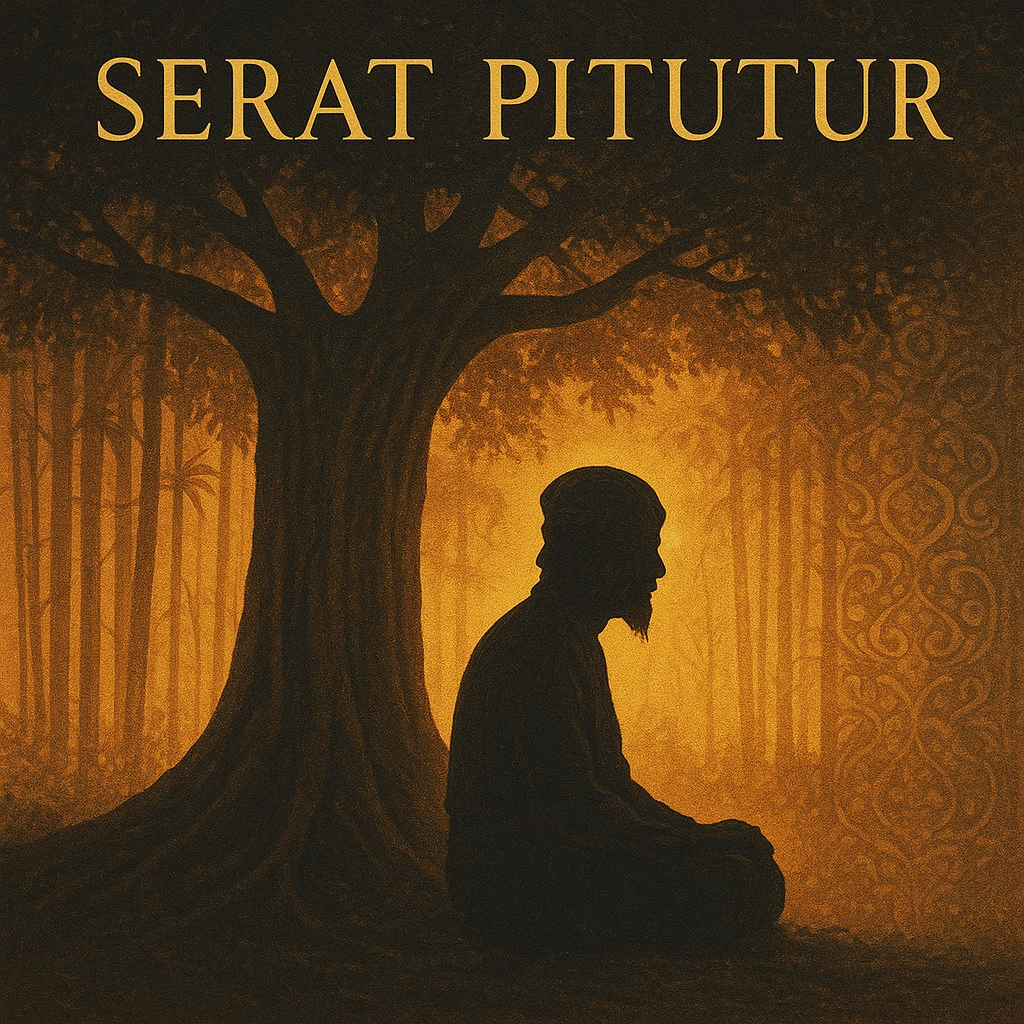
Exploring the depths of Javanese philosophy and its relevance in the modern world.
The serat pitutur is an unwritten heritage from the Javanese ancestors. It is not taught on a whiteboard or in a seminar, but through the practice of silence and gazes full of meaning.
“Our ancestors did not author books,
but sowed meaning into every spoken word.
They did not speak often,
but their every step was a luminous sentence.”
In the old homes nestled in the Javanese hinterlands, where walls are still woven from bamboo and the night sounds are crisp and clear, the pitutur (ancestral wisdom) grows. It is not a book placed on a shelf, not a lengthy status on social media, but a soft voice entrusted from one mouth to another’s heart.
We call it serat pitutur. Not merely a collection of wise sentences, but a legacy of feeling. It is not meant to be memorized, but to be lived.
In the modern world, where everything races toward speed, we sometimes forget that there is a form of knowledge that demands not velocity, but a precision of the soul. And perhaps, Ngger (a term of endearment for a child), if you stay silent long enough, you will hear that voice. A voice from deep within. A voice from the ancestors who never truly departed.
Noble Teachings from Javanese Ancestors

Serat is a manuscript. Pitutur is counsel. Thus, serat pitutur is a living manuscript—not one written with ink, but one recorded through conduct and guarded by feeling.
A Serat Pitutur can take many forms:
- A short sentence full of meaning: “Sepi ing pamrih, rame ing gawe” (Silent in personal gain, bustling in creative work).
- A tembang macapat (classical Javanese poetic verse).
- A wayang (shadow puppetry) story or fable.
- Even the silence of a mbah kakung (grandfather) can be a pitutur.
The Difference with Modern Quotes
Quotes often sound loud. Pitutur is often whispered. Quotes aim to motivate; pitutur aims to give direction. Quotes are suited for a phone screen; pitutur lives in daily conduct. Quotes come from the outside; pitutur emerges from inner awareness.
7 Ancestral Teachings Still Relevant Today

1. “Urip iku mung mampir ngombe”
Life is but a brief stop to drink. It is not eternal. It is not entirely ours.
When everyone is racing to become “immortal” online, this reminds us: We are only passing through. So do not cling too tightly to that which is fleeting.
2. “Sura dira jayaningrat, lebur dening pangastuti”
The courage and power of a king will dissolve in the face of a gentle heart.
Amidst a harsh world, this teaches that the truly powerful are those who do not need to prove it with force.
3. “Aja dumeh”
Do not feel superior just because you possess something.
This acts as a shield against a lifestyle of showing off. It is fine to have more, but do not feel you *are* more.
4. “Ojo gumunan, ojo kagetan, ojo dumeh”
Do not be easily impressed, do not be easily shocked, do not be arrogant.
With news going viral every minute, this is a spiritual brake: Learn not to be quickly impressed, panicked, or arrogant.
5. “Sepi ing pamrih, rame ing gawe”
Quiet in self-interest, bustling in good works.
When everyone wants to be seen and validated, this is the antidote: Do good things, even if they are not posted.
6. “Memayu hayuning bawana”
Act for the sake of the world’s beauty and safety.
This is for anyone who feels that life is not just about “me,” but also about “us.”
7. “Sing sapa ngerti wektune, slamet uripe”
Whoever understands their time will have a safe life.
Many people fail not because they are incapable, but because they do not understand timing. Knowing when to retreat is also a part of victory.
Ancestral Knowledge Needs No Degree, Yet It Guides
They did not attend universities, but they knew when to be silent. They had no diplomas, but they could guide an entire village to live in harmony. That is the knowledge of pitutur—knowledge not passed down on paper, but through the vibration of the heart and action.
The Knowledge of Feeling vs. The Knowledge of Words
There is knowledge delivered through a speech. There is also knowledge delivered through the way a person brews tea and sets the cup down slowly. Our ancestors were masters of the second kind. They did not discuss “mindfulness,” but their lives were filled with awareness. This knowledge of feeling (ilmu rasa) is not popular. But it saves.
Serat Pitutur is Not for Memorizing, but for Living
Pitutur is not a collection of quotes. It is a teaching that only comes alive when it is lived. It only needs one thing: laku (practice in action).
True pitutur does not come out of the mouth, but from one’s deeds. When it is only memorized without being lived, it becomes empty words. What makes you wise is not how many pitutur you have memorized, but how many have manifested as your character.
Why Has the Modern World Lost Pitutur?

We live in an age where everyone is speaking, but few are listening. The serat pitutur has never disappeared. What has been lost is our ability to bow our heads and absorb it.
The world moves fast, but feeling cannot be rushed. Technology connects information, but disconnects feeling. Formal education glorifies the brain, but ignores the heart. The serat pitutur is not lost. It is merely forgotten, covered by the noise of a world that is too loud.
Serat Pitutur as a Compass for the Soul
A map can guide the body. Pitutur guides the soul. It is an inner compass forged by time, feeling, and experience. In life, we are often confused. Logic is not always enough. It is here that pitutur becomes a guiding light, providing direction not with pressure, but with a calm sense of knowing.
Pitutur does not promise quick success. But it promises a path that will not lead your heart astray.
A Modern Interpretation: From Ancestral Practice to Digital Navigation
Once, pitutur was written on lontar leaves; today, it can appear on a phone screen. But its meaning has not changed: to guide humans so they do not lose their way.
For modern generations, the serat pitutur can be seen as the Javanese version of a life navigation system. “Ojo gumunan, ojo kagetan” is emotional regulation. “Sepi ing pamrih, rame ing gawe” is the concept of deep work. “Sing sapa ngerti wektune” is the principle that timing is everything.
The serat pitutur will not die as long as there is one generation willing to interpret it with the heart. Not merely to be remembered, but to be brought back to life, in a new way. Because in truth, pitutur does not need the times. The times need pitutur.
FAQ on Serat Pitutur & Javanese Philosophy
What is Serat Pitutur in Javanese culture?
Serat Pitutur is ancestral wisdom from Java, expressed through proverbs, poetic verses, wayang stories, and daily conduct, rather than written texts.
Why is Serat Pitutur still relevant today?
Its values are timeless—humility, harmony, compassion, and living in balance with others and nature.
How is ancestral pitutur different from modern quotes?
Quotes are often motivational and catchy, while pitutur is a life compass that only gains meaning when practiced in real life.
How can we apply pitutur in modern life?
Start small—live by principles like “Sepi ing pamrih, rame ing gawe” (work sincerely without seeking recognition) or “Aja dumeh” (stay humble even when you have more).
Conclusion: The Voice of the Ancestors Never Truly Departs
The serat pitutur is not a legacy to be stored in a glass cabinet. It is a small light that, if you nurture it within your soul, will shine every time the world extinguishes your hope.
A Call to Action:
This week, try doing one small thing: Choose one pitutur from this article. Live it, quietly. See what changes—not in the world, but within your soul. True pitutur is not that which makes you feel you know more, but that which makes you feel: “Ah, yes… this is what I have forgotten to live.”
check weton here