Have you ever gazed at your reflection on tranquil water, dear one, and wondered, “Who am I, truly?”
On one hand, you feel a stirring within your chest—a spirit to create, a desire to prove yourself, a fire yearning to blaze. Yet on the other, there’s a strong pull asking you to be silent, to be calm, not to stand out amidst the crowd. It feels as if two *dalang* (puppet masters) are on one stage, pulling the curtains in opposite directions.
Have you ever felt, dear one, that life is like grasping dust in a strong wind? A phenomenon that ancestors called Lebu Katiup Angin (Dust Blown by the Wind, a Javanese concept referring to instability, financial struggles, or frequent changes in life). There are times when fortune comes rushing in, as heavy as December rain, yet it vanishes without a trace, evaporating into thin air. Work, dwelling, even circles of friends seem to never truly settle. Today here, tomorrow already changed. Your inner heart knows you have potential, hidden intelligence, but why does fate seem to toy with you, seemingly unwilling to grant you a sure harbor to dock? Why do the foundations you try to build always feel like a sandcastle on the beach?
Then there is a peculiarity, a paradox you might recognize. Although you often feel awkward, shy, and prefer solitude in a corner, people are easily drawn to you. There’s an unseen charm that makes you respected in silence. Your soft advice is often heeded more than others’ shouts. People feel comfortable confiding their deepest secrets to you. However, that very kindness often makes it hard for you to save money and makes you an easy target for those who wish to take advantage. Your hand is quicker to give than to receive.
If this story feels like a mirror of your life, if this vibration makes your heart stir, know that you are not alone. This is the pulse, this is the *lakon* (life’s role or narrative) of the destiny born on Selasa Wage Wuku Galungan (Tuesday Wage, Wuku Galungan, a specific combination in the Javanese calendar system)—a weton (a traditional Javanese birth calculation system) that lives in a grand paradox between strength and fragility, between mystical charm and a fate full of twists and turns. Our journey today is to understand why that mirror appears cracked, and how to put it back together.
Dissecting the Energy of Fire Upon Earth

To understand a tree, we must recognize its soil and its sunlight. So it is with you, dear one. In the grand book of Primbon Jawa (Javanese traditional divination manual), our character is a reflection of the fusion of *dina* (day) and *pasaran* (a five-day week cycle in the Javanese calendar) energies. This is not a blind prophecy that shackles, but *ilmu titen* (Javanese traditional empirical science based on observation and pattern recognition), an ancient ancestral science of reading the character of the universe as reflected within human beings. Each day and *pasaran* carries its own energetic vibration, forming our fundamental character.
The Meaning of Tuesday: Geni, The Brave One
Selasa (Tuesday) has a neptu (a numerical value assigned to each day of the Javanese calendar, used in *weton* calculations) of 3. In Javanese cosmology, Tuesday is under the influence of the Geni (Fire) element. Fire is a powerful source of energy. It symbolizes a blazing spirit, the courage to break through limits, ambition to reach the peak, and passion to conquer. This is the source of driving force within you, dear one. When you feel challenged and want to prove something, when you fiercely debate to uphold a principle, that is your Geni energy blazing.
However, remember the other nature of Fire. Uncontrolled fire can become consuming anger, impulsive explosive emotions, and jealousy that incinerates peace of mind. When you feel easily offended by trivial words, or feel your anger is difficult to contain, that is the other side of Fire that needs to be tamed, not extinguished.
The Meaning of Pasaran Wage: Tanah, The Patient Nurturer
Wage has a neptu of 4. Your uncle (Ky Tutur) needs to clarify here, as there are various schools of thought in kawruh Jawa (Javanese knowledge or wisdom, often related to esoteric or spiritual understanding). Some refer to Wage as Water. However, your uncle leans towards an older and deeper perspective, held by many elders (*pinisepuh* – revered elders or spiritual leaders), which refers to Wage as Earth (*Tanah*). Why? Because the combination of Fire and Earth gives birth to a far more complete and profound meaning.
Earth (*Tanah*) is a symbol of extraordinary patience, unwavering steadfastness, a nurturing nature (*pamomong* – a caring or mentoring quality), and humility. Earth is the foundation of life, where all seeds grow. This is the source of your tranquility, your ability to receive, and your expansive heart. When you patiently listen to a friend’s complaints for hours, when you diligently work on something complex, that is your Earth energy at work. However, Earth can also become hard, rigid, difficult to cultivate, and sometimes lazy or passive. When you feel reluctant to move, find it hard to accept change, or suppress feelings too much until they become resentment, that is the other side of Earth that needs to be loosened.
Neptu 7: The Meeting Point of Fire and Earth, The Birth of the Volcano
The total calculation of your neptu weton is 7 (3 + 4). This is the meeting point between Fire and Earth. Imagine, dear one, what happens when volatile Fire meets tranquil Earth? It doesn’t extinguish. Instead, this combination creates extraordinary potential, but also powerful conflict.
- Pottery Potential: Fire bakes clay into strong pottery, pots, or bricks. This means your spirit and hard work (Fire), if grounded with patience (Earth), will produce something sturdy, mature, beneficial, and long-lasting. Your creations, if pursued diligently, will possess profound quality.
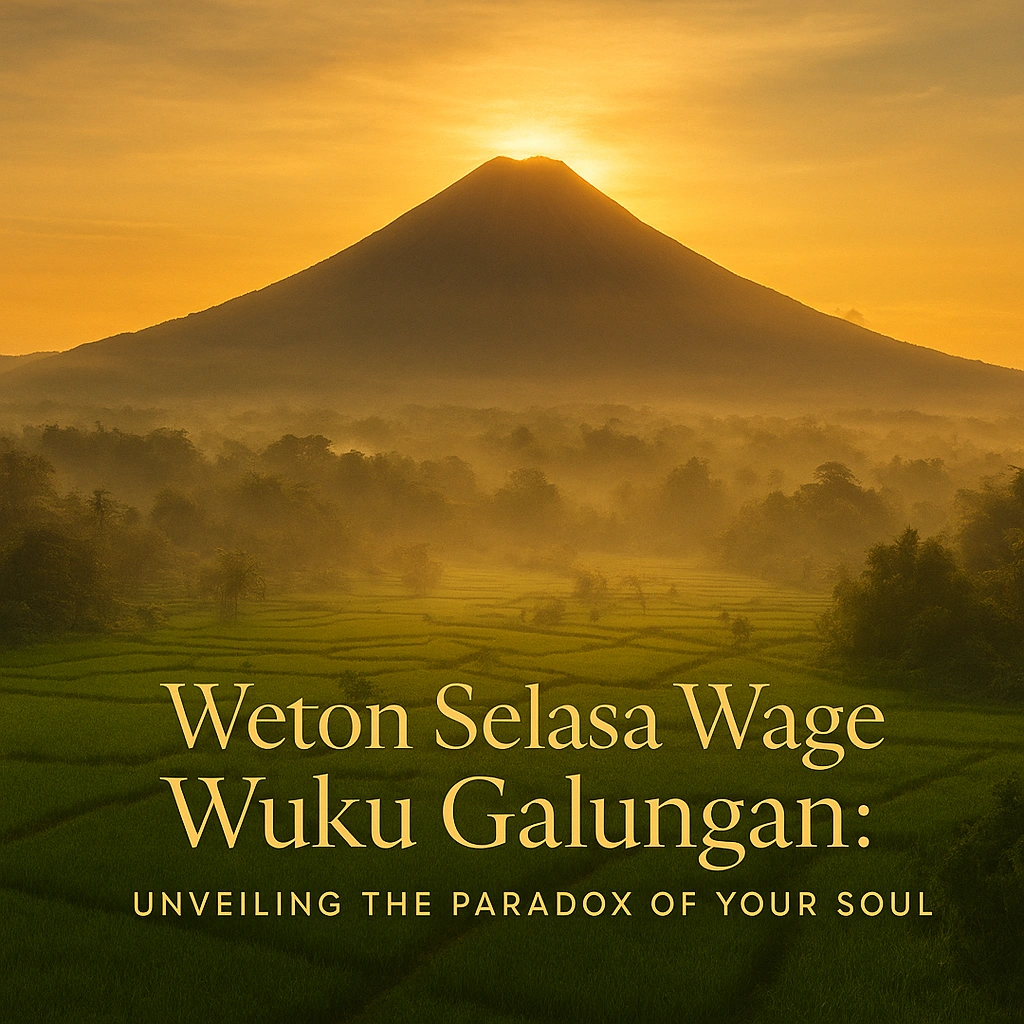
- Volcano Character: This is the most accurate depiction of the true character of Weton Selasa Wage. On the surface, you appear calm, steadfast, patient, and grounded (Earth nature). Others see you as a peaceful and unassuming individual. But deep within, in your soul, molten lava churns—in the form of ambition, emotion, and strong principles (Fire nature). If your anger is ignited or your life principles violated, your “eruption” can be devastating and surprising to those around you.
This conflict becomes the greatest weakness of Selasa Wage. Its energy is often spent holding back inner turmoil, making it appear tired or unstable externally. This is the root of the Lebu Katiup Angin (dust blown by the wind) fate, because its energy circulates internally, rather than being channeled constructively and balanced outwardly.
The Uniqueness of Being Born in Wuku Galungan
Now, let’s open the true treasure chest, a blessing often unrecognized by those who bear this weton. You do not just carry the energy of Fire upon Earth, dear one. Your birth is overshadowed by one of the most unique and sacred *wuku* (one of the 30 cycles in the Javanese Pawukon calendar system) in the 30-week cycle of Ramalan Pawukon (Javanese astrological predictions based on the *Pawukon* calendar), namely Wuku Galungan. This is the blessing that distinguishes you from other Selasa Wage weton, this is the light that illuminates your internal conflicts.
The Sacred Aegis of Wuku Galungan: The Victory of Dharma Within
Wuku Galungan is the core of the sacred Galungan (a Balinese Hindu holiday celebrating the victory of Dharma over Adharma) celebration, which philosophically symbolizes the victory of Dharma (goodness, truth, virtue) against Adharma (evil, falsehood, wickedness). This is not just about ceremonial celebration. Being born in this energy cycle means your soul, dear one, naturally possesses very strong seeds of Dharma. You have a tendency to always defend what is right, uphold justice, and possess high spirituality that you may not even realize.
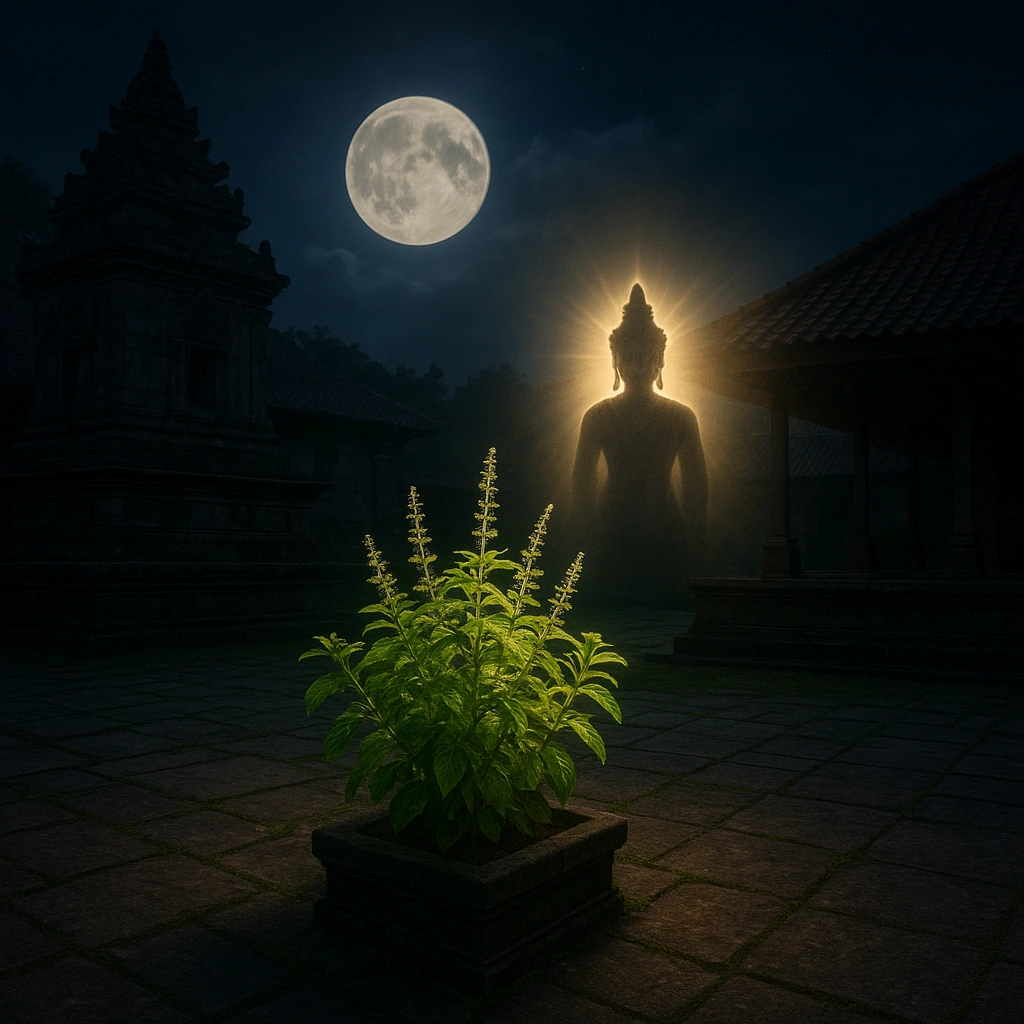
Your tendency to yield for the sake of goodness is not a weakness, but a manifestation of the victory of Dharma itself. You prefer peace, dear one, rather than winning a trivial argument. Its sheltering tree is Pohon Tlasih (Ocimum sanctum, Holy Basil tree), whose leaves are fragrant and often used in rituals. This is a symbol of good character and a fragrant reputation, which makes you genuinely liked by many people, not superficially. Its sheltering bird is Burung Lere-lere (a specific bird in Javanese symbolism, often associated with caution), a symbol of prudence and inner vigilance.
The Blessing of Batara Kamajaya: Unconscious Ethereal Charm
This is the ultimate key, dear one. The deity that overshadows Wuku Galungan is Batara Kamajaya (a deity in Javanese mythology, the god of love, beauty, and compassion), the god of love, beauty, and compassion. He is the husband of Dewi Ratih, a symbol of true love. This is why, despite your shy and solitary nature, you possess a high allure or charm that works subtly. People feel comfortable, trust you, and want to protect you. This is not magic or a love charm (*pelet*), but a pure energy vibration from the influence of Batara Kamajaya for Selasa Wage that radiates from your aura.
This charm does not work with dazzling splendor like stage lights, but with a coolness like the light of a full moon that mesmerizes people in silence. The generous and compassionate nature that often leaves you short of money is also a vibration from the compassion of this god of love. This is the foremost uniqueness of being born on Selasa Wage Wuku Galungan: a combination of the strong volcano character with the gentle charm of the god of love. A very rare and precious combination.
The Play of The Leaky Pot Maker
A Moment of Enlightenment for Oneself
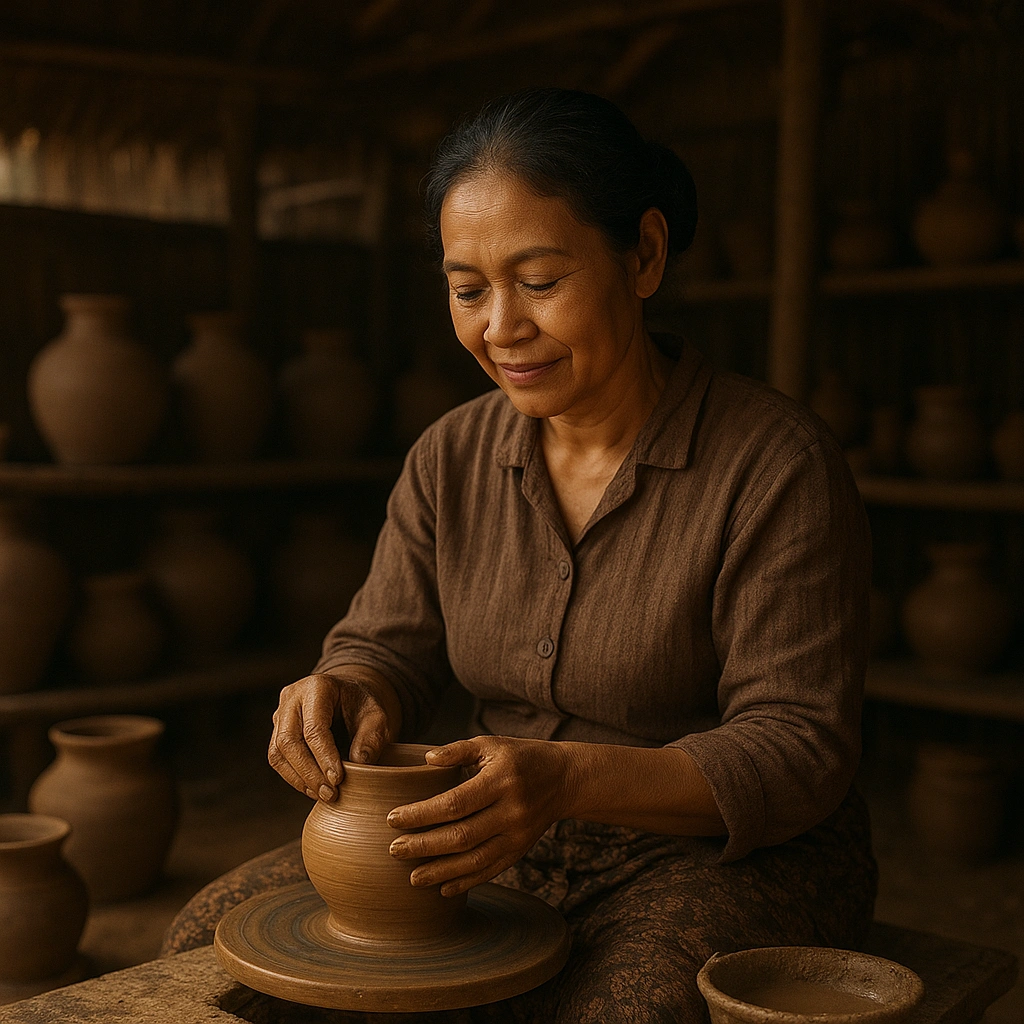
Let’s immerse ourselves in a story for a more complete understanding. Imagine a young woman named Ratih, born on a Selasa Wage during the Wuku Galungan cycle. Ratih is a pottery maker whose hands seem blessed. The clay in her hands seems to come alive, transforming into *kendi* (traditional Javanese clay pots) of such beautiful and harmonious forms. This is a perfect blend of her Earth patience (Wage) and Fire artistic passion (Selasa).
People from across the village come to buy her *kendi*. They are captivated by the beauty of her work and by Ratih’s gentle words, her calm eyes, and her soothing aura (the charm of Batara Kamajaya). However, there’s one problem. Ratih never has enough money. She can’t bear to set high prices. When an old woman praised her *kendi* but didn’t have enough money, Ratih said, “It’s alright, mother. Take it, consider it a gift from me.” The prosperity that came from selling her *kendi* was always spent helping neighbors or relatives in need. Her *kendi* of prosperity seemed to leak. She felt tired, confused, and wondered why her fate was so. She felt her destiny was to be poor, even though her work was appreciated.
One day, a wise buyer who had observed her for a long time, after buying a *kendi*, sat for a moment and gently said, “Ratih, your hands can create the most beautiful *kendi*, but you forgot to make a sturdy *kendi* for yourself. Your problem is not bad luck. Your problem is you haven’t learned to be a ‘Pandita Sakti’ (a powerful sage/priest). You are quiet, but your work speaks. You are shy, but your kindness makes people seek you. Your leaky prosperity is not fate, but because your ‘earth’ is too loose with compassion. You haven’t baked it with ‘fire’ of firmness to become a strong, uncracked vessel.”
Ratih fell silent. The words were like thunder on a clear day. She finally understood. All this time she had only used the patience of Earth and the gentleness of Kamajaya. She forgot that she also possessed the Fire of firmness within her. She had the right to value the fruits of her labor. This was the “Aha!” moment. The prosperity and fate of Weton Selasa Wage, like dust blown by the wind, were not fixed destiny. They were the result of the Fire and Earth energies not yet in harmony. The result of Batara Kamajaya’s charm not yet managed with wisdom. The problem wasn’t external, but internal. You are not a victim of fate, dear one; you are a *dalang* (puppet master) who has not yet recognized all the puppets in their box.
Actionable Solutions (“Laku”) – Baking Earth into Kendi
Simply understanding won’t mend a leaky *kendi*, dear one. There needs to be *laku* (spiritual practice, discipline, or conscious conduct)—a conscious action to balance your energies and become the *dalang* (puppet master) of your own life. This isn’t about changing who you are, but about harmonizing all your potentials.
Laku 1: Niteni Geni, Mantesi Lemah (Recognizing Fire, Solidifying Earth)
This is the *laku* of awareness, the foundation of everything. The goal is to become a wise observer of your own inner turmoil.
- Fire Breath Practice (*Laku Napas Geni*): Every morning, before starting your day, sit quietly for five minutes. Practice this simple breathing exercise: Inhale through your nose for 4 counts, feeling the air fill your abdomen. Hold your breath for 4 counts, feeling warm energy gather in your chest. Then slowly exhale through your mouth for 6 counts, releasing all tension. Do this 5-10 times. This *laku* functions to control your ‘Fire’ so it doesn’t wildly explode, but becomes warm, focused, and directed energy.
- Rasa Journal (Buku Pengilon – Soul Mirror Book): Prepare a small notebook you call “Soul Mirror Book.” Every night before bed, write down the answers to these three questions:
- “Today, what moment made my fire blaze (both spirit and anger)?”
- “Today, what moment made my earth feel peaceful (or conversely, feel hard and lazy)?”
- “Did I use my fire and earth in balance today?”
By recognizing the patterns over a week, a month, you will become an expert in reading your inner stirrings, dear one.
Laku 2: Nggawe Gerabah, Nata Urip (Creating a Vessel, Arranging Life)
This is the *laku* of discipline to mend the leaky *kendi* and give direction to the wind. This is a practical solution for the Lebu Katiup Angin problem.
- Prosperity Vessel (Conscious Budgeting): This is mandatory, non-negotiable. Every time you receive income, immediately set aside 10-20% to save in a separate, hard-to-access account. Consider it a “tax” for your future. The remaining 80% is what you may use, dear one, for living, giving, and enjoying. This *laku* will create a sturdy “kendi” of prosperity. Remember, your best direction for prosperity tends to come from the South and East. Seek jobs or opportunities that come from those directions.
- Career Vessel (Focus on Expertise): The character of a Selasa Wage man at work or a Selasa Wage woman often shines brightest in jobs that require patience, meticulousness, but also a touch of “fire” creativity. Suitable jobs for this neptu 7 are:
- Creative & Craft Fields: Artist, artisan, designer, writer, chef. These professions allow your Fire of creativity to bake Earth (material) into valuable, tangible works. You can spend hours diligently pursuing details (Earth) for a beautiful vision (Fire).
- Healing & Counseling Fields: Therapist, counselor, nurse, spiritual teacher. Here, your Earth’s tranquility becomes a refuge for restless souls, and Kamajaya’s compassionate charm becomes a natural tranquilizer.
- Analysis & Research Fields: Researcher, data analyst, editor, forensic accountant. The patience of Earth allows you to find patterns and details overlooked by others in a hurry. Your Fire becomes the spirit to uncover truth behind numbers and data.
- Jobs to Avoid: Avoid jobs that demand aggressive, high-target sales, cunning office politics, or overly competitive and chaotic environments. Those will drain your inner energy and make your Fire explode more often in anger than in passion.
Laku 3: Nguripke Kamajaya (Activating the Dharma Charm)
This is the *laku* to use your greatest blessing wisely, so your charm brings blessings, not misfortune.
- Firmness in Kindness: Train yourself, dear one, to say “no” politely and without guilt. You can say, dear one, “I truly wish to help, but currently my condition doesn’t allow it,” or “Thank you for the offer, but the price of my work is fixed.” Your generous nature is a blessing, but don’t let it bring you suffering. Remember, dear one, you cannot pour from an empty *kendi*.
- Choose a Balancing Partner: The character of a Selasa Wage woman in romance or a man is a loyal life partner, but their heart is easily touched and they often sacrifice. The best *jodoh* (destined soulmate or life partner) for Weton Selasa Wage are those who can be a firm “hand” to hold your *kendi*, who appreciate your gentleness but can also protect you from your own nature. Seek those with neptu 10 (Minggu Legi, Selasa Pon, Jumat Wage) or 15 (Rabu Kliwon, Kamis Pon, Jumat Pahing).
- Dynamics with Neptu 10 & 15: Partners with these *neptu* usually have a more stable, rational character, and can be good advisors. They will not take advantage of your kindness; instead, they will remind you to take care of yourself. They can be a firmer “earth” for your “fire.” According to *jodoh* (matchmaking) calculations for neptu 7 meeting these *neptu*, they can complement each other and bring glory.
- Avoid Conflicting Partners: Avoid partners forbidden for Selasa Wage, which are other neptu 7 (will both be unstable and drain each other’s energy) or those with overly harsh and selfish characters (neptu 14 or 16) who could break your *kendi*. To see deeper compatibility, you can refer to the Primbon Jodoh En Kaweruhjawa (Javanese matchmaking guide).
Try This Tonight:
Go home, dear one. Sit with your partner on the porch, under the dim light. Hold their hand, and look into their eyes. Tell them: “We both have a special ‘kendi.’ Let’s care for this *kendi* together, so it is always full of happiness and prosperity.” Then, invite your partner to share one small thing that made them feel a little burdened today, and one small thing that made them grateful. That’s all. Feel how the ‘water’ in your *kendi* begins to feel lighter.
Bridges & Promises – A Wider Map
Thus, dear one, is a glimpse of the *babad* (chronicle or history) about Weton Selasa Wage Wuku Galungan. Remember, weton is just a map, not a fixed destiny. You are the traveler, and you hold the steering wheel of this journey. The potential for happiness and abundant prosperity is already there; it’s just a matter of how you cultivate it.
Our discussion this time has only touched the surface of the boundless ocean of kaweruh Jawa (Javanese knowledge or wisdom). There are many other weton and wuku combinations that form different characters and life journeys.
For you who seek to understand more about Pangarasan (Javanese term for a specific calculation determining a person’s inner disposition or ‘feeling’ towards certain situations, often related to their inherent traits) or Rakam (Javanese term for a general fate or disposition, often related to one’s interaction with the world), or even Pancasuda (a Javanese calculation for determining compatibility or overall life disposition, often indicating prosperity or challenges), these are deeper layers of understanding. These terms are branches from a great river that we can explore later.
Understanding Selasa Wage Wuku Galungan is the main foundation. This is your ship’s anchor. From here, you can begin to explore the meaning of other *weton*-*weton* to understand the people around you, or to find the job most aligned with your soul’s calling. All of that will be slowly revealed to you at another time, when you are ready to step further, dear one.
FAQ about Weton Selasa Wage Wuku Galungan
Q: What is the meaning of Weton Selasa Wage Wuku Galungan?
A: Weton Selasa Wage Wuku Galungan symbolizes the meeting of Fire (Selasa) and Earth (Wage) energies, combined with the sacred blessing of Wuku Galungan. It reflects a paradox of strength and gentleness, ambition and patience, with hidden charm from Batara Kamajaya.
Q: Why is Selasa Wage often called Lebu Katiup Angin?
A: This weton is associated with the fate of Lebu Katiup Angin (dust blown by the wind) because its energy is often unstable—financial matters, friendships, and work may feel uncertain or easily change. The challenge is to harmonize Fire and Earth within to find stability.
Q: What career is suitable for someone born on Selasa Wage Wuku Galungan?
A: Ideal careers include creative fields (artist, writer, artisan), healing professions (counselor, nurse, spiritual teacher), or analytical work (researcher, editor, data analyst). These align with patience, creativity, and compassion that define this weton.
Q: Who is the best life partner for Weton Selasa Wage?
A: The most harmonious matches are partners with neptu 10 (Minggu Legi, Selasa Pon, Jumat Wage) or neptu 15 (Rabu Kliwon, Kamis Pon, Jumat Pahing). They bring stability, protectiveness, and balance to the volcanic energy of Selasa Wage.
Q: How can someone born on Selasa Wage find prosperity?
A: The key is conscious discipline—saving consistently (creating a “prosperity vessel”), focusing on expertise, and practicing firmness in kindness. By balancing generosity with self-respect, prosperity flows more steadily.
Closing Wisdom (“Pitutur”)
Listen closely, dear one. Before you leave this veranda, keep this wisdom deep within your soul. Let it be a true heirloom, a guiding mantra for the soul of one who carries Weton Selasa Wage Wuku Galungan. When doubt comes, when fate feels uncertain, when your heart is weary of the world, close your eyes and remember your Uncle’s (Ky Tutur’s) message.
Your journey is not about extinguishing the Fire or hardening the Earth. It’s not about choosing one and discarding the other. Your journey is about becoming the alchemist, the master craftsman (*empu*), who wisely unites both elements in the furnace of the soul. Changing them from a source of conflict into a source of creation. Changing them from a destructive erupting mountain into a mountain whose soil is fertile due to the heat from within.
Always remember the blessing of Batara Kamajaya that rests upon you. Your charm lies not in noisy applause, but in the tranquility you radiate. Use it to spread compassion, not to let yourself be taken advantage of. Use it to bring peace, not to run from reality.
Truly, your task is not to be a directionless wind, but to be a fertile volcano: storing the fire of spirit within the earth of patience to cultivate life.
For further understanding of Javanese culture in general, you can visit Wikipedia: Javanese Culture.
About the Author
This wisdom is delivered by Ky Tutur — a symbolic figure representing noble Javanese values, such as wisdom, simplicity, and compassion. These writings are compiled by the KaweruhJawa.com team, consisting of cultural researchers, academics, and spiritual practitioners dedicated to preserving and translating Javanese local wisdom into a language relevant for the present generation.
We believe that ancestral heritage is not just a relic, but also a compass for life. Each article is written through a process of research, cross-generational discussion, and deep contemplation, in order to maintain the accuracy and nobility of the values contained within.
Learn more about our writing team and philosophy →